



Retinoic Acid Receptor alpha Antibody (YA096)
(Synonyms: NR1B1, RARA, Retinoic acid receptor alpha, RAR-alpha, Nuclear receptor subfamily 1 group B member 1)Based on 1 publication(s) in Google Scholar
Retinoic Acid Receptor alpha Antibody (YA096) is a Rabbit-derived and non-conjugated IgG monoclonal antibody, targeting to Retinoic Acid Receptor alpha.
-
Host:
Rabbit
-
Isotype:
IgG
-
Application:
WB, FC
-
Reactivity :
Human
-
Formulation:
Supplied in 1*TBS (pH7.4), 0.05% BSA and 40% Glycerol. Preservative: 0.05% Sodium Azide.
-
Conjugation:
Non-conjugated


To place orders, for customer services and technical support, please contact: MedChemExpress USA
Tel: 609-228-6898 E-mail: [email protected] [email protected]



Publications Citing Use of MedChemExpress (MCE) Retinoic Acid Receptor alpha Antibody (YA096)
More

Applications
| Application |
WB

WB: Western Blot
|
FC
FC: Flow Cytometry
|
|---|---|---|
| Dilution Ratio | 1:50-1:2000 | 1:50-1:100 |


Product Details
Retinoic Acid Receptor alpha Antibody (YA096) is a Rabbit-derived and non-conjugated IgG monoclonal antibody, targeting to Retinoic Acid Receptor alpha.
-
Host Rabbit

-
Clonality Recombinant,Monoclonal

-
Species ReactivityHuman
-
Observed Molecular WeightObserved band size: 75 kDa
Note: Due to possible protein modifications or aggregation, the molecular weight should be confirmed by actual measurement, and the predicted value is for reference only.

-
Calculated Molecular Weight Predicted band size: 51 kDa

Synthetic peptide corresponding to Human Retinoic Acid Receptor alpha.AA range:1-50.
Endogenous
Protein A affinity purified.
Non-conjugated
Unmodified
IgG


Product Properties
-
Appearance
Solution
-
Formulation
Supplied in 1*TBS (pH7.4), 0.05% BSA and 40% Glycerol. Preservative: 0.05% Sodium Azide.
-
Concentration
Batch-dependent, Please check the COA for the concentration of each lot. Check Lot Concentration
-
Storage & Stability
Stored at -20°C for 1 year. Avoid repeated freeze / thaw cycles.
-
Shipping
Shipping with blue ice.


Publications (1)
-
Journal Impact Factor
-
Most Recent
-
Cell Commun Signal
Retinoic acid enhances γδ T cell cytotoxicity in nasopharyngeal carcinoma by reversing immune exhaustion. [Abstract]2025 Mar 29;23(1):156. PMID: 40158172


Verification Images
-
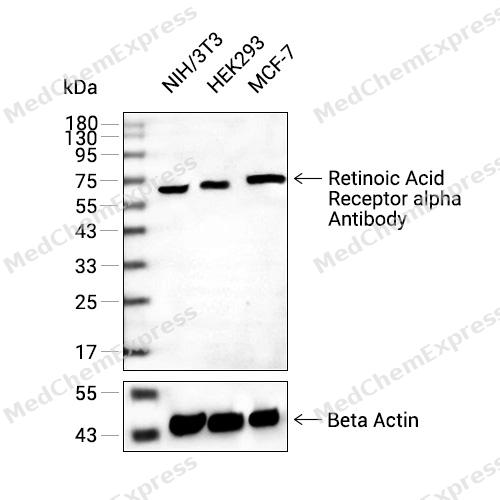 Western blot analysis of extracts from NIH/3T3(lane2(20μg) , HEK293(lane 3(20μg) and MCF-7(lane 4(20ug) using Retinoic Acid Receptor alpha Antibody (HY-P80308) Rabbit mAb. Proteins were transferred to a PVDF membrane and blocked with 5% non-fat milk in TBST for 2 hour at room temperature. The primary antibody (1/1000) and Loading control antibody (Beta Actin, HY-P80438, 1/10000) was used in 5% non-fat milk in TBST at 4°C overnight. Goat Anti-Mouse/Rabbit IgG-HRP Secondary Antibody (1/10000) was used for 1 hour at room temperature.
 -
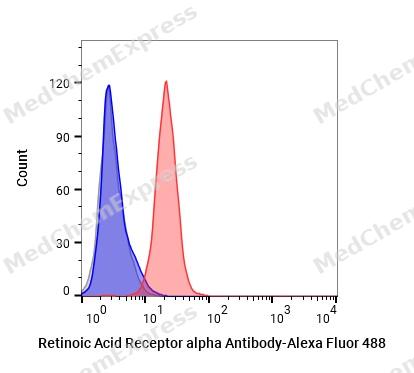 Flow cytometric analysis of 1X10^6 MCF-7 cells labeling Retinoic Acid Receptor alpha Antibody (HY-P80308, red). Cells were fixed with 4% paraformaldehyde. Then stained with the primary antibody at 1/50 dilution for an hour at 4℃. Alexa Fluor® 488-conjugated AffiniPure Goat Anti- Rabbit IgG H&L (HY-P8002) was used as the secondary antibody at 1/1,000 dilution for 30 minutes at 4℃. Rabbit IgG Isotype Control (HY-P80879, blue) was used as the isotype control, cells without incubation with primary antibody were used as the unlabeled control (black).


Background
-
Function
Retinoic Acid Receptor alpha receptor for retinoic acid. Retinoic acid receptors bind as heterodimers to their target response elements in response to their ligands, all-trans or 9-cis retinoic acid, and regulate gene expression in various biological processes. The RXR/RAR heterodimers bind to the retinoic acid response elements (RARE) composed of tandem 5'-AGGTCA-3' sites known as DR1-DR5. In the absence of ligand, the RXR-RAR heterodimers associate with a multiprotein complex containing transcription corepressors that induce histone deacetylation, chromatin condensation and transcriptional suppression. On ligand binding, the corepressors dissociate from the receptors and associate with the coactivators leading to transcriptional activation. Formation of a complex with histone deacetylases might lead to inhibition of RARE DNA element binding and to transcriptional repression. Transcriptional activation and RARE DNA element binding might be supported by the transcription factor KLF2. RARA plays an essential role in the regulation of retinoic acid-induced germ cell development during spermatogenesis. Has a role in the survival of early spermatocytes at the beginning prophase of meiosis. In Sertoli cells, may promote the survival and development of early meiotic prophase spermatocytes. In concert with RARG, required for skeletal growth, matrix homeostasis and growth plate function. Together with RXRA, positively regulates microRNA-10a expression, thereby inhibiting the GATA6/VCAM1 signaling response to pulsatile shear stress in vascular endothelial cells. In association with HDAC3, HDAC5 and HDAC7 corepressors, plays a role in the repression of microRNA-10a and thereby promotes the inflammatory response[1][2][3][4][5][6][7][8].
-
Subcellular Localization
Nucleus; Cytoplasm
-
Expression
Tissue_specificity:Expressed in monocytes
Induction:Expression is induced ba retinoic acid (PubMed:19398580) . Down-regulated by aging (PubMed:26463675) . Induced by pulsatile shear stress (PubMed:28167758) -
Isoforms & Post-Translational Modification
P10276 has 3 isomers: P10276-1: 50771 Da (predicted); P10276-2: 50742 Da (predicted); P10276-3: 39700 Da (predicted).
Phosphorylated on serine and threonine residues. Phosphorylation does not change during cell cycle. Phosphorylation on Ser-77 is crucial for transcriptional activity (By similarity). Phosphorylation by AKT1 is required for the repressor activity but has no effect on DNA binding, protein stability nor subcellular localization. Phosphorylated by PKA in vitro. This phosphorylation on Ser-219 and Ser-369 is critical for ligand binding, nuclear localization and transcriptional activity in response to FSH signaling;Sumoylated with SUMO2, mainly on Lys-399 which is also required for SENP6 binding. On all-trans retinoic acid (ATRA) binding, a conformational change may occur that allows sumoylation on two additional site, Lys-166 and Lys-171. Probably desumoylated by SENP6. Sumoylation levels determine nuclear localization and regulate ATRA-mediated transcriptional activity;Trimethylation enhances heterodimerization with RXRA and positively modulates the transcriptional activation;Ubiquitinated by UBR5, leading to its degradation: UBR5 specifically recognizes and binds ligand-bound RARA when it is not associated with coactivators (NCOAs) (PubMed:37478846). In presence of NCOAs, the UBR5-degron is not accessible, preventing its ubiquitination and degradation (PubMed:37478846);Acetylated; acetylation is increased upon pulsatile shear stress and decreased upon oscillatory shear stress -
Subunit
Heterodimer; with RXRA (via C-terminus); association with RXRA is enhanced by pulsatile shear stress (PubMed:10698945, PubMed:10882070, PubMed:15509776, PubMed:20215566, PubMed:21152046, PubMed:28167758). Binds DNA preferentially as a heterodimer (PubMed:10698945, PubMed:28167758). RXRA serves as enhancer to induce RARA binding to RARE (PubMed:30468856). Interacts with RXRG (PubMed:28167758). Interacts with coactivators NCOA3 and NCOA6 (PubMed:10567404, PubMed:9267036). Interacts with NCOA7; the interaction requires ligand-binding (PubMed:11971969). Interacts (via the ligand-binding domain) with PRAME; the interaction is ligand (retinoic acid)-dependent (PubMed:16179254). Interacts with AKT1; the interaction phosphorylates RARA and represses transactivation (PubMed:16417524). Interacts with PRKAR1A; the interaction negatively regulates RARA transcriptional activity (PubMed:20215566). Interacts with NCOR1 and NCOR2 (PubMed:20543827). Interacts with PRMT2 (PubMed:12039952). Interacts with LRIF1 (PubMed:17455211). Interacts with ASXL1 and NCOA1 (PubMed:16606617). Interacts with ACTN4 (PubMed:22351778). In a complex with HDAC3, HDAC5 and HDAC7; the HDACs serve as corepressors of RARA, causing its deacetylation and inhibition of RARE DNA element binding; association with HDAC3, HDAC5 and HDAC7 is increased upon oscillatory shear stress (PubMed:28167758). Interacts with CDK7 (By similarity). In the absence of hormonal ligand, interacts with TACC1 (PubMed:20078863)
-
SwissProt ID
-
Synonyms
NR1B1, RARA, Retinoic acid receptor alpha, RAR-alpha, Nuclear receptor subfamily 1 group B member 1
-
Research Field
Epigenetics and Nuclear Signaling
Documentation
-
Data Sheet (263 KB)
-
SDS (252 KB)
- English - EN (252 KB)
- Français - FR (252 KB)
- Deutsch - DE (252 KB)
- Norwegian - NO (252 KB)
- Español - ES (252 KB)
- Swedish - SV (252 KB)
- Italian - IT (252 KB)
- Korean - KR (252 KB)
- Portuguese - PT (252 KB)
-
User Guide for Antibodies (1077 KB)
References
[1]. Srinivas H, et al. Akt phosphorylates and suppresses the transactivation of retinoic acid receptor alpha. Biochem J. 2006 May 1;395(3):653-62. [Content Brief]
[2]. Zhu L, et al. Small ubiquitin-like modifier-2 modification of retinoic acid receptor-alpha regulates its subcellular localization and transcriptional activity. Endocrinology. 2009 Dec;150(12):5586-95. [Content Brief]
[3]. Santos NC, et al. Activity of retinoic acid receptor-alpha is directly regulated at its protein kinase A sites in response to follicle-stimulating hormone signaling. Endocrinology. 2010 May;151(5):2361-72. [Content Brief]
[4]. Sato Y, et al. The "Phantom Effect" of the Rexinoid LG100754: structural and functional insights. PLoS One. 2010 Nov 30;5(11):e15119. [Content Brief]
[5]. Tsai JM, et al. UBR5 forms ligand-dependent complexes on chromatin to regulate nuclear hormone receptor stability. Mol Cell. 2023 Aug 3;83(15):2753-2767.e10. [Content Brief]
[6]. Lee DY, et al. MicroRNA-10a is crucial for endothelial response to different flow patterns via interaction of retinoid acid receptors and histone deacetylases. Proc Natl Acad Sci U S A. 2017 Feb 21;114(8):2072-2077. [Content Brief]
[7]. Qin Z, et al. ZNF536, a novel zinc finger protein specifically expressed in the brain, negatively regulates neuron differentiation by repressing retinoic acid-induced gene transcription. Mol Cell Biol. 2009 Jul;29(13):3633-43. [Content Brief]
[8]. Chen H, et al. Nuclear receptor coactivator ACTR is a novel histone acetyltransferase and forms a multimeric activation complex with P/CAF and CBP/p300. Cell. 1997 Aug 8;90(3):569-80. [Content Brief]

 Powered by Bioz
