



TRPM7 Antibody (YA2391)
(Synonyms: ALSPDC; CHAK; CHAK1; LTrpC7; TRPM7)
Based on 1 Customer Validation
TRPM7 Antibody (YA2391) is a Rabbit-derived and non-conjugated IgG monoclonal antibody, targeting to TRPM7.
-
Host:
Rabbit
-
Isotype:
IgG
-
Application:
WB, ICC/IF, FC
-
Reactivity :
Human, Mouse, Rat
-
Formulation:
Supplied in 50mM Tris-Glycine(pH 7.4), 0.15M NaCl, 40%Glycerol, 0.01% sodium azide and 0.05% BSA.
-
Conjugation:
Non-conjugated


To place orders, for customer services and technical support, please contact: MedChemExpress USA
Tel: 609-228-6898 E-mail: [email protected] [email protected]





Applications
| Application |
WB

WB: Western Blot
|
ICC/IF
ICC/IF: Immunocytochemistry/
Immunofluorescence |
FC
FC: Flow Cytometry
|
|---|---|---|---|
| Dilution Ratio | 1:500-1:1000 | 1:50-1:200 | 1:50-1:100 |


Product Details
TRPM7 Antibody (YA2391) is a Rabbit-derived and non-conjugated IgG monoclonal antibody, targeting to TRPM7.
-
Host Rabbit

-
Clonality Recombinant,Monoclonal

-
Species ReactivityHuman, Mouse, Rat
-
Observed Molecular WeightObserved band size: 213 kDa
Note: Due to possible protein modifications or aggregation, the molecular weight should be confirmed by actual measurement, and the predicted value is for reference only.

-
Calculated Molecular Weight Predicted band size: 213 kDa

Entrez Gene: 54822 Human ; 58800 Mouse ;
SwissProt: Q96QT4 Human ; Q923J1 Mouse ;
OMIM: 105500 Human
A synthesized peptide derived from human TRPM7
Endogenous
Affinity Chromatography
Non-conjugated
Unmodified
IgG


Product Properties
-
Appearance
Solution
-
Formulation
Supplied in 50mM Tris-Glycine(pH 7.4), 0.15M NaCl, 40%Glycerol, 0.01% sodium azide and 0.05% BSA.
-
Concentration
Batch-dependent, Please check the COA for the concentration of each lot. Check Lot Concentration
-
Storage & Stability
Stored at -20°C for 1 year. Avoid repeated freeze / thaw cycles.
-
Shipping
Shipping with blue ice.


Verification Images
-
 Western blot analysis of extracts from Hela (lane2, 20μg), K562 (lane3, 20μg), HepG2 (lane4, 20μg) and HCT116 (lane5, 20μg) using TRPM7 Antibody (HY-P82646). Proteins were transferred to a PVDF membrane and blocked with 5% non-fat milk in TBST for 2 hour at room temperature. The primary antibody (1/1000) and Loading control antibody (Beta Actin, HY-P80993, 1/10,000) was used in 5% non-fat milk in TBST at 4°C overnight. Goat Anti-Rabbit IgG-HRP Secondary Antibody (HY-P8001,1/10,000) was used for 1 hour at room temperature.
 -
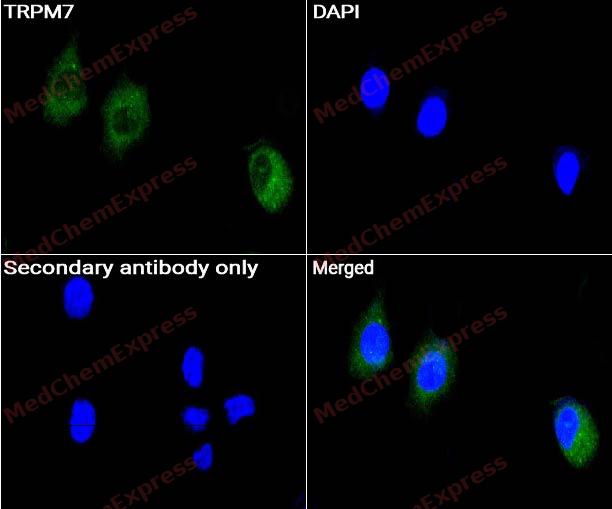 Immunocytochemistry analysis of SH-SY5Y cells labeling TRPM7 with TRPM7 antibody (HY-P82646) at 1/50 dilution. Cells were fixed in 4% paraformaldehyde for 15 minutes at room temperature, permeabilized with 0.1% Triton X-100 for 10 minutes at room temperature, then blocked with QuickBlock™ Blocking Buffer for Immunol Staining for 10 min at room temperature. Cells were then incubated with TRPM7 antibody (HY-P82646) at 1/50 dilution in QuickBlock™ Blocking Buffer for Immunol Staining at 4 ℃. Alexa Fluor® 488-conjugated AffiniPure Goat Anti-Rabbit IgG H&L(HY-P8002, Green) was used as the secondary antibody at 1/1,000 dilution. PBS instead of the primary antibody was used as the secondary antibody only control. The Nuclear counterstain was DAPI (Blue).
 -
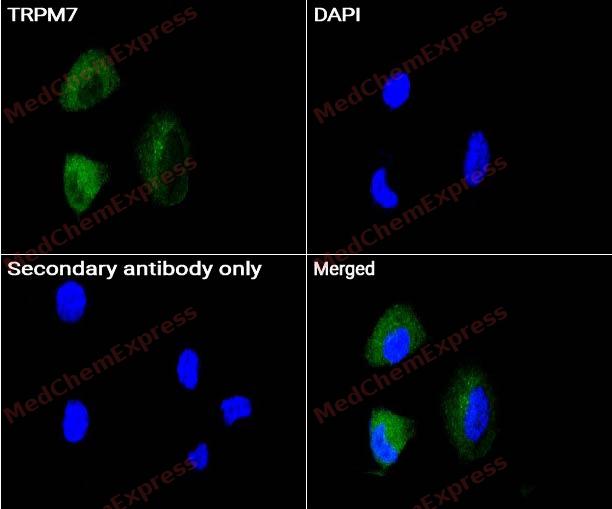 Immunocytochemistry analysis of SH-SY5Y cells labeling TRPM7 with TRPM7 antibody (HY-P82646) at 1/100 dilution. Cells were fixed in 4% paraformaldehyde for 15 minutes at room temperature, permeabilized with 0.1% Triton X-100 for 10 minutes at room temperature, then blocked with QuickBlock™ Blocking Buffer for Immunol Staining for 10 min at room temperature. Cells were then incubated with TRPM7 antibody (HY-P82646) at 1/100 dilution in QuickBlock™ Blocking Buffer for Immunol Staining at 4 ℃. Alexa Fluor® 488-conjugated AffiniPure Goat Anti-Rabbit IgG H&L(HY-P8002, Green) was used as the secondary antibody at 1/1,000 dilution. PBS instead of the primary antibody was used as the secondary antibody only control. The Nuclear counterstain was DAPI (Blue).
 -
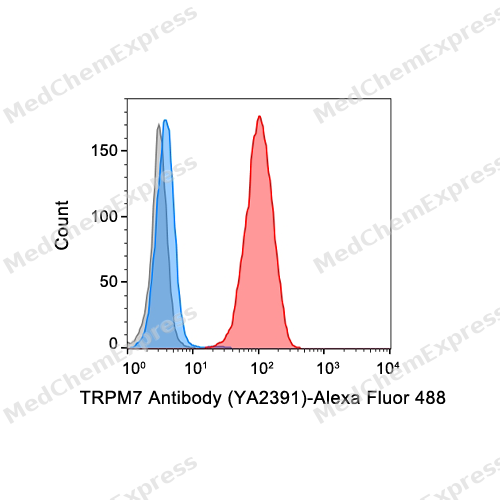 Flow cytometric analysis of 1X10^6 Hela cells labeling TRPM7 Antibody (YA2391) (HY-P82646, red). Cells were fixed with 4% paraformaldehyde. Then stained with the primary antibody at 1/50 dilution for an hour at 4℃. Alexa Fluor® 488-conjugated AffiniPure Goat Anti-Rabbit IgG H&L (HY-P8002) was used as the secondary antibody at 1/1,000 dilution for 30 minutes at 4℃. Rabbit IgG Isotype Control (HY-P80879, blue) was used as the isotype control, cells without incubation with primary antibody were used as the unlabeled control (black).


Background
-
Function
TRPM7 is a TRP melastatin channel-kinase that conducts divalent and monovalent cations and combines channel and enzymatic activities[1]. Mechanistically, vascular TRPM7 supports Mg2+ homeostasis and regulates vascular smooth muscle cell growth, apoptosis, adhesion, contraction, cytoskeletal organization, and migration[2]. In inflammation, TRPM7 channel and kinase activity regulate neutrophil transmigration and reactive oxygen species production through Akt/mTOR signaling[3]. In intestinal disease models, TRPM7 knockdown reduces LPS-induced apoptosis and inflammatory cytokine expression by modulating TLR4/NF-κB and MEK/ERK pathways[4]. In kidney fibrosis models, TRPM7 expression increases after unilateral ureteral obstruction, while the inhibitor NS8593 reduces tubular and interstitial cell proliferation and TGF-β1/Smad signaling[5]. Compared with related TRPM6, which is found primarily in epithelial cells, TRPM7 is ubiquitously expressed, making it a broader experimental target for ion-homeostasis and disease-mechanism studies[2]. For pharmacological research, carvacrol inhibits TRPM7 current and reduces neonatal hypoxic-ischemic brain injury, whereas CBGA suppresses TRPM7 currents through a kinase-domain-dependent mechanism[6][7].
-
Subcellular Localization
Cell membrane; Multi-pass membrane protein; Cytoplasmic vesicle membrane; Multi-pass membrane protein; Nucleus
-
Subunit
Homotetramer (By similarity). Forms heteromers with TRPM6; heteromeric channels are functionally different from the homomeric channels (PubMed:14976260, PubMed:16636202)
-
SwissProt ID
-
Synonyms
ALSPDC; CHAK; CHAK1; LTrpC7; TRPM7
-
Research Field
Neuroscience


Documentation
-
Data Sheet (262 KB)
-
SDS (251 KB)
- English - EN (251 KB)
- Français - FR (251 KB)
- Deutsch - DE (251 KB)
- Norwegian - NO (251 KB)
- Español - ES (251 KB)
- Swedish - SV (251 KB)
- Italian - IT (251 KB)
- Korean - KR (251 KB)
- Portuguese - PT (251 KB)
-
User Guide for Antibodies (1077 KB)
References
[2]. Yogi A, et al. Transient receptor potential melastatin 7 (TRPM7) cation channels, magnesium and the vascular system in hypertension. Circ J. 2011;75(2):237-45. [Content Brief]
[3]. Nadolni W, et al. TRPM7 Kinase Is Essential for Neutrophil Recruitment and Function via Regulation of Akt/mTOR Signaling. Front Immunol. 2021 Feb 15;11:606893. [Content Brief]
[4]. An L, et al. Knockdown of TRPM7 attenuates apoptosis and inflammation in neonatal necrotizing enterocolitis model cell IEC-6 via modulating TLR4/NF-κB and MEK/ERK pathways. Iran J Basic Med Sci. 2022 Aug;25(8):947-953. [Content Brief]
[5]. Suzuki S, et al. TRPM7 contributes to progressive nephropathy. Sci Rep. 2020 Feb 11;10(1):2333. [Content Brief]
[6]. Chen W, et al. TRPM7 inhibitor carvacrol protects brain from neonatal hypoxic-ischemic injury. Mol Brain. 2015 Feb 19;8:11. [Content Brief]
[7]. Suzuki S, et al. Cannabigerolic Acid (CBGA) Inhibits the TRPM7 Ion Channel Through its Kinase Domain. Function (Oxf). 2023 Dec 7;5(1):zqad069. [Content Brief]

 Powered by Bioz
