



Y14 Antibody (YA2439)
(Synonyms: BOV1; BOV1A; BOV1B; BOV1C; HSPC114; MDS014; RBM 8; RBM 8A; RBM 8B; RBM8; rbm8a; RBM8B; ZNRP; ZRNP1)
Based on 1 Customer Validation
Y14 Antibody (YA2439) is a Rabbit-derived and non-conjugated IgG monoclonal antibody, targeting to Y14.
-
Host:
Rabbit
-
Isotype:
IgG
-
Application:
WB, IHC-P, ICC/IF, FC, IP
-
Reactivity :
Human, Mouse, Rat
-
Formulation:
Supplied in rabbit IgG in 50 mM Tris-Glycine(pH 7.4), 0.15 M NaCl, 40% Glycerol, 0.01% sodium azide and 0.05% BSA.
-
Conjugation:
Non-conjugated


To place orders, for customer services and technical support, please contact: MedChemExpress USA
Tel: 609-228-6898 E-mail: [email protected] [email protected]





Applications
| Application |
WB

WB: Western Blot
|
IHC-P
IHC-P: Immunohistochemistry-Paraffin
|
ICC/IF
ICC/IF: Immunocytochemistry/
Immunofluorescence |
FC
FC: Flow Cytometry
|
IP
IP: Immunoprecipitation
|
|---|---|---|---|---|---|
| Dilution Ratio | 1:1000-1:2000 | 1:100-1:200 | 1:50-1:200 | 1:50-1:100 | 1:50 |


Product Details
Y14 Antibody (YA2439) is a Rabbit-derived and non-conjugated IgG monoclonal antibody, targeting to Y14.
-
Host Rabbit

-
Clonality Recombinant,Monoclonal

-
Species ReactivityHuman, Mouse, Rat
-
Observed Molecular WeightObserved band size: 24 kDa
Note: Due to possible protein modifications or aggregation, the molecular weight should be confirmed by actual measurement, and the predicted value is for reference only.

-
Calculated Molecular Weight Predicted band size: 20 kDa

Entrez Gene: 9939 Human ; 545388 Mouse ; 60365 Mouse ; 295284 Rat
SwissProt: Q9Y5S9 Human ; Q9CWZ3 Mouse ; Q27W01 Rat
OMIM: 274000 Human
A synthesized peptide derived from human Y14 aa1-36.
Endogenous
Affinity Purified
Non-conjugated
Unmodified
IgG


Product Properties
-
Appearance
Solution
-
Formulation
Supplied in rabbit IgG in 50 mM Tris-Glycine(pH 7.4), 0.15 M NaCl, 40% Glycerol, 0.01% sodium azide and 0.05% BSA.
-
Concentration
Batch-dependent, Please check the COA for the concentration of each lot. Check Lot Concentration
-
Storage & Stability
Stored at -20°C for 1 year. Avoid repeated freeze / thaw cycles.
-
Shipping
Shipping with blue ice.


Verification Images
-
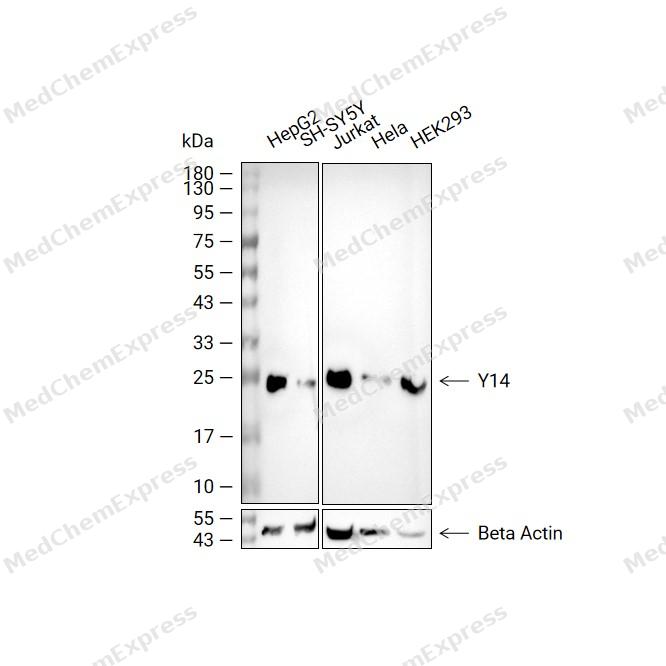 Western blot analysis of extracts from HepG2 (lane 2, 20ug), SH-SY5Y (lane 3, 20ug), Jurkat (lane 4, 20ug) and Hela (lane 5, 20ug), HEK293 (lane 6, 20ug) using Y14 Antibody (HY-P82694). Proteins were transferred to a PVDF membrane and blocked with 5% non-fat milk in TBST at 4°C overnight. The primary antibody (1/1000) and Loading control antibody (Beta Actin, HY-P80993, 1/10,000) was used in 5% non-fat milk in TBST for 2 hour at room temperature. Goat Anti-Rabbit IgG-HRP Secondary Antibody (HY-P8001, 1/10,000) was used for 1 hour at room temperature.
 -
 Immunohistochemical analysis of paraffin-embedded human liver using Y14 antibody. The section was pre-treated using heat mediated antigen retrieval with EDTA (pH 9.0) for 14 minutes. The tissues were blocked in 5% BSA for 30 minutes at room temperature, washed with TBST, and then probed with the primary antibody (HY-P82694, 1/400) for 1 hour at room temperature. The detection was performed using Polymer HRP-conjugated Goat Anti-Mouse/Rabbit lgG(H&L) secondary antibody (HY-P83652). DAB was used as the chromogen. Tissues were counterstained with hematoxylin and mounted with DPX.
 -
 Immunohistochemical analysis of paraffin-embedded human liver cancer using Y14 antibody. The section was pre-treated using heat mediated antigen retrieval with EDTA (pH 9.0) for 14 minutes. The tissues were blocked in 5% BSA for 30 minutes at room temperature, washed with TBST, and then probed with the primary antibody (HY-P82694, 1/400) for 1 hour at room temperature. The detection was performed using Polymer HRP-conjugated Goat Anti-Mouse/Rabbit lgG(H&L) secondary antibody (HY-P83652). DAB was used as the chromogen. Tissues were counterstained with hematoxylin and mounted with DPX.
 -
 Immunohistochemical analysis of paraffin-embedded human pancreas using Y14 antibody. The section was pre-treated using heat mediated antigen retrieval with EDTA (pH 9.0) for 14 minutes. The tissues were blocked in 5% BSA for 30 minutes at room temperature, washed with TBST, and then probed with the primary antibody (HY-P82694, 1/400) for 1 hour at room temperature. The detection was performed using Polymer HRP-conjugated Goat Anti-Mouse/Rabbit lgG(H&L) secondary antibody (HY-P83652). DAB was used as the chromogen. Tissues were counterstained with hematoxylin and mounted with DPX.
 -
 Immunohistochemical analysis of paraffin-embedded human colon cancer using Y14 antibody. The section was pre-treated using heat mediated antigen retrieval with EDTA (pH 9.0) for 14 minutes. The tissues were blocked in 5% BSA for 30 minutes at room temperature, washed with TBST, and then probed with the primary antibody (HY-P82694, 1/400) for 1 hour at room temperature. The detection was performed using Polymer HRP-conjugated Goat Anti-Mouse/Rabbit lgG(H&L) secondary antibody (HY-P83652). DAB was used as the chromogen. Tissues were counterstained with hematoxylin and mounted with DPX.
 -
 Immunohistochemical analysis of paraffin-embedded human ovarian cancer using Y14 antibody. The section was pre-treated using heat mediated antigen retrieval with EDTA (pH 9.0) for 14 minutes. The tissues were blocked in 5% BSA for 30 minutes at room temperature, washed with TBST, and then probed with the primary antibody (HY-P82694, 1/400) for 1 hour at room temperature. The detection was performed using Polymer HRP-conjugated Goat Anti-Mouse/Rabbit lgG(H&L) secondary antibody (HY-P83652). DAB was used as the chromogen. Tissues were counterstained with hematoxylin and mounted with DPX.
 -
 Immunohistochemical analysis of paraffin-embedded human cervical cancer using Y14 antibody. The section was pre-treated using heat mediated antigen retrieval with EDTA (pH 9.0) for 14 minutes. The tissues were blocked in 5% BSA for 30 minutes at room temperature, washed with TBST, and then probed with the primary antibody (HY-P82694, 1/400) for 1 hour at room temperature. The detection was performed using Polymer HRP-conjugated Goat Anti-Mouse/Rabbit lgG(H&L) secondary antibody (HY-P83652). DAB was used as the chromogen. Tissues were counterstained with hematoxylin and mounted with DPX.
 -
 Flow cytometric analysis of 1X10⁶ Jurkat cells labeling Y14 Antibody (HY-P82694, red). Cells were fixed with 4% paraformaldehyde and permeabilised with 90% methanol. Then stained with the primary antibody at 1/50 dilution for an hour at 4℃. AF488-conjugated Goat Anti-Rabbit IgG H&L (HY-P8002) was used as the secondary antibody at 1/1,000 dilution for 30 minutes at 4℃. Rabbit IgG Isotype Control (HY-P80879, blue) was used as the isotype control, cells without incubation with primary antibody were used as the unlabeled control (black).


Background
-
Function
Y14 is required for pre-mRNA splicing as component of the spliceosome. Core component of the splicing-dependent multiprotein exon junction complex (EJC) deposited at splice junctions on mRNAs. The EJC is a dynamic structure consisting of core proteins and several peripheral nuclear and cytoplasmic associated factors that join the complex only transiently either during EJC assembly or during subsequent mRNA metabolism. The EJC marks the position of the exon-exon junction in the mature mRNA for the gene expression machinery and the core components remain bound to spliced mRNAs throughout all stages of mRNA metabolism thereby influencing downstream processes including nuclear mRNA export, subcellular mRNA localization, translation efficiency and nonsense-mediated mRNA decay (NMD). The MAGOH-RBM8A heterodimer inhibits the ATPase activity of EIF4A3, thereby trapping the ATP-bound EJC core onto spliced mRNA in a stable conformation. The MAGOH-RBM8A heterodimer interacts with the EJC key regulator PYM1 leading to EJC disassembly in the cytoplasm and translation enhancement of EJC-bearing spliced mRNAs by recruiting them to the ribosomal 48S preinitiation complex. Its removal from cytoplasmic mRNAs requires translation initiation from EJC-bearing spliced mRNAs. Associates preferentially with mRNAs produced by splicing. Does not interact with pre-mRNAs, introns, or mRNAs produced from intronless cDNAs. Associates with both nuclear mRNAs and newly exported cytoplasmic mRNAs. The MAGOH-RBM8A heterodimer is a component of the nonsense mediated decay (NMD) pathway. Involved in the splicing modulation of BCL2L1/Bcl-X (and probably other apoptotic genes); specifically inhibits formation of proapoptotic isoforms such as Bcl-X(S); the function is different from the established EJC assembly[1][2].
-
Subcellular Localization
Nucleus; Nucleus speckle; Cytoplasm
-
Expression
Tissue_specificity:Ubiquitous -
Isoforms & Post-Translational Modification
Q9Y5S9 has 2 isomers: Q9Y5S9-1: 19889 Da (predicted); Q9Y5S9-2: 19760 Da (predicted).
-
Subunit
Heterodimer with either MAGOH or MAGOHB (PubMed:10662555, PubMed:12730685, PubMed:12781131, PubMed:23917022). Part of the mRNA splicing-dependent exon junction complex (EJC) complex; the core complex contains CASC3, EIF4A3, MAGOH or MAGOHB, and RBM8A (PubMed:11707413, PubMed:16170325, PubMed:16314458, PubMed:16923391, PubMed:16931718, PubMed:19033377, PubMed:20479275, PubMed:23917022). Component of the ALYREF/THOC4-EJC-RNA complex; in the complex interacts with EIF4A3 and MAGOH; these interactions are likely specific to RNA-bound EJC (PubMed:16314458, PubMed:37020021). Interacts with PYM1; the interaction is direct and dissociates the EJC from spliced mRNAs (PubMed:14968132, PubMed:18026120, PubMed:19410547). Part of a complex that contains the EJC core components CASC3, EIF4A3, MAGOH and RBM8A plus proteins involved in nonsense-mediated mRNA decay, such as UPF1, UPF2, UPF3A and UPF3B (PubMed:11546873, PubMed:12718880, PubMed:20479275). Found in a post-splicing complex with NXF1, MAGOH, UPF1, UPF2, UPF3A, UPF3B and RNPS1 (PubMed:11546874). Interacts with DDX39B, MAGOH, DPH1, UPF3B, RNPS1, SRRM1 and ALYREF/THOC4 (PubMed:11013075, PubMed:11118221, PubMed:11707413, PubMed:12944400). Interacts with IPO13; the interaction mediates the nuclear import of the MAGOH-RBM8A heterodimer (PubMed:11447110). Identified in the spliceosome C complex (PubMed:11991638, PubMed:28502770, PubMed:29301961). Associates with polysomes (PubMed:12121612)
-
SwissProt ID
-
Synonyms
BOV1; BOV1A; BOV1B; BOV1C; HSPC114; MDS014; RBM 8; RBM 8A; RBM 8B; RBM8; rbm8a; RBM8B; ZNRP; ZRNP1
-
Research Field
-


Documentation
-
Data Sheet (260 KB)
-
SDS (252 KB)
- English - EN (252 KB)
- Français - FR (252 KB)
- Deutsch - DE (252 KB)
- Norwegian - NO (252 KB)
- Español - ES (252 KB)
- Swedish - SV (252 KB)
- Italian - IT (252 KB)
- Korean - KR (252 KB)
- Portuguese - PT (252 KB)
-
User Guide for Antibodies (1077 KB)
References

 Powered by Bioz
