



DEL-22379
Based on 3 publication(s) in Google Scholar
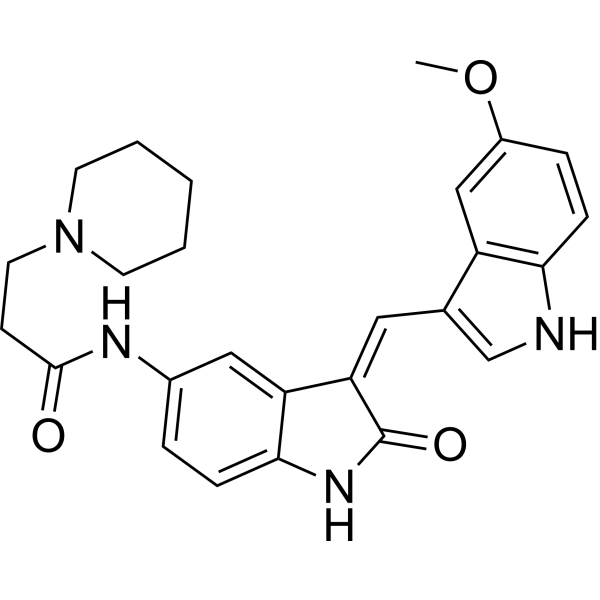
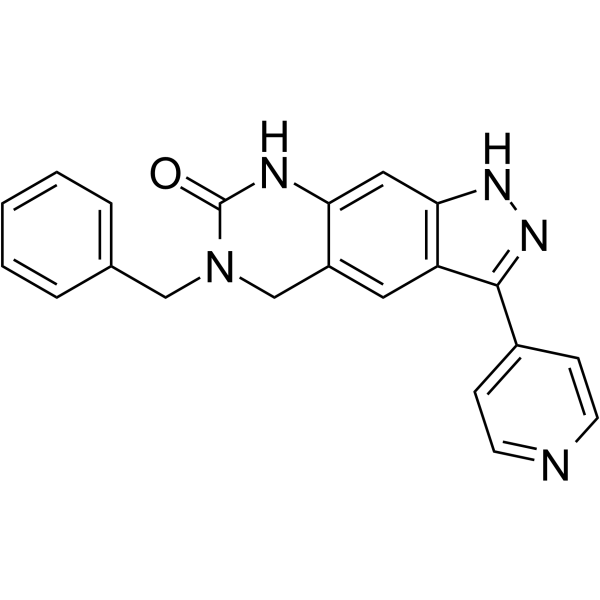
DEL-22379 is an ERK dimerization Inhibitor. DEL-22379 readily binds to ERK2 with a Kd estimated in the low micromolar range, though binding is detectable even at low nanomolar concentrations. ERK2 dimerization is progressively inhibited with an IC50 of ~0.5 μM.
For research use only. We do not sell to patients.
- Purity: 99.69%
- CAS No.: 181223-80-3
- Formula: C26H28N4O3
- Molecular Weight:444.53
-
Storage:Powder -20°C, 3 years , 4°C, 2 years ; In solvent -80°C, 2 years , -20°C, 1 year

To place orders, for customer services and technical support, please contact: MedChemExpress USA
Tel: 609-228-6898 E-mail: [email protected] [email protected]


-
 Biological Activity
-
Chemical Information
-
Solvent & Solubility
- Protocol
- Purity & Documentation
- References
-
 Help & FAQs


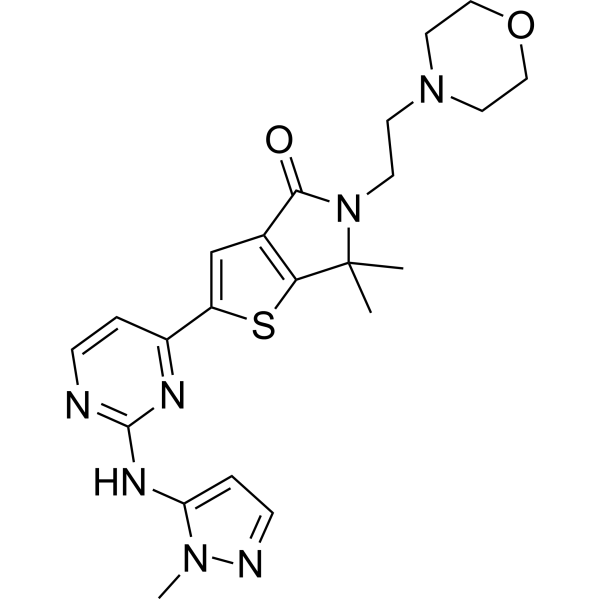
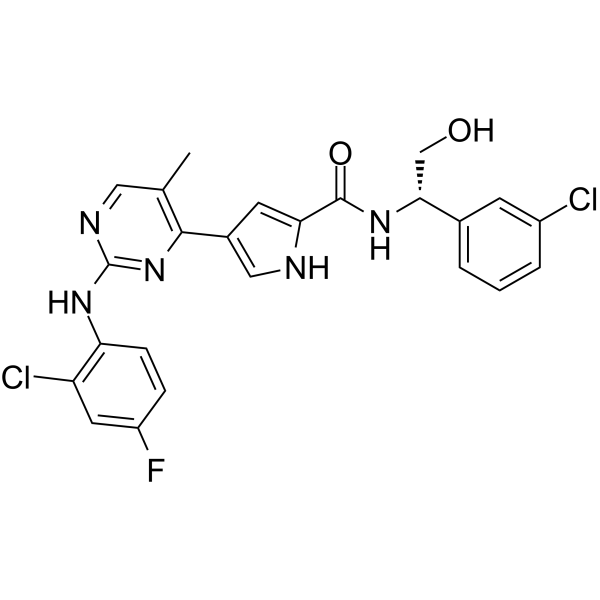
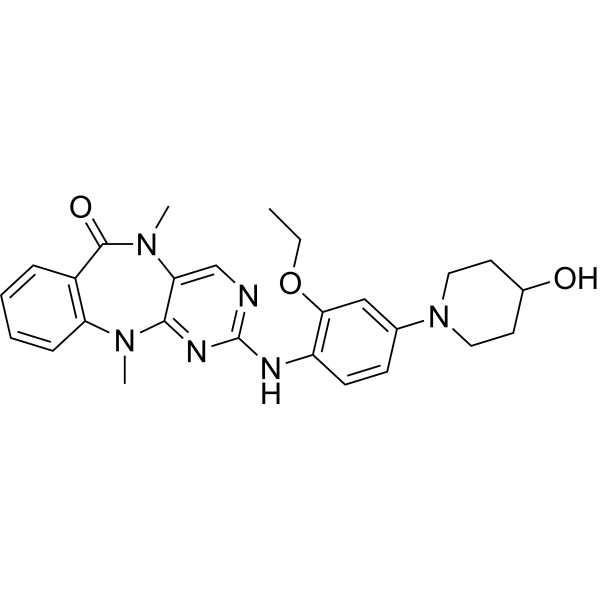
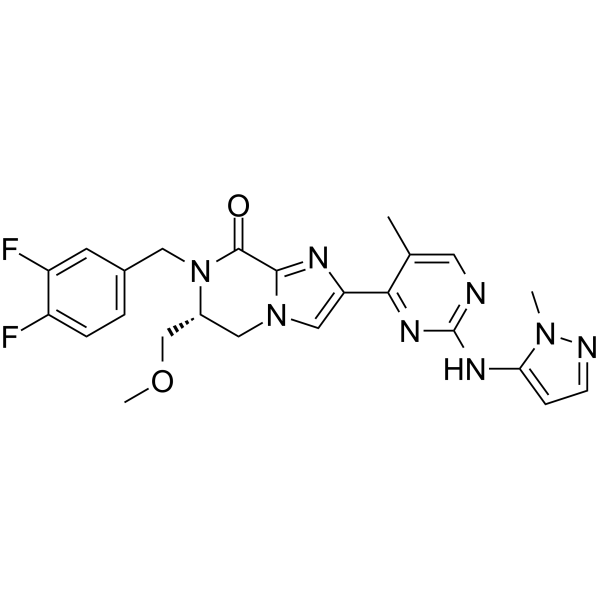
Publications Citing Use of MedChemExpress (MCE) DEL-22379
More

Biological Activity
Description
IC50 & Target
[1]|
ERK2 0.5 μM (IC50) |
In Vitro
DEL-22379 is an ERK dimerization inhibitor. DEL-22379 abolishes EGF-induced co-immunoprecipitation of ectopic ERK2 molecules tagged with hemagglutinin (HA) or FLAG epitopes, with an estimated half-maximal inhibitory concentration (IC50) of ~0.5 μM. DEL-22379 inhibits growth of tumor cells harboring RAS-ERK pathway oncogenes. The biological effects of DEL-22379 are investigated on tumor cells in culture. The cytostatic effects of DEL-22379 are compared to those of the MEK inhibitor PD-0325901 and the ERK kinase inhibitor SCH-772984, as reflected by their half-maximal growth inhibitory concentrations (GI50). Cell lines harboring mutant BRAF are the most sensitive to the three compounds. In comparison, wild-type (WT) cell lines for BRAF and RAS are the most resistant, and RAS mutant cells exhibit a range of sensitivities. In cells showing different oncogenic genotypes, distinct sensitivity to DEL-22379 can not be attributed to variations on its effects on dimerization, because DEL-22379 displays similar dimerization- and cytoplasmic signaling-inhibitory dose responses (IC50 of 150-400 nM) regardless of the genotype[1].
MedChemExpress (MCE) has not independently confirmed the accuracy of these methods. They are for reference only.
In Vivo
MedChemExpress (MCE) has not independently confirmed the accuracy of these methods. They are for reference only.


Chemical Information
-
CAS No. 181223-80-3
-
Appearance Solid
-
Molecular Weight 444.53
-
Formula C26H28N4O3
-
Color Yellow to orange
-
SMILES
O=C(CCN1CCCCC1)NC2=CC=C(NC(/C3=C\C4=CNC5=C4C=C(OC)C=C5)=O)C3=C2
-
Shipping
Room temperature in continental US; may vary elsewhere.
-
Storage
Powder -20°C 3 years 4°C 2 years In solvent -80°C 2 years -20°C 1 year


Publications (3)
-
Journal Impact Factor
-
Most Recent
-
-
-
Biomed Pharmacother
Tanshinol alleviates ischemia-induced myocardial fibrosis via targeting ERK2 and disturbing the intermolecular autophosphorylation of ERK2Thr188. [Abstract]2023 Dec:168:115729. PMID: 37862964


Solvent & Solubility
In Vitro:
DMSO : 100 mg/mL (224.96 mM; Need ultrasonic; Hygroscopic DMSO has a significant impact on the solubility of product, please use newly opened DMSO)
Please refer to the solubility information to select the appropriate solvent. Once prepared, please aliquot and store the solution to prevent product inactivation from repeated freeze-thaw cycles.
Storage method and period of stock solution: -80°C, 2 years; -20°C, 1 year. When stored at -80°C, please use it within 2 years. When stored at -20°C, please use it within 1 year.
Please refer to the solubility information to select the appropriate solvent. Once prepared, please aliquot and store the solution to prevent product inactivation from repeated freeze-thaw cycles.
Storage method and period of stock solution: -80°C, 2 years; -20°C, 1 year. When stored at -80°C, please use it within 2 years. When stored at -20°C, please use it within 1 year.
Concentration (start) × Volume (start) = Concentration (final) × Volume (final)
In Vivo:
Select the appropriate dissolution method based on your experimental animal and administration route.
- For the following dissolution methods, please ensure to first prepare a clear stock solution using an In Vitro approach and then sequentially add co-solvents:
- To ensure reliable experimental results, the clarified stock solution can be appropriately stored based on storage conditions. As for the working solution for In Vivo experiments, it is recommended to prepare freshly and use it on the same day.
- The percentages shown for the solvents indicate their volumetric ratio in the final prepared solution. If precipitation or phase separation occurs during preparation, heat and/or sonication can be used to aid dissolution.
Add each solvent one by one: 10% DMSO 40% PEG300 5% Tween-80 45% Saline
Solubility: ≥ 2.5 mg/mL (5.62 mM); Clear solution
This protocol yields a clear solution of ≥ 2.5 mg/mL (saturation unknown).
Taking 1 mL working solution as an example, add 100 μL DMSO stock solution (25.0 mg/mL) to 400 μL PEG300, and mix evenly; then add 50 μL Tween-80 and mix evenly; then add 450 μL Saline to adjust the volume to 1 mL.
Preparation of Saline: Dissolve 0.9 g sodium chloride in ddH₂O and dilute to 100 mL to obtain a clear Saline solution.
In Vivo Dissolution Calculator
Please enter the basic information of animal experiments:
-
-
-
-
Recommended: Prepare an additional quantity of animals to account for potential losses during experiments.
Please enter your animal formula composition:
-
%DMSO +
Recommended: Keep the proportion of DMSO in working solution below 2% if your animal is weak.
-
%+
-
+%Tween-80 + +
-
%Saline +
The co-solvents required include: DMSO, . All of co-solvents are available by MedChemExpress (MCE). , Tween 80. All of co-solvents are available by MedChemExpress (MCE).
Working solution concentration: 0.22 mg/mL
Method for preparing stock solution: mg drug dissolved in μL DMSO. Stock solution concentration: mg/mL.
1. Take μL DMSO stock solution;
2. Add μL .
μL , mix evenly;
3. Then add μL Tween 80, mix evenly;
4. Then add μL
Please ensure that the stock solution in the first step is dissolved to a clear state, and add co-solvents in sequence. You can use ultrasonic heating (ultrasonic cleaner, recommended frequency 20-40 kHz), vortexing, etc. to assist dissolution.

Protocol
Cell Assay[1]
HEK293T cells are plated at a density of 1,000-2,000 cells/well and treated with DEL-22379 (0.2-1 μ M) for 48 hr, Alamar Blue is added, and the colorimetric change is measured at 570 and 600 nm. GI50 is estimated by nonlinear regression using GraphPad5 Prism Software. Apoptosis is analyzed by evaluating caspase 3 activity, either by western blotting or using the Caspase-Glo 3/7 luminogenic assay[1].
MedChemExpress (MCE) has not independently confirmed the accuracy of these methods. They are for reference only.
Animal Administration[1]
Mice[1]
Cancer cells are xenografted in female, athymic nu/nu mice of 8 weeks of age. 3×10⁶ cells are injected subcutaneously in the lateral flank and allowed to develop for 10-15 days before treatment with DEL-22379 at 15 mg/kg every 12 hr for 2 weeks. patient-derived xenografts (PDXs) are performed using patient-derived colorectal cancer cells harboring BRAFV600E from non-necrotic areas of primary adenocarcinomas from patients that undergo surgical resection. Cells are grafted in both flanks or in the cecum of NOD-SCID mice. DEL-22379 is administered by intra-peritoneal injection at a concentration of 15 mg/kg every 12 hr for 30 days[1].
MedChemExpress (MCE) has not independently confirmed the accuracy of these methods. They are for reference only.


Purity & Documentation
-
Data Sheet (284 KB)
-
SDS (394 KB)
- English - EN (394 KB)
- Français - FR (394 KB)
- Deutsch - DE (394 KB)
- Norwegian - NO (394 KB)
- Español - ES (394 KB)
- Swedish - SV (394 KB)
- Italian - IT (394 KB)
- Korean - KR (394 KB)
- Portuguese - PT (394 KB)
-
Handling Instructions (2659 KB)
References


Complete Stock Solution Preparation Table
Please refer to the solubility information to select the appropriate solvent. Once prepared, please aliquot and store the solution to prevent product inactivation from repeated freeze-thaw cycles.
Storage method and period of stock solution: -80°C, 2 years; -20°C, 1 year. When stored at -80°C, please use it within 2 years. When stored at -20°C, please use it within 1 year.
| Optional Solvent | Concentration Solvent Mass | 1 mg | 5 mg | 10 mg | 25 mg |
|---|---|---|---|---|---|
| DMSO | 1 mM | 2.2496 mL | 11.2478 mL | 22.4957 mL | 56.2392 mL |
| 5 mM | 0.4499 mL | 2.2496 mL | 4.4991 mL | 11.2478 mL | |
| 10 mM | 0.2250 mL | 1.1248 mL | 2.2496 mL | 5.6239 mL | |
| 15 mM | 0.1500 mL | 0.7499 mL | 1.4997 mL | 3.7493 mL | |
| 20 mM | 0.1125 mL | 0.5624 mL | 1.1248 mL | 2.8120 mL | |
| 25 mM | 0.0900 mL | 0.4499 mL | 0.8998 mL | 2.2496 mL | |
| 30 mM | 0.0750 mL | 0.3749 mL | 0.7499 mL | 1.8746 mL | |
| 40 mM | 0.0562 mL | 0.2812 mL | 0.5624 mL | 1.4060 mL | |
| 50 mM | 0.0450 mL | 0.2250 mL | 0.4499 mL | 1.1248 mL | |
| 60 mM | 0.0375 mL | 0.1875 mL | 0.3749 mL | 0.9373 mL | |
| 80 mM | 0.0281 mL | 0.1406 mL | 0.2812 mL | 0.7030 mL | |
| 100 mM | 0.0225 mL | 0.1125 mL | 0.2250 mL | 0.5624 mL |


DEL-22379 Related Classifications
HY-18932 Related Classifications
 Powered by Bioz