



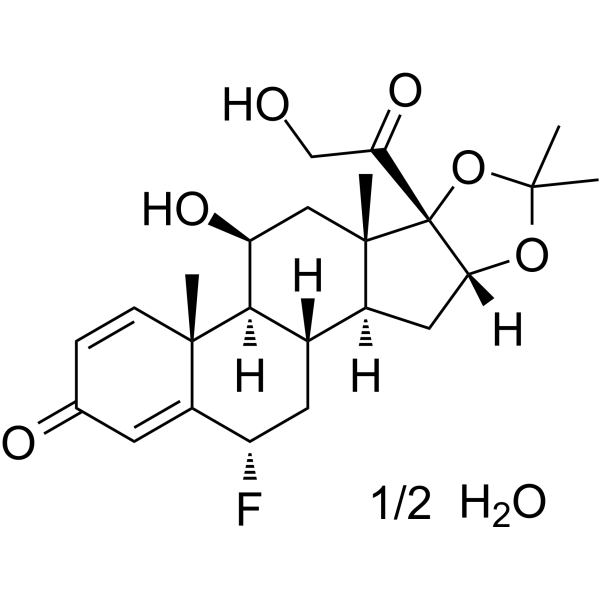
Flunisolide hemihydrate
Based on 1 publication(s) in Google Scholar
Flunisolide hemihydrate is a corticosteroid, which is an orally active glucocorticoid receptor activator with anti-inflammatory activity. Flunisolide hemihydrate can induce eosinophil apoptosis, and is used for the research of asthma or rhinitis, and inflammation.
Nos produits utilisent uniquement pour la recherche. Nous ne vendons pas aux patients.
- CAS No.: 77326-96-6
- Formule: C24H33FO7
- Masse moléculaire:443.51
-
Stockage:
Please store the product under the recommended conditions in the Certificate of Analysis.

To place orders, for customer services and technical support, please contact: MedChemExpress USA
Tel: 609-228-6898 E-mail: [email protected] [email protected]


-
 Activité biologique
-
Chemical Information
- Pureté et documentation
- Références
-
 Help & FAQs


Publications Citing Use of MedChemExpress (MCE) Flunisolide hemihydrate
More

Activité biologique
Description
In Vitro
Flunisolide hemihydrate (0.1-10 μM, 1 h) inhibits lung fibroblast (Isolated from lung) activation[1]. Flunisolide hemihydrate (10 μM, 24 h) reduces MMP-9, TIMP-1, TGF-β and fibronectin release by sputum cells (isolated from mild to moderate asthmatics), and induces sputum eosinophil apoptosis[2]. Flunisolide hemihydrate (0.1-10 µM μM, 24 h) effectively inhibits ICAM-1 expression and GM-CSF and IL-5 release induced by TNF-alpha in BEAS-2B cells[3]. Flunisolide hemihydrate (115 µM, 0-3 h) can be transported in a polarized way in the apical (ap) to basolateral (bl) direction in Calu-3 cells and is demonstrated to be ATP-dependent[4].
MedChemExpress (MCE) has not independently confirmed the accuracy of these methods. They are for reference only.
-
Cell Line:Eosinophil
-
Concentration:10 μM
-
Incubation Time:24 h
-
Result:Induced sputum eosinophil apoptosis.
In Vivo
MedChemExpress (MCE) has not independently confirmed the accuracy of these methods. They are for reference only.
-
Animal Model:Male Swiss Webster mice (instilled, intranasally, with crystalline silica, 10 mg/50 µL, particle size 0.5-10 µm)[1]
-
Dosage:0.3-10 µg/mouse, daily, from days 21-27
-
Administration:Intranasal administration
-
Result:Reduced both granulomatous response, collagen deposition, concerning granuloma formation caused by silica particles. Reduced the number of F4/80 and α-SMA positive cells.
Essai clinique
| NCT Number | Sponsor | Condition | Start Date |
Phase

|
|---|---|---|---|---|
| NCT01329991 | Plexxikon| | 2011-05 | PHASE1 |


Chemical Information
-
CAS No. 77326-96-6
-
Masse moléculaire 443.51
-
Formule C24H33FO7
-
SMILES
C[C@@]12[C@@]3(C(CO)=O)[C@@](OC(C)(O3)C)([H])C[C@@]1([H])[C@]4([H])C[C@H](F)C5=CC(C=C[C@]5(C)[C@@]4([H])[C@@H](O)C2)=O.[1/2].O
-
Livraison
Room temperature in continental US; may vary elsewhere.
-
Stockage
Please store the product under the recommended conditions in the Certificate of Analysis.


Publications (1)
-
Journal Impact Factor
-
Most Recent
-
Drug Test Anal
High-throughput liquid chromatography tandem mass spectrometry assay as initial testing procedure for analysis of total urinary fraction. [Abstract]2021 Feb;13(2):283-298. PMID: 32852861


Pureté et documentation
Références
[1]. Tatiana Paula Teixeira Ferreira, et al. Intranasal Flunisolide Suppresses Pathological Alterations Caused by Silica Particles in the Lungs of Mice. Front Endocrinol (Lausanne). 2020 Jun 17;11:388. [Content Brief]
[2]. M Profita, et al. In vitro effects of flunisolide on MMP-9, TIMP-1, fibronectin, TGF-beta1 release and apoptosis in sputum cells freshly isolated from mild to moderate asthmatics. Allergy. 2004 Sep;59(9):927-32. [Content Brief]
[3]. S Boero, et al. Modulation by flunisolide of tumor necrosis factor-alpha-induced stimulation of airway epithelial cell activities related to eosinophil inflammation. J Asthma. 2010 May;47(4):381-7. [Content Brief]
[4]. B I Florea, et al. Evidence of P-glycoprotein mediated apical to basolateral transport of flunisolide in human broncho-tracheal epithelial cells (Calu-3). Br J Pharmacol. 2001 Dec;134(7):1555-63. [Content Brief]

Calculators
Concentration (start) × Volume (start) = Concentration (final) × Volume (final)


Flunisolide hemihydrate Related Classifications
HY-B1121A Related Classifications
 Powered by Bioz