



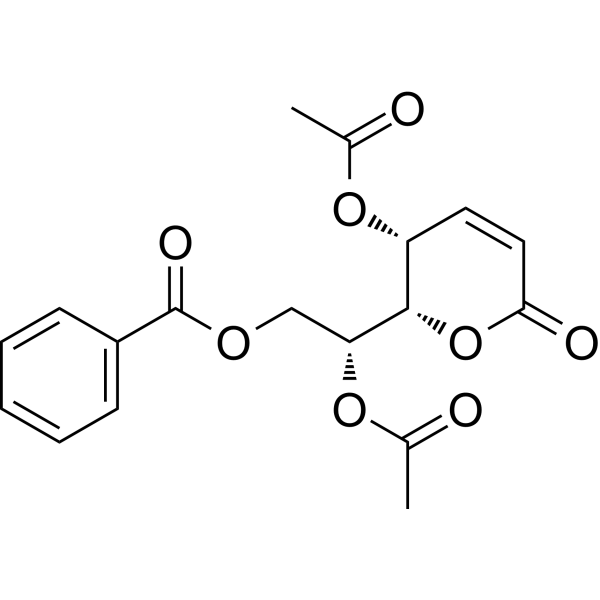
(-)-Cleistenolide
(-)-Cleistenolide is a α,β-unsaturated δ-lactone isolated from Cleistochlamys kirkii Oliver. (-)-Cleistenolide has antibacterial and antitumor activity.
Nos produits utilisent uniquement pour la recherche. Nous ne vendons pas aux patients.
- CAS No.: 1003600-48-3
- Formule: C18H18O8
- Masse moléculaire:362.33
-
Stockage:
Please store the product under the recommended conditions in the Certificate of Analysis.

To place orders, for customer services and technical support, please contact: MedChemExpress USA
Tel: 609-228-6898 E-mail: [email protected] [email protected]


-
 Activité biologique
-
Chemical Information
- Protocole
- Pureté et documentation
- Références
-
 Help & FAQs




Activité biologique
Description
Cellular Effect
|
Cell Line

|
Type | Value | Description | References |
|---|---|---|---|---|
| A549 | IC50 |
16.34 μM
Compound: 1
|
Cytotoxicity against human A549 cells assessed as cell growth inhibition after 72 hrs by MTT assay
Cytotoxicity against human A549 cells assessed as cell growth inhibition after 72 hrs by MTT assay
|
[PMID: 27231128] |
| A549 | IC50 |
16.34 μM
Compound: 1
|
Antiproliferative activity against human A549 cells assessed as inhibition of cell growth incubated for 72 hrs by MTT assay
Antiproliferative activity against human A549 cells assessed as inhibition of cell growth incubated for 72 hrs by MTT assay
|
[PMID: 39067378] |
| HeLa | IC50 |
7.32 μM
Compound: 1
|
Cytotoxicity against human HeLa cells assessed as cell growth inhibition after 72 hrs by MTT assay
Cytotoxicity against human HeLa cells assessed as cell growth inhibition after 72 hrs by MTT assay
|
[PMID: 27231128] |
| HeLa | IC50 |
7.32 μM
Compound: 1
|
Antiproliferative activity against human HeLa cells assessed as inhibition of cell growth incubated for 72 hrs by MTT assay
Antiproliferative activity against human HeLa cells assessed as inhibition of cell growth incubated for 72 hrs by MTT assay
|
[PMID: 39067378] |
| HL-60 | IC50 |
1.21 μM
Compound: 1
|
Cytotoxicity against human HL60 cells assessed as cell growth inhibition after 72 hrs by MTT assay
Cytotoxicity against human HL60 cells assessed as cell growth inhibition after 72 hrs by MTT assay
|
[PMID: 27231128] |
| HL-60 | IC50 |
1.21 μM
Compound: 1
|
Antiproliferative activity against human HL-60 cells assessed as inhibition of cell growth incubated for 72 hrs by MTT assay
Antiproliferative activity against human HL-60 cells assessed as inhibition of cell growth incubated for 72 hrs by MTT assay
|
[PMID: 39067378] |
| Jurkat | IC50 |
14.22 μM
Compound: 1
|
Cytotoxicity against human Jurkat cells assessed as cell growth inhibition after 72 hrs by MTT assay
Cytotoxicity against human Jurkat cells assessed as cell growth inhibition after 72 hrs by MTT assay
|
[PMID: 27231128] |
| Jurkat | IC50 |
14.22 μM
Compound: 1
|
Antiproliferative activity against human Jurkat cells assessed as inhibition of cell growth incubated for 72 hrs by MTT assay
Antiproliferative activity against human Jurkat cells assessed as inhibition of cell growth incubated for 72 hrs by MTT assay
|
[PMID: 39067378] |
| K562 | IC50 |
7.65 μM
Compound: 1
|
Cytotoxicity against human K562 cells assessed as cell growth inhibition after 72 hrs by MTT assay
Cytotoxicity against human K562 cells assessed as cell growth inhibition after 72 hrs by MTT assay
|
[PMID: 27231128] |
| K562 | IC50 |
7.65 μM
Compound: 1
|
Antiproliferative activity against human K562 cells assessed as inhibition of cell growth incubated for 72 hrs by MTT assay
Antiproliferative activity against human K562 cells assessed as inhibition of cell growth incubated for 72 hrs by MTT assay
|
[PMID: 39067378] |
| MCF7 | IC50 |
26.07 μM
Compound: 1
|
Cytotoxicity against human MCF7 cells assessed as cell growth inhibition after 72 hrs by MTT assay
Cytotoxicity against human MCF7 cells assessed as cell growth inhibition after 72 hrs by MTT assay
|
[PMID: 27231128] |
| MCF7 | IC50 |
26.07 μM
Compound: 1
|
Antiproliferative activity against estrogen receptor positive human MCF7 cells assessed as inhibition of cell growth incubated for 72 hrs by MTT assay
Antiproliferative activity against estrogen receptor positive human MCF7 cells assessed as inhibition of cell growth incubated for 72 hrs by MTT assay
|
[PMID: 39067378] |
| MDA-MB-231 | IC50 |
2.25 μM
Compound: 1
|
Cytotoxicity against human MDA-MB-231 cells assessed as cell growth inhibition after 72 hrs by MTT assay
Cytotoxicity against human MDA-MB-231 cells assessed as cell growth inhibition after 72 hrs by MTT assay
|
[PMID: 27231128] |
| MDA-MB-231 | IC50 |
2.25 μM
Compound: 1
|
Antiproliferative activity against estrogen receptor negative human MDA-MB-231 cells assessed as inhibition of cell growth incubated for 72 hrs by MTT assay
Antiproliferative activity against estrogen receptor negative human MDA-MB-231 cells assessed as inhibition of cell growth incubated for 72 hrs by MTT assay
|
[PMID: 39067378] |
| MRC5 | IC50 |
>100 μM
Compound: 1
|
Cytotoxicity against human MRC5 cells assessed as cell growth inhibition after 72 hrs by MTT assay
Cytotoxicity against human MRC5 cells assessed as cell growth inhibition after 72 hrs by MTT assay
|
[PMID: 27231128] |
| MRC5 | IC50 |
>100 μM
Compound: 1
|
Cytotoxicity against human MRC5 cells assessed as inhibition of cell growth incubated for 72 hrs by MTT assay
Cytotoxicity against human MRC5 cells assessed as inhibition of cell growth incubated for 72 hrs by MTT assay
|
[PMID: 39067378] |
| Raji | IC50 |
36.94 μM
Compound: 1
|
Cytotoxicity against human Raji cells assessed as cell growth inhibition after 72 hrs by MTT assay
Cytotoxicity against human Raji cells assessed as cell growth inhibition after 72 hrs by MTT assay
|
[PMID: 27231128] |
| Raji | IC50 |
36.94 μM
Compound: 1
|
Antiproliferative activity against human Raji cells assessed as inhibition of cell growth incubated for 72 hrs by MTT assay
Antiproliferative activity against human Raji cells assessed as inhibition of cell growth incubated for 72 hrs by MTT assay
|
[PMID: 39067378] |
In Vitro
(-)-Cleistenolide (compound 1) exhibits potent cytotoxicity against cancer cell lines and low cytotoxicity in normal cells MRC-5[1].
MedChemExpress (MCE) has not independently confirmed the accuracy of these methods. They are for reference only. Further protocols information, click here.
-
Cell Line:K562, HL-60, Jurkat, Raji, MCF-7, MDA-MB 231, HeLa, A549 and MRC-5[1]
-
Concentration:0-100 μM
-
Incubation Time:
-
Result:Exhibited potent cytotoxicity against cancer cell lines with IC50s of 7.65 μM, 1.21 μM, 14.22 μM, 36.94 μM, 26.07 μM, 2.25 μM, 7.32 μM and 16.34 μM in K562, HL-60, Jurkat, Raji, MCF-7, MDA-MB 231, HeLa and A549, respectively; and had low cytotoxicity in normal cells MRC-5 with an IC50 over 100 μM.


Chemical Information
-
CAS No. 1003600-48-3
-
Masse moléculaire 362.33
-
Formule C18H18O8
-
SMILES
CC(O[C@@H]1C=CC(O[C@@H]1[C@H](OC(C)=O)COC(C2=CC=CC=C2)=O)=O)=O
-
Synonyms
Cleistenolide
-
Structure Classification
-
Initial Source
-
Livraison
Room temperature in continental US; may vary elsewhere.
-
Stockage
Please store the product under the recommended conditions in the Certificate of Analysis.

Protocole
-
Research Protocol for Infectious Diseases
Infectious-disease experiments test how pathogens interact with host barriers, innate immune receptors, inflammatory signaling, pathogen replication, and tissue injury; pattern-recognition receptors such as TLRs, RIG-I-like receptors, NOD-like receptors, and inflammasomes detect microbial molecules and activate NF-κB, interferon, and cytokine responses. The central hypothesis is that infection severity reflects the balance between pathogen burden and host response: protective inflammation restricts pathogen growth, whereas excessive or mislocalized inflammation contributes to tissue damage and disease phenotype. Unresolved questions include which host pathways are protective versus pathogenic, why some infection models fail to translate to human disease, and which combined readouts best predict clinically relevant infection outcomes.
-
Subcutaneous Cell-Line-Derived Xenograft
Subcutaneous cell-line-derived xenograft (CDX) models are established by implanting cultured human cancer cell lines into immunodeficient mice, where the injected cells form localized tumors that can be monitored in vivo as a measure of tumorigenic potential, growth kinetics, and treatment response. These models are widely used in oncology research because they allow reproducible tumor formation and enable comparative assessment of tumor growth between different cell lines or genetic manipulations in a controlled in vivo microenvironment. Subcutaneous implantation of cancer cells in immunodeficient mice is a standard approach for evaluating tumor growth behavior and therapeutic response across multiple cancer types, including prostate, esophageal, pancreatic, and colon cancer models.


Pureté et documentation
Références

Calculators
Concentration (start) × Volume (start) = Concentration (final) × Volume (final)


(-)-Cleistenolide Related Classifications
HY-N10391 Related Classifications
 Powered by Bioz