



Pseudoginsenoside F11
Based on 2 publication(s) in Google Scholar
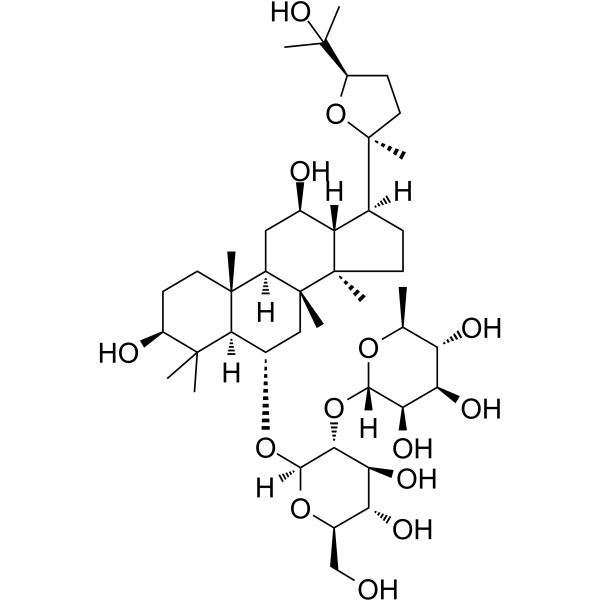
Pseudoginsenoside F11 is an orally active neuroprotective agent. Pseudoginsenoside F11 reduces the expression of β-amyloid precursor protein, inhibits the production of Aβ1-40, downregulates the expression of JNK2, p53 and activated Caspase 3, and restores the activities of SOD and Glutathione peroxidase. Pseudoginsenoside F11 inhibits the excessive activation of μ-Calpain and restores the level of neuronal Nitric oxide synthase. Pseudoginsenoside F11 reduces infarct volume, alleviates cerebral edema, decreases neuronal loss, improves neurological deficits and enhances long-term functional outcomes in transient cerebral ischemia models. Pseudoginsenoside F11 antagonizes Methamphetamine-induced behavioral deficits, dopamine level reduction and neurotoxicity without altering the baseline behaviors of normal mice. Pseudoginsenoside F11 can be used in studies related to Alzheimer's disease, transient cerebral ischemic injury and Methamphetamine-induced neurotoxicity.
Nur für Forschungszwecke. Wir verkaufen nicht an Patienten.
- Reinheit: 99.87%
- CAS. Nr.: 69884-00-0
- Formel: C42H72O14
- Molecular Weight:801.01
-
Speicherung:
4°C, sealed storage, away from moisture and light
* In solvent : -80°C, 6 months; -20°C, 1 month (sealed storage, away from moisture and light)


-
 Biologische Aktivität
-
Chemical Information
-
Lösungsmittel & Löslichkeit
- Reinheit & Dokumentation
- Verweise
-
 Help & FAQs
-

Apoptosis Compound Library
HY-L003
-
Immunology/Inflammation Compound Library
HY-L007
-
Kinase Inhibitor Library
HY-L009
-
MAPK Compound Library
HY-L010
-
Metabolism/Protease Compound Library
HY-L012
-
Neuronal Signaling Compound Library
HY-L013
-
Natural Product Library
HY-L021
-
Autophagy Compound Library
HY-L029
-
Anti-Aging Compound Library
HY-L034
-
Antioxidant Compound Library
HY-L037
-
Reprogramming Compound Library
HY-L039
-
Glycoside Compound Library
HY-L042
-
Oxygen Sensing Compound Library
HY-L045
-
Anti-Cardiovascular Disease Compound Library
HY-L046
-
Ferroptosis Compound Library
HY-L051
-
Endoplasmic Reticulum Stress Compound Library
HY-L054
-
Medicine Food Homology Compound Library
HY-L055
-
Terpenoids Library
HY-L056
-
Pyroptosis Compound Library
HY-L059
-
Orally Active Compound Library
HY-L061
-
Glutamine Metabolism Compound Library
HY-L064
-
Traditional Chinese Medicine Active Compound Library
HY-L065
-
Anti-Alzheimer's Disease Compound Library
HY-L069
-
Neuroprotective Compound Library
HY-L070
-
Anti-Lung Cancer Compound Library
HY-L075
-
Anti-Pancreatic Cancer Compound Library
HY-L077
-
Anti-Blood Cancer Compound Library
HY-L079
-
Anti-Cancer Metabolism Compound Library
HY-L083
-
Anti-Parkinson's Disease Compound Library
HY-L085
-
Neurodegenerative Disease-related Compound Library
HY-L086
-
Anti-Obesity Compound Library
HY-L087
-
Angiogenesis-Related Compound Library
HY-L088
-
Transcription Factor-Targeted Library
HY-L090
-
Food-Sourced Compound Library
HY-L094
-
Antidepressant Compound Library
HY-L108
-
Anti-inflammatory Traditional Chinese Medicine Active Compound Library
HY-L114
-
Plant-Sourced Natural Product Library
HY-L115
-
Human Metabolite Library
HY-L123
-
Anti-Pulmonary Fibrosis Compound Library
HY-L125
-
Cuproptosis Compound Library
HY-L133
-
Pain-Related Compound Library
HY-L139
-
Metabolic Enzyme Compound Library
HY-L146
-
Protease Inhibitor Library
HY-L147
-
Membrane Protein-targeted Compound Library
HY-L149
-
Serine/Threonine Kinase Inhibitor Library
HY-L164
-
Anti-Hematopathy Compound Library
HY-L171
-
Multi-Target Compound Library
HY-L176
-
Radioprotector Library
HY-L178
-
Bioactive Compound Library Max
HY-L181
-
MCE Bioactive Compound Library
HY-L001V
-
Natural Product Library Plus
HY-L021P
-
Natural Product and Natural Product-Like Compound Library
HY-L021M
-
Bioactive Compound Library
HY-L001
-
Protein Kinase Compound Library
HY-L196
-
Cell Proliferation Compound Library
HY-L201
-
High-Throughput Bioactive Compound Library
HY-L205
-
High-Throughput Natural Product Library
HY-L206
-
Ancient Chinese Classical Formulas Traditional Chinese Medicine Active Compound Library
HY-L209
-
Mass Spectrometry Human Metabolite Library
HY-L215
-
Diarrhea-Related Traditional Chinese Medicine Active Compound Library
HY-L224
-
Mongolian Medicine Compound Library
HY-L238
-
Natural Product Diversity Scaffold Library
HY-L245
-
Tonifying Traditional Chinese Medicine Monomer Compound Library
HY-L246
-
Mass Spectrometry Natural Product Library
HY-L262


Publications Citing Use of MedChemExpress (MCE) Pseudoginsenoside F11
MoreAlle Caspase Isoform-spezifische Produkte anzeigen
More

Biologische Aktivität
|
JNK2 |
Caspase 3 |
Pseudoginsenoside F11 (10-100 μM; 2 h pre-treatment; 0-24 h OGD/R) protects cultured primary cortical neurons against OGD/R-induced injury by increasing cell viability, restoring neurite structure, maintaining calcium homeostasis, replenishing ATP levels, inhibiting μ-Calpain-mediated α-Fodrin cleavage, reversing deficits in NMDA receptor subunits/PSD95/nNOS, and alleviating endoplasmic reticulum stress, with the most robust effects observed at 100 μM[2].
MedChemExpress (MCE) has not independently confirmed the accuracy of these methods. They are for reference only.
Pseudoginsenoside F11 (8 mg/kg; p.o.; daily; 28 days) significantly improves learning and memory deficits in APP/PS1 mice, mediated by reduced amyloidogenesis, restored antioxidant function, reduced neuronal apoptosis, and improved neuronal histopathology[1].
Pseudoginsenoside F11 (12 mg/kg; i.v.; single dose, 0-8 hours post-reperfusion; 3-12 mg/kg; i.v. initial dose, i.p. daily; 14 days) produces dose-dependent neuroprotection in transient cerebral ischemia-reperfusion injured rats, reducing acute brain damage by up to 48.1% infarct volume reduction with a 4-hour therapeutic window, improving long-term survival by 13.6% at 12 mg/kg, and restoring motor function and neuronal health via repression of sustained calcium overload[2].
Pseudoginsenoside F11 (4-8 mg/kg; p.o.; two times at 4-hour intervals) significantly protects against methamphetamine-induced behavioral neurotoxicities (anxiety, despair, memory impairment) and partially reverses methamphetamine-induced brain dopamine depletion in mice[3].
MedChemExpress (MCE) has not independently confirmed the accuracy of these methods. They are for reference only.
-
Animal Model:KM mice (male, 6-8 week-old, Alzheimer's disease model via intracerebroventricular injection of 410 pmol Aβ1-42)[1]
-
Dosage:0.32 mg/kg; 1.6 mg/kg; 8 mg/kg
-
Administration:p.o.; daily; 15 days
-
Result:Significantly reduced Aβ1-42-induced increases in escape latency (p < 0.05 on days 3, 4, and 5 of place navigation testing) and escape distance (p < 0.05 on day 5 of place navigation testing) at 8 mg/kg.
Restored reduced time spent in the target quadrant (p = 0.004) in the Morris water maze probe test and blocked reduced step-through latency in the retention trial (p = 0.026) at 8 mg/kg.
Reduced escape latency on day 3 of place navigation testing (p < 0.05) and restored reduced time spent in the target quadrant (p = 0.011) in the probe test at 1.6 mg/kg.
Showed no significant effects on swim velocity across all doses.
-
Animal Model:Swiss mice (male, 7-week-old, 20-22 g, methamphetamine-induced neurotoxicity model)[3]
-
Dosage:4 mg/kg; 8 mg/kg
-
Administration:p.o.; two times at 4-hour intervals
-
Result:Shortened methamphetamine-induced prolonged time spent in the dark box in the light-dark box task.
Reversed methamphetamine-induced prolonged immobility time in the forced swimming task.
Shortened methamphetamine-induced prolonged latency to find food and reduced the number of errors in the appetitively motivated T-maze task.
Shortened methamphetamine-induced prolonged escape latency to locate the hidden platform across test days in the Morris water maze task.
Partially but significantly antagonized the methamphetamine-induced decrease in brain dopamine (DA) content, with a 23.22% recovery of DA levels.
Showed no significant effect on methamphetamine-induced decreases in 3,4-dihydroxyphenacetic acid (DOPAC), homovanillic acid (HVA), 5-hydroxyindoacetic acid (5-HIAA), or 5-hydroxytryptamine (5-HT) contents.
Affected neither swimming ability, spontaneous behavior, nor baseline levels of brain monoamines and their metabolites in non-methamphetamine-treated mice.


Chemical Information
-
CAS. Nr. 69884-00-0
-
Appearance Solid
-
Molecular Weight 801.01
-
Formel C42H72O14
-
Color White to light yellow
-
SMILES
C[C@@]([C@@]12C)(C[C@H](O[C@@](O[C@H](CO)[C@@H](O)[C@@H]3O)([H])[C@@H]3O[C@@](O[C@@H](C)[C@H](O)[C@H]4O)([H])[C@@H]4O)[C@@]5([H])C6(C)C)[C@@](C[C@@H](O)[C@]1([H])[C@]([C@]7(O[C@@H](C(C)(O)C)CC7)C)([H])CC2)([H])[C@]5(CC[C@@H]6O)C
-
Synonyms
Ginsenoside A1
-
Structure Classification
-
Initial Source
-
Versand
Room temperature in continental US; may vary elsewhere.
-
Speicherung
4°C, sealed storage, away from moisture and light
* In solvent : -80°C, 6 months; -20°C, 1 month (sealed storage, away from moisture and light)


Publications (2)
-
Journal Impact Factor
-
Most Recent
-
Phytomedicine
Pseudoginsenoside F11 enhances YBX1-mediated transcriptional repression of PRPS2 to inhibit the stemness and pulmonary metastasis of triple- negative breast cancer. [Abstract]2026 Jun:155:158064. PMID: 41855762 -
Front Pharmacol
Pseudoginsenoside F11 Enhances the Viability of Random-Pattern Skin Flaps by Promoting TFEB Nuclear Translocation Through AMPK-mTOR Signal Pathway. [Abstract]2021 Apr 29:12:667524. PMID: 33995096


Lösungsmittel & Löslichkeit
DMSO : 50 mg/mL (62.42 mM; ultrasonic and warming and heat to 60°C; Hygroscopic DMSO has a significant impact on the solubility of product, please use newly opened DMSO)
H2O : 0.67 mg/mL (0.84 mM; Need ultrasonic)
Please refer to the solubility information to select the appropriate solvent. Once prepared, please aliquot and store the solution to prevent product inactivation from repeated freeze-thaw cycles.
Storage method and period of stock solution: -80°C, 6 months; -20°C, 1 month (sealed storage, away from moisture and light). When stored at -80°C, please use it within 6 months. When stored at -20°C, please use it within 1 month.
* Note: If you choose water as the stock solution, please dilute it to the working solution, then filter and sterilize it with a 0.22 μm filter before use.
Please refer to the solubility information to select the appropriate solvent. Once prepared, please aliquot and store the solution to prevent product inactivation from repeated freeze-thaw cycles.
Storage method and period of stock solution: -80°C, 6 months; -20°C, 1 month (sealed storage, away from moisture and light). When stored at -80°C, please use it within 6 months. When stored at -20°C, please use it within 1 month.
* Note: If you choose water as the stock solution, please dilute it to the working solution, then filter and sterilize it with a 0.22 μm filter before use.
Konzentration (Stammlösung) × Volumen (Stammlösung) = Konzentration (Ziellösung) × Volumen (Ziellösung)
Select the appropriate dissolution method based on your experimental animal and administration route.
- For the following dissolution methods, please ensure to first prepare a clear stock solution using an In Vitro approach and then sequentially add co-solvents:
- To ensure reliable experimental results, the clarified stock solution can be appropriately stored based on storage conditions. As for the working solution for In Vivo experiments, it is recommended to prepare freshly and use it on the same day.
- The percentages shown for the solvents indicate their volumetric ratio in the final prepared solution. If precipitation or phase separation occurs during preparation, heat and/or sonication can be used to aid dissolution.
Add each solvent one by one: 10% DMSO 40% PEG300 5% Tween-80 45% Saline
Solubility: ≥ 2.5 mg/mL (3.12 mM); Clear solution
This protocol yields a clear solution of ≥ 2.5 mg/mL (saturation unknown).
Taking 1 mL working solution as an example, add 100 μL DMSO stock solution (25.0 mg/mL) to 400 μL PEG300, and mix evenly; then add 50 μL Tween-80 and mix evenly; then add 450 μL Saline to adjust the volume to 1 mL.
Preparation of Saline: Dissolve 0.9 g sodium chloride in ddH₂O and dilute to 100 mL to obtain a clear Saline solution.
Add each solvent one by one: 10% DMSO 90% (20% SBE-β-CD in Saline)
Solubility: ≥ 2.5 mg/mL (3.12 mM); Clear solution
This protocol yields a clear solution of ≥ 2.5 mg/mL (saturation unknown).
Taking 1 mL working solution as an example, add 100 μL DMSO stock solution (25.0 mg/mL) to 900 μL 20% SBE-β-CD in Saline, and mix evenly.
Preparation of 20% SBE-β-CD in Saline (4°C, storage for one week): 2 g SBE-β-CD powder is dissolved in 10 mL Saline, completely dissolve until clear.
Please enter the basic information of animal experiments:
-
-
-
-
Recommended: Prepare an additional quantity of animals to account for potential losses during experiments.
Please enter your animal formula composition:
-
%DMSO +
Recommended: Keep the proportion of DMSO in working solution below 2% if your animal is weak.
-
%+
-
+%Tween-80 + +
-
%Saline +
The co-solvents required include: DMSO, . All of co-solvents are available by MedChemExpress (MCE). , Tween 80. All of co-solvents are available by MedChemExpress (MCE).
Working solution concentration: 0.22 mg/mL
Method for preparing stock solution: mg drug dissolved in μL DMSO. Stock solution concentration: mg/mL. * In solvent : -80°C, 6 months; -20°C, 1 month (sealed storage, away from moisture and light)
1. Take μL DMSO stock solution;
2. Add μL .
μL , mix evenly;
3. Then add μL Tween 80, mix evenly;
4. Then add μL
Please ensure that the stock solution in the first step is dissolved to a clear state, and add co-solvents in sequence. You can use ultrasonic heating (ultrasonic cleaner, recommended frequency 20-40 kHz), vortexing, etc. to assist dissolution.


Reinheit & Dokumentation
-
Data Sheet (286 KB)
-
SDS (393 KB)
- English - EN (393 KB)
- Français - FR (393 KB)
- Deutsch - DE (393 KB)
- Norwegian - NO (393 KB)
- Español - ES (393 KB)
- Swedish - SV (393 KB)
- Italian - IT (393 KB)
- Portuguese - PT (393 KB)
-
Handling Instructions (2659 KB)
Verweise
[1]. Wang CM, et al. Anti-amnesic effect of pseudoginsenoside-F11 in two mouse models of Alzheimer's disease. Pharmacol Biochem Behav. 2013;106:57-67. [Content Brief]
[2]. Zhang T, et al. Pseudoginsenoside-F11 Protects against Transient Cerebral Ischemia Injury in Rats Involving Repressing Calcium Overload. Neuroscience. 2019;411:86-104. [Content Brief]
[3]. Wu CF, et al. Protective effects of pseudoginsenoside-F11 on methamphetamine-induced neurotoxicity in mice. Pharmacol Biochem Behav. 2003;76(1):103-109. [Content Brief]


Complete Stock Solution Preparation Table
Please refer to the solubility information to select the appropriate solvent. Once prepared, please aliquot and store the solution to prevent product inactivation from repeated freeze-thaw cycles.
Storage method and period of stock solution: -80°C, 6 months; -20°C, 1 month (sealed storage, away from moisture and light). When stored at -80°C, please use it within 6 months. When stored at -20°C, please use it within 1 month.
| Optional Solvent | Concentration Solvent Mass | 1 mg | 5 mg | 10 mg | 25 mg |
|---|---|---|---|---|---|
| DMSO | 1 mM | 1.2484 mL | 6.2421 mL | 12.4842 mL | 31.2106 mL |
| 5 mM | 0.2497 mL | 1.2484 mL | 2.4968 mL | 6.2421 mL | |
| 10 mM | 0.1248 mL | 0.6242 mL | 1.2484 mL | 3.1211 mL | |
| 15 mM | 0.0832 mL | 0.4161 mL | 0.8323 mL | 2.0807 mL | |
| 20 mM | 0.0624 mL | 0.3121 mL | 0.6242 mL | 1.5605 mL | |
| 25 mM | 0.0499 mL | 0.2497 mL | 0.4994 mL | 1.2484 mL | |
| 30 mM | 0.0416 mL | 0.2081 mL | 0.4161 mL | 1.0404 mL | |
| 40 mM | 0.0312 mL | 0.1561 mL | 0.3121 mL | 0.7803 mL | |
| 50 mM | 0.0250 mL | 0.1248 mL | 0.2497 mL | 0.6242 mL | |
| 60 mM | 0.0208 mL | 0.1040 mL | 0.2081 mL | 0.5202 mL |
* Note: If you choose water as the stock solution, please dilute it to the working solution, then filter and sterilize it with a 0.22 μm filter before use.


Pseudoginsenoside F11 Related Classifications
Art. -Nr.: HY-N0541
 Powered by Bioz
- Pseudoginsenoside F11
- 69884-00-0
- Ginsenoside A1
- Pseudoginsenoside F 11
- Pseudoginsenoside F-11
- Ginsenoside A 1
- Ginsenoside A-1
- Amyloid-β
- JNK
- MDM-2/p53
- Caspase
- SOD
- Glutathione Peroxidase
- NO Synthase
- Aβ1-40
- cortex
- superoxide dismutase
- hippocampus
- cleaved caspase 3
- μ-Calpain
- β-amyloid precursor protein
- glutathione peroxidase
- JNK 2
- p53
- Inhibitor
- inhibitor
- inhibit