



Calcitonin (human)

Based on 1 Customer Validation
Calcitonin (human) is a hypocalcemic hormone. Calcitonin can lower blood calcium levels and inhibit bone resorption. Calcitonin can be used in hypercalcemia or osteoporosis research.
Nur für Forschungszwecke. Wir verkaufen nicht an Patienten.
- Reinheit : 99.97%
- CAS. Nr.: 21215-62-3
- Formel: C151H226N40O45S3
- Molecular Weight:3417.87
-
Speicherung:
Sealed storage, away from moisture.
Powder -80°C, 2 years , -20°C, 1 year* In solvent : -80°C, 6 months; -20°C, 1 month (sealed storage, away from moisture)


To place orders, for customer services and technical support, please contact: MedChemExpress USA
Tel: 609-228-6898 E-mail: [email protected] [email protected]


-
 Biologische Aktivität
-
Chemical Information
-
Lösungsmittel & Löslichkeit
- Protokoll
- Reinheit & Dokumentation
- Verweise
-
 Help & FAQs


-
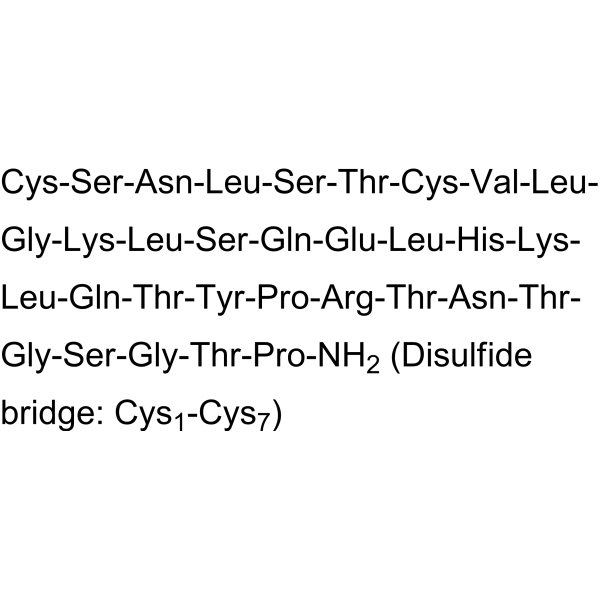
HY-P0090
Calcitonin (salmon)CGRP Receptor Agonist -

HY-P1071
α-CGRP (human)Vasodilator -

HY-P1548
β-CGRP, humanCalcitonin Peptide -

HY-P1471
Adrenomedullin (AM) (22-52), humanAdrenomedullin Receptor Antagonist -

HY-P1464
Amylin, amide, ratAMY1/AMY3 Ligand -
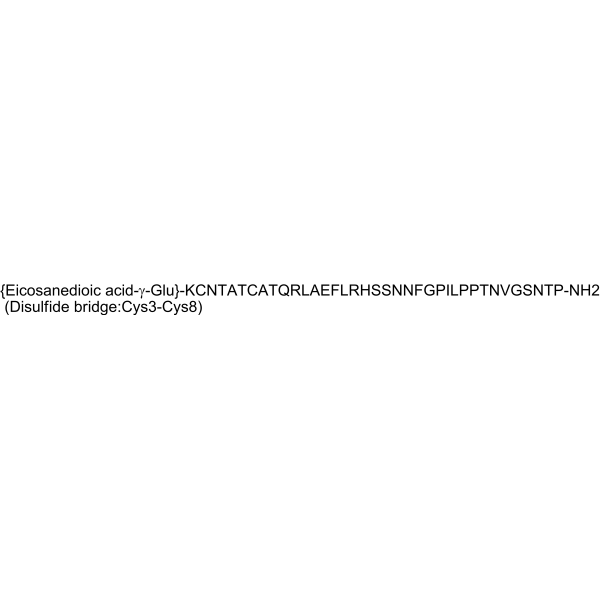
HY-P3462
CagrilintideAMYR/CTR agonist -
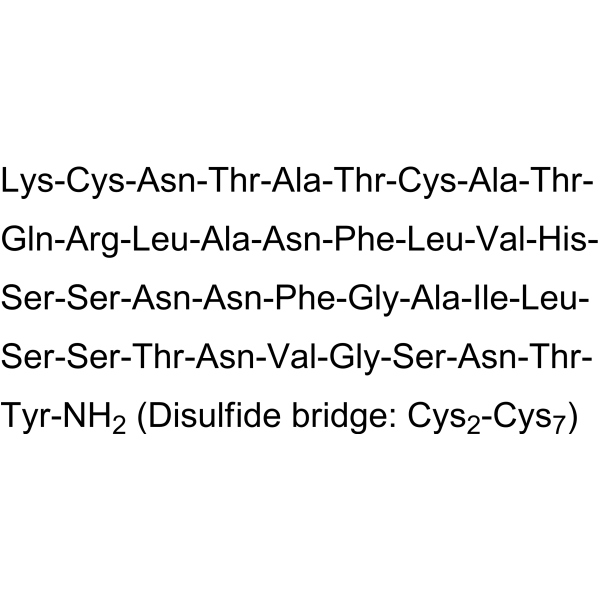
HY-P1070
Amylin, amide, humanGlucoregulatory Hormone -
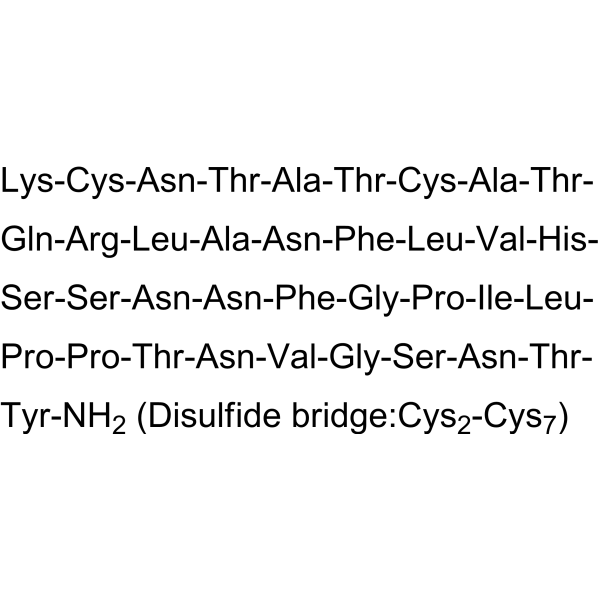
HY-P0058
PramlintideAnti-diabetic Agent -

HY-P0276
GIP, humanInsulin Secretion Stimulator -

HY-P10798
EloralintideAmylin Receptor Agonist -
HY-P3462A
Cagrilintide acetateAMYR/CTR Agonist -

HY-P1782
Calcitonin (8-32), salmonAmylin Receptor Antagonist


Biologische Aktivität
Beschreibung
In Vitro
Calcitonin shows a potent inhibitory action on osteoclast mediated bone resorption[1].
MedChemExpress (MCE) has not independently confirmed the accuracy of these methods. They are for reference only. Further protocols information, click here.
In Vivo
MedChemExpress (MCE) has not independently confirmed the accuracy of these methods. They are for reference only.
-
Animal Model:Female Sprague-Dawley rats[3]
-
Dosage:2 mg/kg
-
Administration:Oral gavage; 2 mg/kg; once daily; 9 weeks
-
Result:Suppressed ovariectomy-induced cartilage degradation (P<0.001) compared with the carrier control.
Prevented cartilage erosion compared with treatment with the carrier alone (P<0.01), and the extent of erosions was comparable with that in sham-operated animals.


Chemical Information
-
CAS. Nr. 21215-62-3
-
Appearance Solid
-
Molecular Weight 3417.87
-
Formel C151H226N40O45S3
-
Color White to off-white
-
Sequence
Cys-Gly-Asn-Leu-Ser-Thr-Cys-Met-Leu-Gly-Thr-Tyr-Thr-Gln-Asp-Phe-Asn-Lys-Phe-His-Thr-Phe-Pro-Gln-Thr-Ala-Ile-Gly-Val-Gly-Ala-Pro-NH2 (Disulfide bridge:Cys1-Cys7)
-
Sequence Shortening
CGNLSTCMLGTYTQDFNKFHTFPQTAIGVGAP-NH2 (Disulfide bridge:Cys1-Cys7)
-
Versand
Room temperature in continental US; may vary elsewhere.
-
Speicherung
Sealed storage, away from moisture
Powder -80°C 2 years -20°C 1 year * In solvent : -80°C, 6 months; -20°C, 1 month (sealed storage, away from moisture)


Lösungsmittel & Löslichkeit
In Vitro:
DMSO : ≥ 50 mg/mL (14.63 mM; Hygroscopic DMSO has a significant impact on the solubility of product, please use newly opened DMSO)
H2O : 1.98 mg/mL (0.58 mM; ultrasonic and adjust pH to 3 with 1 M HCl)
* "≥" means soluble, but saturation unknown.
Please refer to the solubility information to select the appropriate solvent. Once prepared, please aliquot and store the solution to prevent product inactivation from repeated freeze-thaw cycles.
Storage method and period of stock solution: -80°C, 6 months; -20°C, 1 month (sealed storage, away from moisture). When stored at -80°C, please use it within 6 months. When stored at -20°C, please use it within 1 month.
* Note: If you choose water as the stock solution, please dilute it to the working solution, then filter and sterilize it with a 0.22 μm filter before use.
Please refer to the solubility information to select the appropriate solvent. Once prepared, please aliquot and store the solution to prevent product inactivation from repeated freeze-thaw cycles.
Storage method and period of stock solution: -80°C, 6 months; -20°C, 1 month (sealed storage, away from moisture). When stored at -80°C, please use it within 6 months. When stored at -20°C, please use it within 1 month.
* Note: If you choose water as the stock solution, please dilute it to the working solution, then filter and sterilize it with a 0.22 μm filter before use.
Konzentration (Stammlösung) × Volumen (Stammlösung) = Konzentration (Ziellösung) × Volumen (Ziellösung)

Protokoll
-
Research Protocol for Endocrine Diseases
Endocrine diseases often arise from disrupted hormone production, hormone signaling, or target-tissue responsiveness; for diabetes-focused endocrine disease models, insulin signaling regulates glucose uptake, hepatic glucose output, lipid metabolism, and β-cell compensation. Type 2 diabetes develops through interacting defects in insulin resistance, β-cell dysfunction, adipose inflammation, hepatic glucose overproduction, altered incretin signaling, and ectopic lipid metabolism. A major unresolved question is whether endocrine dysfunction is driven primarily by target-tissue insulin resistance, intrinsic β-cell failure, immune/inflammatory stress, or combined multi-organ failure that differs by disease stage.
-
Osteoclast differentiation from monocyte/macrophage precursors
Osteoclast differentiation is an in vitro induction assay in which monocyte/macrophage-lineage precursors are exposed to macrophage colony-stimulating factor (M-CSF) and receptor activator of NF-κB ligand (RANKL), generating multinucleated osteoclasts that are commonly identified by tartrate-resistant acid phosphatase (TRAP) staining and functionally confirmed by resorption pits on dentin, bone, or mineralized substrates. M-CSF supports survival and expansion of osteoclast precursors, while RANKL binding to RANK drives osteoclast commitment, fusion, maturation, and resorptive function; osteoprotegerin inhibits this pathway by binding RANKL and preventing RANK activation. The main readouts are the number of TRAP-positive multinucleated cells, formation of F-actin rings, and resorbed surface area; TRAP-positive multinucleated cells indicate osteoclast differentiation, whereas pit formation on dentin, bone, or mineralized coating indicates functional bone-resorbing activity.


Reinheit & Dokumentation
-
Data Sheet (287 KB)
-
SDS (254 KB)
- English - EN (254 KB)
- Français - FR (254 KB)
- Deutsch - DE (254 KB)
- Norwegian - NO (254 KB)
- Español - ES (254 KB)
- Swedish - SV (254 KB)
- Italian - IT (254 KB)
- Korean - KR (254 KB)
- Portuguese - PT (254 KB)
-
Handling Instructions (2659 KB)
Verweise
[1]. Sexton PM, et al. Calcitonin. Current Medicinal Chemistry, 01 Nov 1999, 6(11):1067-1093. [Content Brief]
[2]. Foster GV. Calcitonin. A review of experimental and clinical investigations. Postgrad Med J. 1968 May;44(511):411-22. [Content Brief]
[3]. Bodil-Cecilie Sondergaard, et al. The effect of oral calcitonin on cartilage turnover and surface erosion in an ovariectomized rat model. Arthritis Rheum. 2007 Aug;56(8):2674-8. [Content Brief]


Complete Stock Solution Preparation Table
Please refer to the solubility information to select the appropriate solvent. Once prepared, please aliquot and store the solution to prevent product inactivation from repeated freeze-thaw cycles.
Storage method and period of stock solution: -80°C, 6 months; -20°C, 1 month (sealed storage, away from moisture). When stored at -80°C, please use it within 6 months. When stored at -20°C, please use it within 1 month.
| Optional Solvent | Concentration Solvent Mass | 1 mg | 5 mg | 10 mg | 25 mg |
|---|---|---|---|---|---|
| DMSO | 1 mM | 0.2926 mL | 1.4629 mL | 2.9258 mL | 7.3145 mL |
| 5 mM | 0.0585 mL | 0.2926 mL | 0.5852 mL | 1.4629 mL | |
| 10 mM | 0.0293 mL | 0.1463 mL | 0.2926 mL | 0.7314 mL |
* Note: If you choose water as the stock solution, please dilute it to the working solution, then filter and sterilize it with a 0.22 μm filter before use.


Calcitonin (human) Related Classifications
HY-P2273 Related Classifications
 Powered by Bioz