



Diaziquone

Based on 1 Customer Validation
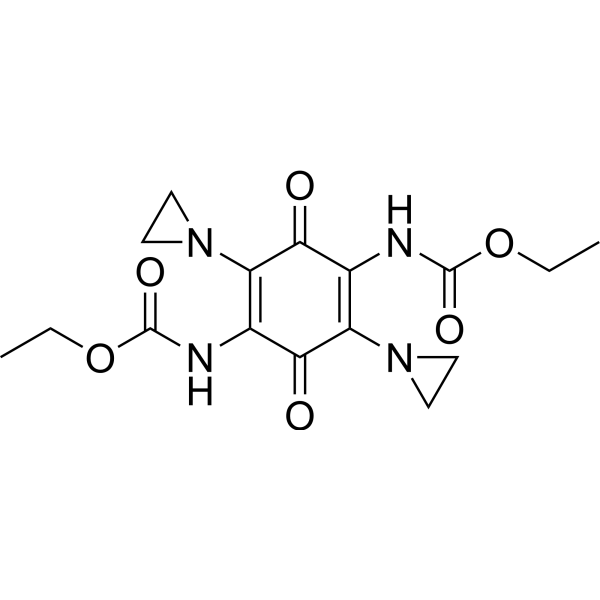
Diaziquone (NSC 182986), an aziridinylbenzoquinone, is a DNA alkylating agent. Diaziquone shows a broad antitumor activity against numerous transplantable murine tumors including curative activity against several intracerebrally implanted tumors. Diaziquone crosses the blood brain barrier.
Nur für Forschungszwecke. Wir verkaufen nicht an Patienten.
- Reinheit : 98.46%
- CAS. Nr.: 57998-68-2
- Formel: C16H20N4O6
- Molecular Weight:364.35
-
Speicherung:Powder -20°C, 3 years ; In solvent -80°C, 6 months , -20°C, 1 month

To place orders, for customer services and technical support, please contact: MedChemExpress USA
Tel: 609-228-6898 E-mail: [email protected] [email protected]


-
 Biologische Aktivität
-
Chemical Information
-
Lösungsmittel & Löslichkeit
- Protokoll
- Reinheit & Dokumentation
- Verweise
-
 Help & FAQs




Biologische Aktivität
Beschreibung
Cellular Effect
|
Cell Line

|
Type | Value | Description | References |
|---|---|---|---|---|
| BJ | EC50 |
<10 μM
Compound: diaziquone
|
Cytotoxicity against human BJ cells assessed as viable cells after 72 hrs by calcein AM assay
Cytotoxicity against human BJ cells assessed as viable cells after 72 hrs by calcein AM assay
|
[PMID: 20192247] |
| CCRF-CEM | EC50 |
0.86 μM
Compound: diaziquone
|
Cytotoxicity against human CEM cells assessed as viable cells after 72 hrs by calcein AM assay
Cytotoxicity against human CEM cells assessed as viable cells after 72 hrs by calcein AM assay
|
[PMID: 20192247] |
| EMT6 | IC50 |
5 μM
Compound: AZQ
|
Tested for 50% inhibition against EMT-6 murine mammary carcinoma cell under normal oxygenated condition
Tested for 50% inhibition against EMT-6 murine mammary carcinoma cell under normal oxygenated condition
|
[PMID: 8515418] |
| EMT6 | IC50 |
7.5 μM
Compound: AZQ
|
Tested for 50% inhibition against EMT-6 murine mammary carcinoma cell under hypoxia condition
Tested for 50% inhibition against EMT-6 murine mammary carcinoma cell under hypoxia condition
|
[PMID: 8515418] |
| HeLa | EC50 |
6.4 μM
Compound: diaziquone
|
Cytotoxicity against human HeLa cells assessed as viable cells after 72 hrs by calcein AM assay
Cytotoxicity against human HeLa cells assessed as viable cells after 72 hrs by calcein AM assay
|
[PMID: 20192247] |
| K562 | IC50 |
63 nM
Compound: 13
|
In vitro cytotoxicity tested against human chronic leukemia K562 cells
In vitro cytotoxicity tested against human chronic leukemia K562 cells
|
[PMID: 9022802] |
| MCF7 | EC50 |
4 μM
Compound: diaziquone
|
Cytotoxicity against human MCF7 cells assessed as viable cells after 72 hrs by calcein AM assay
Cytotoxicity against human MCF7 cells assessed as viable cells after 72 hrs by calcein AM assay
|
[PMID: 20192247] |
| RPMI-8226 | EC50 |
3.4 μM
Compound: diaziquone
|
Cytotoxicity against human RPMI8226 cells assessed as viable cells after 72 hrs by calcein AM assay
Cytotoxicity against human RPMI8226 cells assessed as viable cells after 72 hrs by calcein AM assay
|
[PMID: 20192247] |
| U-266 | EC50 |
2.8 μM
Compound: diaziquone
|
Cytotoxicity against human U266 cells assessed as viable cells after 72 hrs by calcein AM assay
Cytotoxicity against human U266 cells assessed as viable cells after 72 hrs by calcein AM assay
|
[PMID: 20192247] |
In Vitro
Diaziquone is a potent marrow suppressive agent inducing significant degrees of leukopenia, granulocytopenia, and thrombocytopenia[2].
MedChemExpress (MCE) has not independently confirmed the accuracy of these methods. They are for reference only. Further protocols information, click here.
In Vivo
MedChemExpress (MCE) has not independently confirmed the accuracy of these methods. They are for reference only.
-
Animal Model:Homozygous nu/nu BALB/c athymic mice[1]
-
Dosage:6.75 mg /sq m or 26 mg/sq m
-
Administration:6.75 mg /sq m daily for 5 consecutive days or single-dose 26 mg/sq m
-
Result:Showed rapid clearance in the plasma of athymic mice with a half-life of approximately 11.5 min.
Produced significant growth delays.
Produced significant increases in the median growth delay, significant increases in the number of tumor regressions.


Chemical Information
-
CAS. Nr. 57998-68-2
-
Appearance Solid
-
Molecular Weight 364.35
-
Formel C16H20N4O6
-
Color Light yellow to brown
-
SMILES
O=C(C(N1CC1)=C(C2=O)NC(OCC)=O)C(NC(OCC)=O)=C2N3CC3
-
Synonyms
NSC 182986
-
Versand
Room temperature in continental US; may vary elsewhere.
-
Speicherung
Powder -20°C 3 years In solvent -80°C 6 months -20°C 1 month


Lösungsmittel & Löslichkeit
In Vitro:
DMSO : 125 mg/mL (343.08 mM; Need ultrasonic; Hygroscopic DMSO has a significant impact on the solubility of product, please use newly opened DMSO)
Please refer to the solubility information to select the appropriate solvent. Once prepared, please aliquot and store the solution to prevent product inactivation from repeated freeze-thaw cycles.
Storage method and period of stock solution: -80°C, 6 months; -20°C, 1 month. When stored at -80°C, please use it within 6 months. When stored at -20°C, please use it within 1 month.
Please refer to the solubility information to select the appropriate solvent. Once prepared, please aliquot and store the solution to prevent product inactivation from repeated freeze-thaw cycles.
Storage method and period of stock solution: -80°C, 6 months; -20°C, 1 month. When stored at -80°C, please use it within 6 months. When stored at -20°C, please use it within 1 month.
Konzentration (Stammlösung) × Volumen (Stammlösung) = Konzentration (Ziellösung) × Volumen (Ziellösung)

Protokoll
-
Subcutaneous Cell-Line-Derived Xenograft
Subcutaneous cell-line-derived xenograft (CDX) models are established by implanting cultured human cancer cell lines into immunodeficient mice, where the injected cells form localized tumors that can be monitored in vivo as a measure of tumorigenic potential, growth kinetics, and treatment response. These models are widely used in oncology research because they allow reproducible tumor formation and enable comparative assessment of tumor growth between different cell lines or genetic manipulations in a controlled in vivo microenvironment. Subcutaneous implantation of cancer cells in immunodeficient mice is a standard approach for evaluating tumor growth behavior and therapeutic response across multiple cancer types, including prostate, esophageal, pancreatic, and colon cancer models.


Reinheit & Dokumentation
-
Data Sheet (272 KB)
-
SDS (251 KB)
- English - EN (251 KB)
- Français - FR (251 KB)
- Deutsch - DE (251 KB)
- Norwegian - NO (251 KB)
- Español - ES (251 KB)
- Swedish - SV (251 KB)
- Italian - IT (251 KB)
- Korean - KR (251 KB)
- Portuguese - PT (251 KB)
-
Handling Instructions (2659 KB)
Verweise


Complete Stock Solution Preparation Table
Please refer to the solubility information to select the appropriate solvent. Once prepared, please aliquot and store the solution to prevent product inactivation from repeated freeze-thaw cycles.
Storage method and period of stock solution: -80°C, 6 months; -20°C, 1 month. When stored at -80°C, please use it within 6 months. When stored at -20°C, please use it within 1 month.
| Optional Solvent | Concentration Solvent Mass | 1 mg | 5 mg | 10 mg | 25 mg |
|---|---|---|---|---|---|
| DMSO | 1 mM | 2.7446 mL | 13.7231 mL | 27.4461 mL | 68.6153 mL |
| 5 mM | 0.5489 mL | 2.7446 mL | 5.4892 mL | 13.7231 mL | |
| 10 mM | 0.2745 mL | 1.3723 mL | 2.7446 mL | 6.8615 mL | |
| 15 mM | 0.1830 mL | 0.9149 mL | 1.8297 mL | 4.5744 mL | |
| 20 mM | 0.1372 mL | 0.6862 mL | 1.3723 mL | 3.4308 mL | |
| 25 mM | 0.1098 mL | 0.5489 mL | 1.0978 mL | 2.7446 mL | |
| 30 mM | 0.0915 mL | 0.4574 mL | 0.9149 mL | 2.2872 mL | |
| 40 mM | 0.0686 mL | 0.3431 mL | 0.6862 mL | 1.7154 mL | |
| 50 mM | 0.0549 mL | 0.2745 mL | 0.5489 mL | 1.3723 mL | |
| 60 mM | 0.0457 mL | 0.2287 mL | 0.4574 mL | 1.1436 mL | |
| 80 mM | 0.0343 mL | 0.1715 mL | 0.3431 mL | 0.8577 mL | |
| 100 mM | 0.0274 mL | 0.1372 mL | 0.2745 mL | 0.6862 mL |


Diaziquone Related Classifications
HY-119969 Related Classifications
 Powered by Bioz