



EB-0150
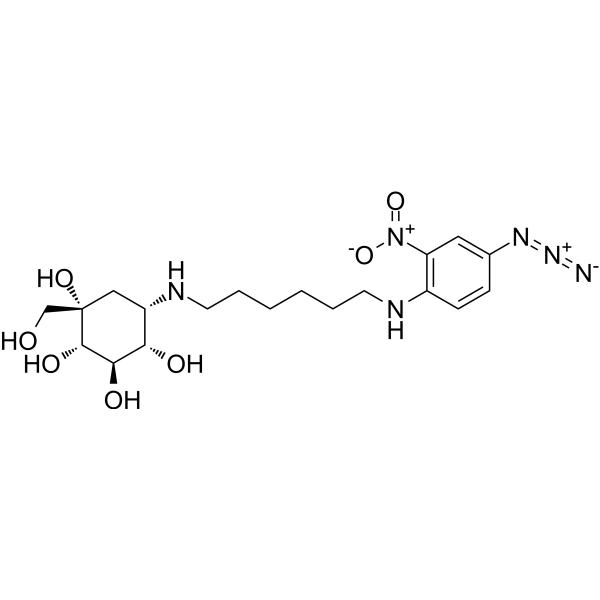
EB-0150 is a potent inhibitor of ER α-glucosidases (α-Glu) Iand II with IC50s of 0.73 and 0.0337 μM, respectively. EB-0150 is a N-substituted derivative of valiolamine with broad-spectrum antiviral. EB-0150 has the potential for the reseach of broad-spectrum agent against the existing and emerging viruses. EB-0150 is a click chemistry reagent, it contains an Azide group and can undergo copper-catalyzed azide-alkyne cycloaddition reaction (CuAAc) with molecules containing Alkyne groups. It can also undergo strain-promoted alkyne-azide cycloaddition (SPAAC) reactions with molecules containing DBCO or BCN groups.
Nos produits utilisent uniquement pour la recherche. Nous ne vendons pas aux patients.
- CAS No.: 2832824-40-3
- Formule: C19H30N6O7
- Masse moléculaire:454.48
-
Stockage:
Please store the product under the recommended conditions in the Certificate of Analysis.

To place orders, for customer services and technical support, please contact: MedChemExpress USA
Tel: 609-228-6898 E-mail: [email protected] [email protected]


-
 Activité biologique
-
Chemical Information
- Protocole
- Pureté et documentation
- Références
-
 Help & FAQs




Activité biologique
Description
Cellular Effect
|
Cell Line

|
Type | Value | Description | References |
|---|---|---|---|---|
| Vero | CC50 |
121.5 μM
Compound: EB-0150
|
Cytotoxicity against African green monkey Vero cells assessed as reduction in cell viability incubated for 3 to 5 days by Cell titer-glo luminescent assay
Cytotoxicity against African green monkey Vero cells assessed as reduction in cell viability incubated for 3 to 5 days by Cell titer-glo luminescent assay
|
[PMID: 34870992] |


Chemical Information
-
CAS No. 2832824-40-3
-
Masse moléculaire 454.48
-
Formule C19H30N6O7
-
SMILES
O[C@@H]1[C@](O)(C[C@@H]([C@@H]([C@H]1O)O)NCCCCCCNC2=C(C=C(C=C2)N=[N+]=[N-])[N+]([O-])=O)CO
-
Livraison
Room temperature in continental US; may vary elsewhere.
-
Stockage
Please store the product under the recommended conditions in the Certificate of Analysis.


Pureté et documentation
Références

Calculators
Concentration (start) × Volume (start) = Concentration (final) × Volume (final)


EB-0150 Related Classifications
HY-145273 Related Classifications
 Powered by Bioz