



ML218 hydrochloride
Based on 2 publication(s) in Google Scholar
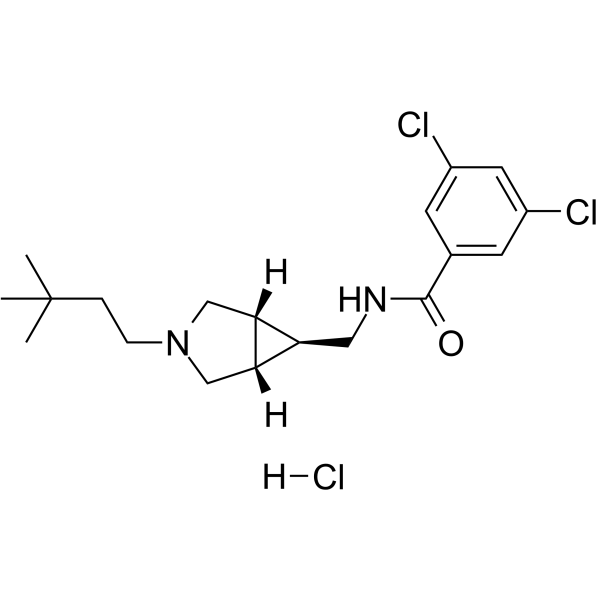
ML218 hydrochloride is a potent, selective and orally active T-type Ca2+ channels (Cav3.1, Cav3.2, Cav3.3) inhibitor with IC50s of 310 nM and 270 nM for Cav3.2 and Cav3.3, respectively. ML218 hydrochloride inhibits the burst activity in subthalamic nucleus (STN) neurons. ML218 hydrochloride has no significant inhibition of L- or N-type calcium channels, KATP or hERG potassium channels. ML218 hydrochloride can penetrate the blood-brain barrier.
Nos produits utilisent uniquement pour la recherche. Nous ne vendons pas aux patients.
- CAS No.: 2319922-08-0
- Formule: C19H27Cl3N2O
- Masse moléculaire:405.79
-
Stockage:
Please store the product under the recommended conditions in the Certificate of Analysis.

To place orders, for customer services and technical support, please contact: MedChemExpress USA
Tel: 609-228-6898 E-mail: [email protected] [email protected]


-
 Activité biologique
-
Chemical Information
- Pureté et documentation
- Références
-
 Help & FAQs


Publications Citing Use of MedChemExpress (MCE) ML218 hydrochloride
MoreVoir tous les produits spécifiques à Isoform Calcium Channel
More

Activité biologique
Description
IC50 & Target
IC50: 310 nM (Cav3.2), 270 nM (Cav3.3), and 150 nM (Ca2+ flux)[1]
In Vitro
In plasma protein binding studies (equilibrium dialysis), ML218 possesses good free fraction in both rat and human. Intrinsic clearance experiments in liver microsomes indicated that ML218 is highly cleared in rat (CLint = 115 mL/min/kg), but low to moderately cleared in human liver microsomes (CLint = 12.7 mL/min/kg)[1].
MedChemExpress (MCE) has not independently confirmed the accuracy of these methods. They are for reference only.
In Vivo
Free brain and plasma concentrations of ML218 increases in a dose proportional manner across the dose range (3 mg/kg: [plasma] = 98 nM, [brain] = 1.66 μM; 10 mg/kg: [plasma] = 282 nM, [brain] = 5.03 μM; 30 mg/kg: 1.2 μM, [brain] = 17.7 μM)[1].
Noncompartmental pharmacokinetic analysis indicates ML218 (1 mg/kg, IV) has a mean residence time (MRT) of nearly 7 h, a value which is consistent with its terminal half-life (t1/2 = 7 h)[1].
MedChemExpress (MCE) has not independently confirmed the accuracy of these methods. They are for reference only.
-
Animal Model:Male Sprague-Dawley rats (275-299 g) induced by haloperidol[1]
-
Dosage:0.03 mg/kg, 0.1 mg/kg, 0.3 mg/kg, 1 mg/kg, 3 mg/kg, 10 mg/kg, 30 mg/kg
-
Administration:Oral administration; once
-
Result:Reversed cataleptic behavior in rats induced by a 0.75 mg/kg dose of haloperidol.


Chemical Information
-
CAS No. 2319922-08-0
-
Masse moléculaire 405.79
-
Formule C19H27Cl3N2O
-
SMILES
O=C(NC[C@@H]1[C@@]2([H])CN(CCC(C)(C)C)C[C@@]12[H])C3=CC(Cl)=CC(Cl)=C3.[H]Cl
-
Livraison
Room temperature in continental US; may vary elsewhere.
-
Stockage
Please store the product under the recommended conditions in the Certificate of Analysis.


Publications (2)
-
Journal Impact Factor
-
Most Recent
-
Biomaterials
Electroactive membranes enhance in-situ alveolar ridge preservation via spatiotemporal electrical modulation of cell motility. [Abstract]2025 Jun:317:123077. PMID: 39756273 -
Mol Genet Genomics
CACNA1H restrains chemotherapy resistance in ovarian clear cell carcinoma cells by repressing autophagy. [Abstract]2024 Aug 6;299(1):77. PMID: 39105964


Pureté et documentation
Références

Calculators
Concentration (start) × Volume (start) = Concentration (final) × Volume (final)


ML218 hydrochloride Related Classifications
HY-103309A Related Classifications
 Powered by Bioz