



Relebactam (Standard)

Based on 1 Customer Validation
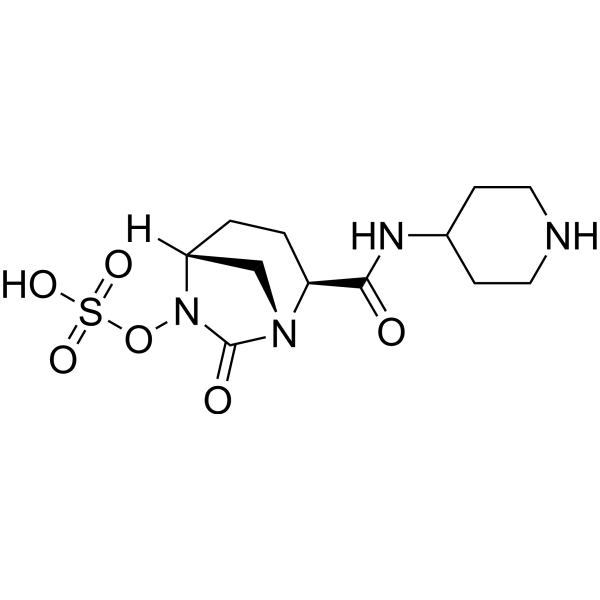
Relebactam (Standard) is the analytical standard of Relebactam. This product is intended for research and analytical applications. Relebactam is a diazabicyclooctane inhibitor with activity against a wide spectrum of β-lactamases, including class A (extended-spectrum β-lactamases and KPC) and class C (AmpC) enzymes. Relebactam shows antibacterial activity.
Nos produits utilisent uniquement pour la recherche. Nous ne vendons pas aux patients.
- Pureté : 99.51%
- CAS No.: 1174018-99-5
- Formule: C12H20N4O6S
- Masse moléculaire:348.38
-
Stockage:
Please store the product under the recommended conditions in the Certificate of Analysis.


To place orders, for customer services and technical support, please contact: MedChemExpress USA
Tel: 609-228-6898 E-mail: [email protected] [email protected]


-
 Product Information
-
Chemical Information
- Pureté et documentation
-
 Help & FAQs





Product Information
Information
Application
The compound is the grade of analytical standard, which is the reference standard supplied assay. It is commonly used in qualitative, quantitative and methodological research experiments in HPLC, GC and MS.


Chemical Information
-
CAS No. 1174018-99-5
-
Appearance Solid
-
Masse moléculaire 348.38
-
Formule C12H20N4O6S
-
Color White to off-white
-
SMILES
O=S(ON1[C@]2([H])CC[C@@H](C(NC3CCNCC3)=O)[N@@](C2)C1=O)(O)=O
-
Synonyms
MK-7655 (Standard)
-
Livraison
Room temperature in continental US; may vary elsewhere.
-
Stockage
Please store the product under the recommended conditions in the Certificate of Analysis.


Pureté et documentation
-
SDS (393 KB)
- English - EN (393 KB)
- Français - FR (393 KB)
- Deutsch - DE (393 KB)
- Norwegian - NO (393 KB)
- Español - ES (393 KB)
- Swedish - SV (393 KB)
- Italian - IT (393 KB)
- Korean - KR (393 KB)
- Portuguese - PT (393 KB)
-
Instruction de manipulation (2659 KB)
Références
[1]. Lapuebla A, et al. Activity of Imipenem with Relebactam against Gram-Negative Pathogens from New York City. Antimicrob Agents Chemother. 2015 Aug;59(8):5029-31. [Content Brief]
[2]. Bush K. A resurgence of β-lactamase inhibitor combinations effective against multidrug-resistant Gram-negative pathogens. Int J Antimicrob Agents. 2015 Nov;46(5):483-93. [Content Brief]

Calculators
Concentration (start) × Volume (start) = Concentration (final) × Volume (final)


Relebactam (Standard) Related Classifications
HY-16752R Related Classifications
 Powered by Bioz