



Chlorpyrifos-oxon
Based on 2 publication(s) in Google Scholar
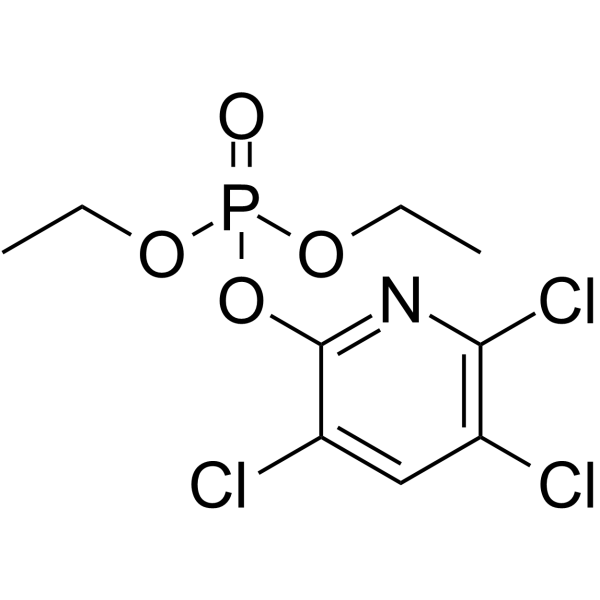
Chlorpyrifos-oxon, an active metabolite of Chlorpyrifos, is a potent phosphorylating agent that potently inhibits AChE. Chlorpyrifos-oxon can induce cross-linking between subunits of tubulin and disrupt microtubule function.
For research use only. We do not sell to patients.
- Purity : 99.39%
- CAS No.: 5598-15-2
- Formula: C9H11Cl3NO4P
- Molecular Weight:334.52
-
Storage:Pure form -20°C, 3 years , 4°C, 2 years ; In solvent -80°C, 6 months , -20°C, 1 month

To place orders, for customer services and technical support, please contact: MedChemExpress USA
Tel: 609-228-6898 E-mail: [email protected] [email protected]


-
 Biological Activity
-
Chemical Information
-
Solvent & Solubility
- Purity & Documentation
- References
-
 Help & FAQs



Publications Citing Use of MedChemExpress (MCE) Chlorpyrifos-oxon
More

Biological Activity
Description
Cellular Effect
|
Cell Line

|
Type | Value | Description | References |
|---|---|---|---|---|
| HEK293 | IC50 |
0.003 μM
Compound: OP7
|
Displacement of [3H]CP-55940 from mouse CB1 receptor expressed in HEK293 cells
Displacement of [3H]CP-55940 from mouse CB1 receptor expressed in HEK293 cells
|
[PMID: 18752948] |
| HEK293 | IC50 |
25 μM
Compound: OP7
|
Displacement of [3H]CP-55940 from mouse CB1 receptor expressed in HEK293 cells in presence of mouse brain membrane
Displacement of [3H]CP-55940 from mouse CB1 receptor expressed in HEK293 cells in presence of mouse brain membrane
|
[PMID: 18752948] |
In Vitro
Treatment of tubulin with 1.5 mM Chlorpyrifos-oxon (CPO) leads to protein aggregation. However, even at 1.5 μM Chlorpyrifos-oxon cross-linked trimers are apparent. Chlorpyrifos-oxon promotes isopeptide bond cross-linking of tubulin monomers to make multimers[2].
In PC12 cells in culture, 24 hours of exposure to Chlorpyrifos at a concentration 10-fold below the concentration that inhibits AChE activity (3.0 μM) impaired neurite outgrowth while Chlorpyrifos-oxon inhibits neurite outgrowth at 1.0 nM[3].
MedChemExpress (MCE) has not independently confirmed the accuracy of these methods. They are for reference only. .
In Vivo
Chlorpyrifos-oxon (3 mg/kg, ip; once; wild-type mice) treatment shows the dimensions of microtubules from Chlorpyrifos-oxon-treated mice are about 60% of those from control mice. The microtubules from mice exposed to Chlorpyrifos-oxon have covalently modified amino acids and abnormal structure, suggesting disruption of microtubule function[4].
MedChemExpress (MCE) has not independently confirmed the accuracy of these methods. They are for reference only.


Chemical Information
-
CAS No. 5598-15-2
-
Appearance <43°C Solid,>43°C Liquid
-
Molecular Weight 334.52
-
Formula C9H11Cl3NO4P
-
Color White to off-white
-
SMILES
O=P(OCC)(OC1=NC(Cl)=C(Cl)C=C1Cl)OCC
-
Shipping
Room temperature in continental US; may vary elsewhere.
-
Storage
Pure form -20°C 3 years 4°C 2 years In solvent -80°C 6 months -20°C 1 month


Publications (2)
-
Journal Impact Factor
-
Most Recent
-
Anal Chem
Exposome-Scale Investigation of Cl-/Br-Containing Chemicals Using High-Resolution Mass Spectrometry, Multistage Machine Learning, and Cloud Computing. [Abstract]2025 Jun 3;97(21):11099-11109. PMID: 40401576 -
Chem Biol Interact
Chlorpyrifos-oxon results in autophagic flux dysfunction contributing to neuronal apoptosis via a ROS/AMPK/CHOP activation pathway. [Abstract]2025 May 1:412:111452. PMID: 40049439


Solvent & Solubility
In Vitro:
DMSO : 100 mg/mL (298.94 mM; Need ultrasonic; Hygroscopic DMSO has a significant impact on the solubility of product, please use newly opened DMSO)
Please refer to the solubility information to select the appropriate solvent. Once prepared, please aliquot and store the solution to prevent product inactivation from repeated freeze-thaw cycles.
Storage method and period of stock solution: -80°C, 6 months; -20°C, 1 month. When stored at -80°C, please use it within 6 months. When stored at -20°C, please use it within 1 month.
Please refer to the solubility information to select the appropriate solvent. Once prepared, please aliquot and store the solution to prevent product inactivation from repeated freeze-thaw cycles.
Storage method and period of stock solution: -80°C, 6 months; -20°C, 1 month. When stored at -80°C, please use it within 6 months. When stored at -20°C, please use it within 1 month.
Concentration (start) × Volume (start) = Concentration (final) × Volume (final)
In Vivo:
Select the appropriate dissolution method based on your experimental animal and administration route.
- For the following dissolution methods, please ensure to first prepare a clear stock solution using an In Vitro approach and then sequentially add co-solvents:
- To ensure reliable experimental results, the clarified stock solution can be appropriately stored based on storage conditions. As for the working solution for In Vivo experiments, it is recommended to prepare freshly and use it on the same day.
- The percentages shown for the solvents indicate their volumetric ratio in the final prepared solution. If precipitation or phase separation occurs during preparation, heat and/or sonication can be used to aid dissolution.
Add each solvent one by one: 10% DMSO 40% PEG300 5% Tween-80 45% Saline
Solubility: ≥ 2.5 mg/mL (7.47 mM); Clear solution
This protocol yields a clear solution of ≥ 2.5 mg/mL (saturation unknown).
Taking 1 mL working solution as an example, add 100 μL DMSO stock solution (25.0 mg/mL) to 400 μL PEG300, and mix evenly; then add 50 μL Tween-80 and mix evenly; then add 450 μL Saline to adjust the volume to 1 mL.
Preparation of Saline: Dissolve 0.9 g sodium chloride in ddH₂O and dilute to 100 mL to obtain a clear Saline solution.
Add each solvent one by one: 10% DMSO 90% (20% SBE-β-CD in Saline)
Solubility: ≥ 2.5 mg/mL (7.47 mM); Clear solution
This protocol yields a clear solution of ≥ 2.5 mg/mL (saturation unknown).
Taking 1 mL working solution as an example, add 100 μL DMSO stock solution (25.0 mg/mL) to 900 μL 20% SBE-β-CD in Saline, and mix evenly.
Preparation of 20% SBE-β-CD in Saline (4°C, storage for one week): 2 g SBE-β-CD powder is dissolved in 10 mL Saline, completely dissolve until clear.
In Vivo Dissolution Calculator
Please enter the basic information of animal experiments:
-
-
-
-
Recommended: Prepare an additional quantity of animals to account for potential losses during experiments.
Please enter your animal formula composition:
-
%DMSO +
Recommended: Keep the proportion of DMSO in working solution below 2% if your animal is weak.
-
%+
-
+%Tween-80 + +
-
%Saline +
The co-solvents required include: DMSO, . All of co-solvents are available by MedChemExpress (MCE). , Tween 80. All of co-solvents are available by MedChemExpress (MCE).
Working solution concentration: 0.22 mg/mL
Method for preparing stock solution: mg drug dissolved in μL DMSO. Stock solution concentration: mg/mL.
1. Take μL DMSO stock solution;
2. Add μL .
μL , mix evenly;
3. Then add μL Tween 80, mix evenly;
4. Then add μL
Please ensure that the stock solution in the first step is dissolved to a clear state, and add co-solvents in sequence. You can use ultrasonic heating (ultrasonic cleaner, recommended frequency 20-40 kHz), vortexing, etc. to assist dissolution.


Purity & Documentation
-
Data Sheet (278 KB)
-
SDS (480 KB)
- English - EN (480 KB)
- Français - FR (480 KB)
- Deutsch - DE (480 KB)
- Norwegian - NO (480 KB)
- Español - ES (480 KB)
- Swedish - SV (480 KB)
- Italian - IT (480 KB)
- Korean - KR (480 KB)
- Portuguese - PT (480 KB)
-
Handling Instructions (2659 KB)
References
[1]. Florian Eyer, et al. Extreme variability in the formation of chlorpyrifos oxon (CPO) in patients poisoned by chlorpyrifos (CPF). Biochem Pharmacol. 2009 Sep 1;78(5):531-7. [Content Brief]
[2]. Lawrence M Schopfer, et al. Chlorpyrifos oxon promotes tubulin aggregation via isopeptide cross-linking between diethoxyphospho-Lys and Glu or Asp: Implications for neurotoxicity. J Biol Chem. 2018 Aug 31;293(35):13566-13577. [Content Brief]
[3]. Jie Gao, et al. Chlorpyrifos and chlorpyrifos oxon impair the transport of membrane bound organelles in rat cortical axons. Neurotoxicology. 2017 Sep;62:111-123. [Content Brief]
[4]. Wei Jiang, et al. Mice treated with chlorpyrifos or chlorpyrifos oxon have organophosphorylated tubulin in the brain and disrupted microtubule structures, suggesting a role for tubulin in neurotoxicity associated with exposure to organophosphorus agents. [Content Brief]


Complete Stock Solution Preparation Table
Please refer to the solubility information to select the appropriate solvent. Once prepared, please aliquot and store the solution to prevent product inactivation from repeated freeze-thaw cycles.
Storage method and period of stock solution: -80°C, 6 months; -20°C, 1 month. When stored at -80°C, please use it within 6 months. When stored at -20°C, please use it within 1 month.
| Optional Solvent | Concentration Solvent Mass | 1 mg | 5 mg | 10 mg | 25 mg |
|---|---|---|---|---|---|
| DMSO | 1 mM | 2.9894 mL | 14.9468 mL | 29.8936 mL | 74.7339 mL |
| 5 mM | 0.5979 mL | 2.9894 mL | 5.9787 mL | 14.9468 mL | |
| 10 mM | 0.2989 mL | 1.4947 mL | 2.9894 mL | 7.4734 mL | |
| 15 mM | 0.1993 mL | 0.9965 mL | 1.9929 mL | 4.9823 mL | |
| 20 mM | 0.1495 mL | 0.7473 mL | 1.4947 mL | 3.7367 mL | |
| 25 mM | 0.1196 mL | 0.5979 mL | 1.1957 mL | 2.9894 mL | |
| 30 mM | 0.0996 mL | 0.4982 mL | 0.9965 mL | 2.4911 mL | |
| 40 mM | 0.0747 mL | 0.3737 mL | 0.7473 mL | 1.8683 mL | |
| 50 mM | 0.0598 mL | 0.2989 mL | 0.5979 mL | 1.4947 mL | |
| 60 mM | 0.0498 mL | 0.2491 mL | 0.4982 mL | 1.2456 mL | |
| 80 mM | 0.0374 mL | 0.1868 mL | 0.3737 mL | 0.9342 mL | |
| 100 mM | 0.0299 mL | 0.1495 mL | 0.2989 mL | 0.7473 mL |


Chlorpyrifos-oxon Related Classifications
HY-136610 Related Classifications
 Powered by Bioz