



VEGF164 Protein, Mouse
Based on 9 publication(s) in Google Scholar
VEGF164 Protein, Mouse is a potent mediator of angiogenesis and binds the semaphorin receptor, neuropilin1.
- Species: Mouse
- Source: E. coli
-
Storage:Stored at -20°C for 2 years from date of receipt. After reconstitution, it is stable at 4°C for 1 week or -20°C for longer (with carrier protein). It is recommended to freeze aliquots at -20°C or -80°C for extended storage.


To place orders, for customer services and technical support, please contact: MedChemExpress USA
Tel: 609-228-6898 E-mail: [email protected] [email protected]


-
 Biological Activity
-
Technical Parameters
-
Product Properties
- Documentation
- References
- Help & FAQs




Biological Activity
Description
VEGF164 Protein, Mouse is a potent mediator of angiogenesis and binds the semaphorin receptor, neuropilin1.
Background
VEGF164 was found to be significantly more potent at inducing inflammation. In vivo blockade of VEGF receptor (VEGFR)-1 significantly suppressed VEGF164-induced corneal inflammation. In vitro, VEGF164 more potently stimulated intracellular adhesion molecule (ICAM)-1 expression on endothelial cells, an effect that was mediated by VEGFR2. VEGF164 was also more potent at inducing the chemotaxis of monocytes, an effect that was mediated by VEGFR1. In an immortalized human leukocyte cell line, VEGF164 was found to induce tyrosine phosphorylation of VEGFR1 more efficiently[1]. VEGF164 is an important isoform in the pathogenesis of early diabetic retinopathy[2].
Verified Bioactivity
The ED50 is <5 ng/mL as measured by human umbilical vein endothelial cells(HUVEC), corresponding to a specific activity of >2.0 × 10⁵ units/mg.
MCE Validation Data
-
Purity - SDS-PAGE
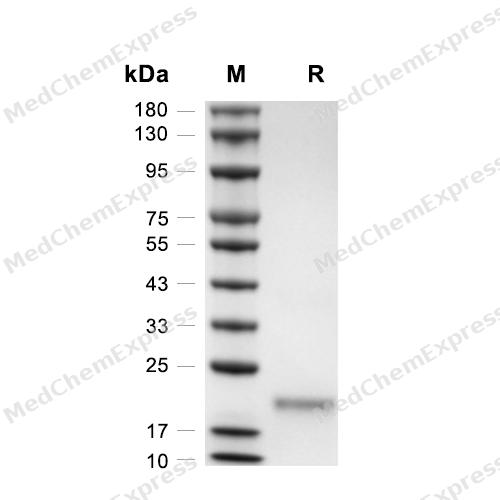
Purity - SDS-PAGE
-
Bioactivity - Cell-Based Assay
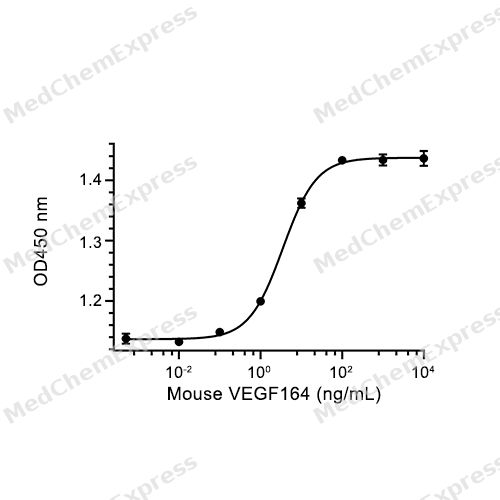
Bioactivity - Cell-Based Assay


Publications (9)
-
Journal Impact Factor
-
Most Recent
-
Adv Sci (Weinh)
Micro-Organ Chip Deciphers Tumor-Derived G-CSF as Remote Commander of Lung Pre-Metastatic Niche via VEGFA-KDR Cascade. [Abstract]2025 Nov 22:e18584. PMID: 41275332 -
Cell Death Dis
USP9X-mediated NRP1 deubiquitination promotes liver fibrosis by activating hepatic stellate cells. [Abstract]2023 Jan 19;14(1):40. PMID: 36653359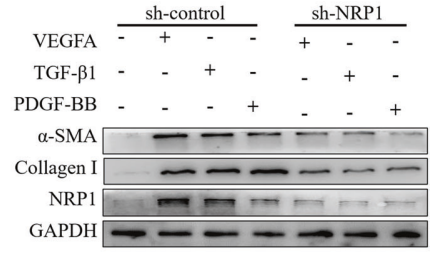
VEGF164 Protein, Mouse purchased from MedChemExpress. Usage Cited in: Cell Death Dis. 2023 Jan 19;14(1):40. [Abstract]
PDGF-BB (20 ng/mL, 72 h), TGF-β1 (5 ng/mL, 72 h), and VEGFA (5 ng/mL, 72 h) upregulated the protein expression of collagen I, α-SMA, and NRP1 in primary HSCs.
-
Diabetologia
MAP4K4 aggravates microvascular anomalies in diabetic retinopathy in a YTHDF2-dependent manner. [Abstract]2025 Jun;68(6):1335-1351. PMID: 40072537 -
Int J Biol Macromol
Multicargo-loaded inverse opal gelatin hydrogel microparticles for promoting bacteria-infected wound healing. [Abstract]2024 Mar;260(Pt 1):129557. PMID: 38242411 -
Cell Mol Gastroenterol Hepatol
Sorafenib Promotes Treg Cell Differentiation To Compromise Its Efficacy via VEGFR/AKT/Foxo1 Signaling in Hepatocellular Carcinoma. [Abstract]2025;19(5):101454. PMID: 39743020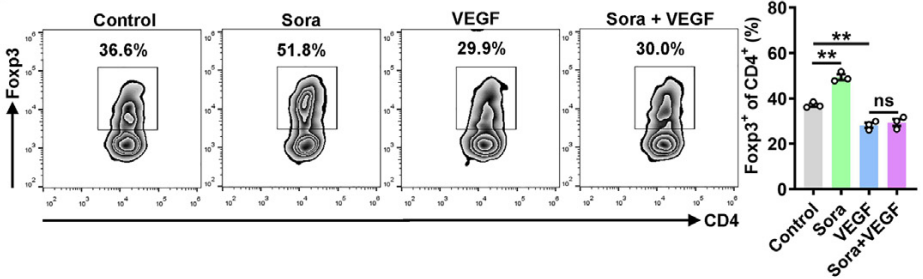
VEGF164 Protein, Mouse purchased from MedChemExpress. Usage Cited in: Cell Mol Gastroenterol Hepatol. 2025;19(5):101454. [Abstract]
FC analysis of Foxp3+CD4+ T cells in naive CD4+ T cells treated with 10 ng/mL VEGF164 Protein, Mouse (VEGF), or 4 μmol/L Sora under Treg-skewing conditions for 4 days (left) and the corresponding statistical analysis (right). The results showed that VEGF164 Protein, Mouse (VEGF), a VEGFR activator, abolished Sora-induced Treg cell differentiation.
-
Cell Mol Life Sci
Acetyl-CoA synthetase 2 alleviates brain injury following cardiac arrest by promoting autophagy in brain microvascular endothelial cells. [Abstract]2025 Apr 17;82(1):160. PMID: 40244361 -
-
-


Technical Parameters
-
Species Mouse
-
Source E. coli
-
Tag Tag Free
-
Accession
Q00731-2 (A27-R190)
-
Molecular Construction
-
N-term
-
VEGF164 (A27-R190)
Accession # Q00731-2 -
C-term
-
-
Protein Length
Full Length of Isoform-2
-
Synonyms
VEGFA; Vascular Endothelial Growth Factor A; VEGF; VPF; Vascular Permeability Factor; Vascular Endothelial Growth Factor A, Long Form; VEGF-A; L-VEGF; Vascular Endothelial Growth Factor A121; Vascular Endothelial Growth Factor A165; Vascular Endothelial G
-
AA Sequence
APTTEGEQKSHEVIKFMDVYQRSYCRPIETLVDIFQEYPDEIEYIFKPSCVPLMRCAGCCNDEALECVPTSESNITMQIMRIKPHQSQHIGEMSFLQHSRCECRPKKDRTKPENHCEPCSERRKHLFVQDPQTCKCSCKNTDSRCKARQLELNERTCRCDKPRR
-
Predicted Molecular Mass
19.6 kDa
-
Molecular Weight
Approximately 20 kDa, based on SDS-PAGE under reducing conditions.
-
Structure/Form
Homodimer
-
Purity
≥ 90%, as determined by reducing SDS-PAGE.


Product Properties
Lyophilized powder
1.Lyophilized from a 0.22 μm filtered solution of PBS, pH 7.4.
2.Lyophilized from a 0.22 μm filtered solution of 20 mM PB, 150 mM NaCl, pH 6.5, 8% trehalose.
Please refer to the lot-specific COA for specific buffer information.
<1 EU/μg, determined by LAL method.
It is not recommended to reconstitute to a concentration less than 100 μg/mL in ddH2O. For long term storage it is recommended to add a carrier protein (0.1% BSA, 5% HSA, 10% FBS or 5% Trehalose).
Stored at -20°C for 2 years from date of receipt. After reconstitution, it is stable at 4°C for 1 week or -20°C for longer (with carrier protein). It is recommended to freeze aliquots at -20°C or -80°C for extended storage.
Room temperature in continental US; may vary elsewhere.


Documentation
-
Data Sheet (262 KB)
-
SDS (252 KB)
- English - EN (252 KB)
- Français - FR (252 KB)
- Deutsch - DE (252 KB)
- Norwegian - NO (252 KB)
- Español - ES (252 KB)
- Swedish - SV (252 KB)
- Italian - IT (252 KB)
- Korean - KR (252 KB)
- Portuguese - PT (252 KB)
-
Handling Instructions (2659 KB)


References
[1]. Usui T, et al. VEGF164(165) as the pathological isoform: differential leukocyte and endothelial responses through VEGFR1 and VEGFR2. Invest Ophthalmol Vis Sci. 2004 Feb;45(2):368-74. [Content Brief]
[2]. Ishida S,et al. VEGF164 is proinflammatory in the diabetic retina. Invest Ophthalmol Vis Sci. 2003 May;44(5):2155-62. [Content Brief]

Calculators
Concentration (start) × Volume (start) = Concentration (final) × Volume (final)


 Powered by Bioz

