



GM-CSF Protein, Rhesus macaque
Based on 1 publication(s) in Google Scholar
GM-CSF Protein, Rhesus macaque functions as a cytokine and affects many cell types, especially macrophages and eosinophils.
- Species: Rhesus Macaque
- Source: E. coli
-
Storage:Stored at -20°C for 2 years from date of receipt. After reconstitution, it is stable at 4°C for 1 week or -20°C for longer (with carrier protein). It is recommended to freeze aliquots at -20°C or -80°C for extended storage.


To place orders, for customer services and technical support, please contact: MedChemExpress USA
Tel: 609-228-6898 E-mail: [email protected] [email protected]


-
 Biological Activity
-
Technical Parameters
-
Product Properties
- Documentation
- References
- Help & FAQs




Biological Activity
Description
GM-CSF Protein, Rhesus macaque functions as a cytokine and affects many cell types, especially macrophages and eosinophils.
Background
Granulocyte Macrophage Colony Stimulating Factor (GM-CSF) is a monomeric glycoprotein that functions as a cytokine —it is a white blood cell growth factor[1]. GM-CSF stimulates stem cells to produce granulocytes (neutrophils, eosinophils, and basophils) and monocytes. Monocytes exit the circulation and migrate into tissue, whereupon they mature into macrophages and dendritic cells. GM-CSF also has some effects on mature cells of the immune system. These include, for example, inhibiting neutrophil migration and causing an alteration of the receptors expressed on the cells surface[2]. GM-CSF also plays a role in embryonic development by functioning as an embryokine produced by reproductive tract[3].
Verified Bioactivity
The ED50 is <0.1 ng/mL as measured by human TF-1 cells, corresponding to a specific activity of >1.0 × 10⁷ units/mg.
MCE Validation Data
-
Purity - SDS-PAGE
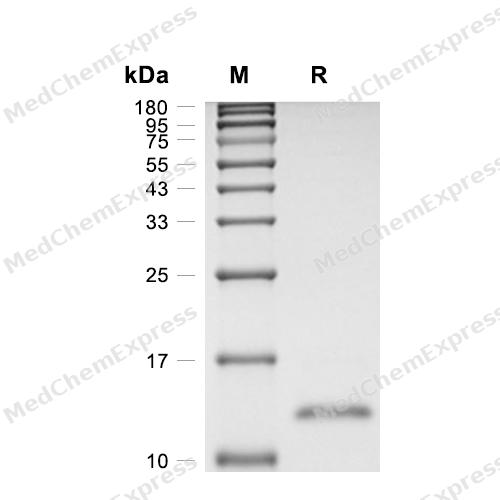
Purity - SDS-PAGE
-
Bioactivity - Cell-Based Assay
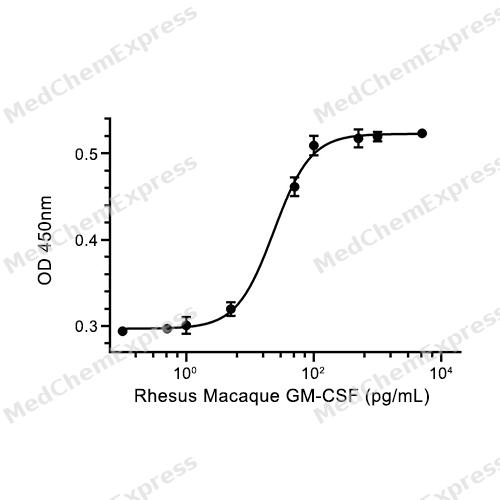
Bioactivity - Cell-Based Assay


Publications (1)
-
Journal Impact Factor
-
Most Recent
-
Nature
2026 May;653(8116):1205-1215. PMID: 41951742


Technical Parameters
-
Species Rhesus Macaque
-
Source E. coli
-
Tag Tag Free
-
Accession
Q9GL44 (A18-E144)
-
Molecular Construction
-
N-term
-
GM-CSF (A18-E144)
Accession # Q9GL44 -
C-term
-
-
Protein Length
Full Length of Mature Protein
-
Synonyms
CSF2; Molgramostim; Colony Stimulating Factor 2; Molgramostin; GMCSF; CSF; Sargramostim; Granulocyte-Macrophage Colony Stimulating Factor; GM-CSF; Granulocyte Macrophage-Colony Stimulating Factor; Colony Stimulating Factor 2 (Granulocyte-Macrophage); Colo
-
AA Sequence
APARSPSPGTQPWEHVNAIQEARRLLNLSRDTAAEMNKTVEVVSEMFDLQEPSCLQTRLELYKQGLQGSLTKLKGPLTMMASHYKQHCPPTPETSCATQIITFQSFKENLKDFLLVIPFDCWEPVQE
-
Predicted Molecular Mass
14.4 kDa
-
Molecular Weight
Approximately 14 kDa, based on SDS-PAGE under reducing conditions.
-
Purity
≥ 95%, as determined by reducing SDS-PAGE.


Product Properties
Lyophilized powder
1.Lyophilized from a 0.22 μm filtered solution of PBS, pH 7.4.
2.Lyophilized from a 0.22 μm filtered solution of 50 mM Tris-HCl, 300 mM NaCl, pH 8.0.
3.Lyophilized from a 0.22 μm filtered solution of PBS, pH 7.4, 8% trehalose.
Please refer to the lot-specific COA for specific buffer information.
Note: For SPR assay, please replace the buffer. Primary amine components (e.g., Tris, imidazole) can affect protein-coupled chips.
<1 EU/μg, determined by LAL method.
It is not recommended to reconstitute to a concentration less than 100 μg/mL in ddH2O. For long term storage it is recommended to add a carrier protein (0.1% BSA, 5% HSA, 10% FBS or 5% Trehalose).
Stored at -20°C for 2 years from date of receipt. After reconstitution, it is stable at 4°C for 1 week or -20°C for longer (with carrier protein). It is recommended to freeze aliquots at -20°C or -80°C for extended storage.
Room temperature in continental US; may vary elsewhere.


Documentation
-
Data Sheet (262 KB)
-
SDS (252 KB)
- English - EN (252 KB)
- Français - FR (252 KB)
- Deutsch - DE (252 KB)
- Norwegian - NO (252 KB)
- Español - ES (252 KB)
- Swedish - SV (252 KB)
- Italian - IT (252 KB)
- Korean - KR (252 KB)
- Portuguese - PT (252 KB)
-
Handling Instructions (2659 KB)


References
[1]. Francisco-Cruz A, et al. Granulocyte-macrophage colony-stimulating factor: not just another haematopoietic growth factor. Med Oncol. 2014 Jan;31(1):774. [Content Brief]
[2]. Gasson JC, et al. Molecular physiology of granulocyte-macrophage colony-stimulating factor. Blood. 1991 Mar 15;77(6):1131-45. [Content Brief]
[3]. Hansen PJ, et al. Programming of the preimplantation embryo by the embryokine colony stimulating factor 2. Anim Reprod Sci. 2014 Sep;149(1-2):59-66. [Content Brief]

Calculators
Concentration (start) × Volume (start) = Concentration (final) × Volume (final)


 Powered by Bioz

