



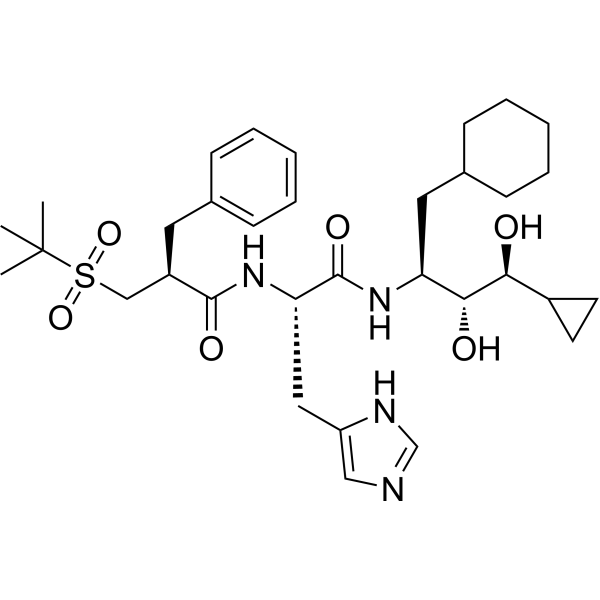
Remikiren
Remikiren (Ro 42-5892) is an orally active and highly specific renin inhibitor. Remikiren specifically inhibits human reninand human plasma renin with IC50 values of 0.7 and 0.8 nM, respectively. Remikiren also reduces mean arterial blood pressure in sodium-depleted marmosets and squirrel monkeys. Remikiren can be used in study of hypertension.
For research use only. We do not sell to patients.
- CAS No.: 126222-34-2
- Formula: C33H50N4O6S
- Molecular Weight:630.84
-
Storage:
Please store the product under the recommended conditions in the Certificate of Analysis.

To place orders, for customer services and technical support, please contact: MedChemExpress USA
Tel: 609-228-6898 E-mail: [email protected] [email protected]


-
 Biological Activity
-
Chemical Information
- Protocols
- Purity & Documentation
- References
-
 Help & FAQs




Biological Activity
Description
IC50 & Target
IC50:0.7 nM (human pure renin), 0.8 nM (plasma renin of human)[1].
In Vitro
Remikiren (0-10 nM; 1-3 h) displays a considerable specificity to inhibit renin[1].
MedChemExpress (MCE) has not independently confirmed the accuracy of these methods. They are for reference only. Further protocols information, click here.
-
Cell Line:Human pure renin, plasma renin of human, marmoset, squirrel monkey
-
Concentration:0-10 nM
-
Incubation Time:1-3 h
-
Result:Inhibited human pure renin and plasma renin of human, marmoset, squirrel monkey with IC50 values of 0.7, 0.8, 1.0 and 1.7 nM, respectively.
In Vivo
Remikiren (3 mg/kg; p.o.; single) shows the duration of blood pressure decrease more than 24 h in sodium-depleted marmosets[1].
MedChemExpress (MCE) has not independently confirmed the accuracy of these methods. They are for reference only.
-
Animal Model:Marmosets and squirrel monkeys (sodium-depleted)[1].
-
Dosage:0.1, 0.3, 1, 3, 10 mg/kg
-
Administration:Oral administration; single.
-
Result:Decreased mean arterial pressure (MAP) by 20-25 mm Hg when at 0.1 mg/kg.
Reached the maximal decrease (30 mm Hg) of MAP with 1 mg/kg in marmosets.
Decreasesd 35 mm Hg blood pressure with 3-10 mg/kg in squirrel monkeys.
-
Animal Model:Marmosets (sodium-depleted)[1].
-
Dosage:3 mg/kg
-
Administration:Oral administration; single.
-
Result:Showed MAP fell by 30 mm Hg, which lasting more than 24 h.


Chemical Information
-
CAS No. 126222-34-2
-
Molecular Weight 630.84
-
Formula C33H50N4O6S
-
SMILES
CC(C)(C)S(C[C@@H](CC1=CC=CC=C1)C(N[C@@H](CC2=CN=CN2)C(N[C@H]([C@@H](O)[C@H](C3CC3)O)CC4CCCCC4)=O)=O)(=O)=O
-
Synonyms
Ro 42-5892; Ro 42-5892/001
-
Shipping
Room temperature in continental US; may vary elsewhere.
-
Storage
Please store the product under the recommended conditions in the Certificate of Analysis.

Protocols
-
Cell Cytotoxicity Assay
Cytotoxicity assays are usually based on the assessment of cell membrane damage, which can also be indirectly detected by measuring cell viability. Detection methods include MTT assay, CKK-8 assay, LDH assay and ATP assay, etc.
-
Research Protocol for Cardiovascular Diseases
Cardiovascular disease can be modeled as maladaptive cardiac remodeling, where ischemic injury or pressure overload activates inflammatory signaling, fibroblast activation, extracellular-matrix deposition, cardiomyocyte hypertrophy, vascular remodeling, and progressive ventricular dysfunction. The TGF-β/SMAD axis is a central profibrotic pathway after myocardial injury and pressure overload, while innate immune and cytokine pathways regulate leukocyte recruitment, scar formation, and adverse remodeling. Key unresolved questions include which inflammatory signals are reparative versus harmful, when fibrosis is protective versus maladaptive, and whether pathway inhibition improves function without weakening necessary infarct healing or compensatory remodeling.


Purity & Documentation
References

Calculators
Concentration (start) × Volume (start) = Concentration (final) × Volume (final)


Remikiren Related Classifications
HY-A0184 Related Classifications
 Powered by Bioz