



Rivipansel
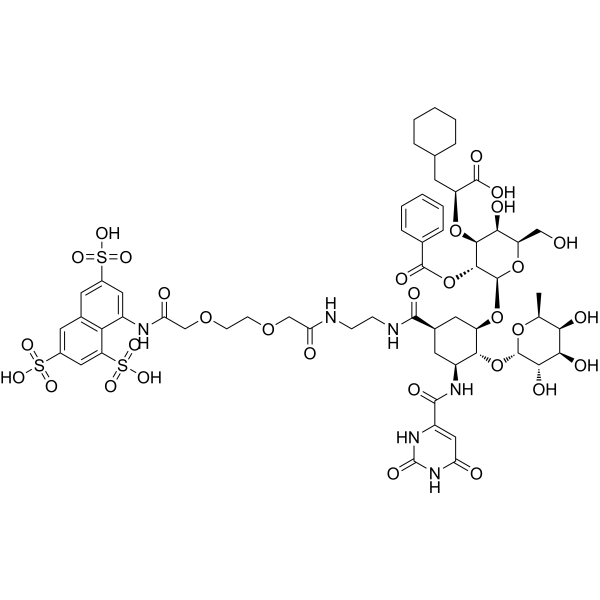
Rivipansel is a small-molecule glycomimetic pan-selectin antagonist with inhibitory activity against E-selectin and P-selectin. Rivipansel binds tightly to the lectin domain of E-selectin, and selectively blocks the recognition of CD62L by E-selectin without affecting the binding of PSGL-1 to E-selectin. Rivipansel functionally inhibits the adhesion of hematopoietic cells to endothelial cells, and is applicable to research related to sickle cell disease.
For research use only. We do not sell to patients.
- CAS No.: 927881-99-0
- Formula: C58H74N6O31S3
- Molecular Weight:1447.42
-
Storage:
Please store the product under the recommended conditions in the Certificate of Analysis.

To place orders, for customer services and technical support, please contact: MedChemExpress USA
Tel: 609-228-6898 E-mail: [email protected] [email protected]


-
 Biological Activity
-
Chemical Information
- Protocols
- Purity & Documentation
- References
-
 Help & FAQs




Biological Activity
Description
In Vitro
Rivipansel dose-dependently inhibits HL-60 cell adhesion to E-selectin-expressing CHO cells in an in vitro shear flow assay, with greater activity against E-selectin than P-selectin[1].
Rivipansel (~6.5 μM) inhibits rolling of isolated human polymorphonuclear neutrophils (PMN) on a recombinant human E-selectin/ICAM-1 coated substrate with a IC50 of ~6.5 μM, via a mechanism independent of PSGL-1[2].
Rivipansel (6.5 μM) reduces E-selectin recognition of sialyl LewisX (sLex) on CD62L in isolated human polymorphonuclear neutrophil (PMN) lysates by ~70%[2].
MedChemExpress (MCE) has not independently confirmed the accuracy of these methods. They are for reference only.
In Vivo
Rivipansel (20 mg/kg; i.v.; single dose) rapidly restores cerebral tissue perfusion and reduces cerebral platelet microthrombi in TNFα-induced cerebral occlusion in Townes SCD mice[1].
MedChemExpress (MCE) has not independently confirmed the accuracy of these methods. They are for reference only.
-
Animal Model:Townes sickle cell disease (TNFα-induced cerebral microvascular occlusion)[1]
-
Dosage:20 mg/kg
-
Administration:i.v.; single dose
-
Result:Rapidly reversed the TNFα-induced reduction in cerebral tissue perfusion.
Reduced the platelet microthrombi present in the cerebral microvasculature of TNFα-treated mice.


Chemical Information
-
CAS No. 927881-99-0
-
Molecular Weight 1447.42
-
Formula C58H74N6O31S3
-
SMILES
O=C([C@H]1C[C@H]([C@@H]([C@H](C1)NC(C2=CC(NC(N2)=O)=O)=O)O[C@H]3[C@H]([C@@H]([C@@H]([C@@H](O3)C)O)O)O)O[C@H]4[C@@H]([C@H]([C@H]([C@H](O4)CO)O)O[C@H](C(O)=O)CC5CCCCC5)OC(C6=CC=CC=C6)=O)NCCNC(COCCOCC(NC7=CC(S(=O)(O)=O)=CC8=C7C(S(=O)(O)=O)=CC(S(=O)(O)=O)=C8)=O)=O
-
Synonyms
GMI-1070
-
Shipping
Room temperature in continental US; may vary elsewhere.
-
Storage
Please store the product under the recommended conditions in the Certificate of Analysis.


Purity & Documentation
References

Calculators
Concentration (start) × Volume (start) = Concentration (final) × Volume (final)


Rivipansel Related Classifications
HY-125475 Related Classifications
 Powered by Bioz