



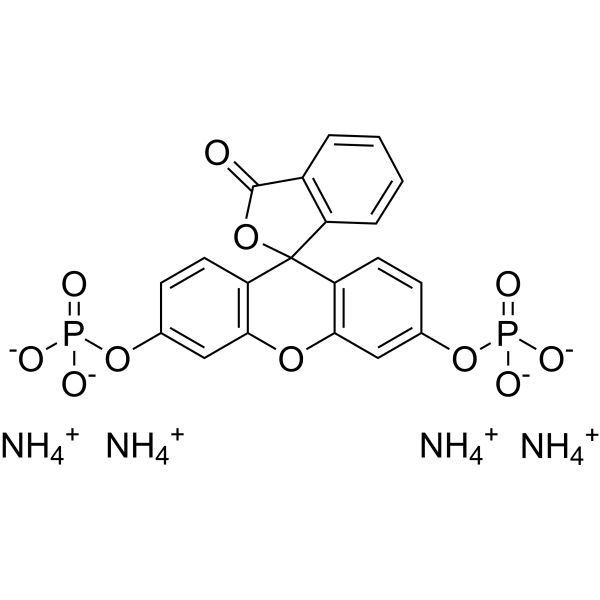
Fluorescein diphosphate tetraammonium
Fluorescein diphosphate tetraammonium is a fluorescent dye, it can be used as a fluorogenic substrate and generats fluorescein as a fluorescent product.
For research use only. We do not sell to patients.
- CAS No.: 217305-49-2
- Formula: C20H26N4O11P2
- Molecular Weight:560.39
-
Storage:
-20°C, sealed storage, away from moisture and light
* In solvent : -80°C, 6 months; -20°C, 1 month (sealed storage, away from moisture and light)

To place orders, for customer services and technical support, please contact: MedChemExpress USA
Tel: 609-228-6898 E-mail: [email protected] [email protected]


-
 Biological Activity
-
Chemical Information
- Purity & Documentation
- References
-
 Help & FAQs




Biological Activity
Description
In Vitro
Fluorescein diphosphate tetraammonium can be used as a fluorogenic substrate, and obtains luorescein as a fluorescent product[1].
Fluorescein diphosphate tetraammonium (50 μM; room temperature) can be used as a substrate in vitro phosphatase assays[2].
Guide (Following is our recommended protocol. This protocol only provides a guideline, and should be modified according to your specific needs).
ELISA with capillary immunosensor (single-step ELISA)[3]:
1. Put various concentrations of antigen in Tris buffer containing 1% BSA into capillary immunosensor.
2. Immobilize capture antibody and enzyme-linked antibody via capillary action, incubates for a preset time, and subsequently washing with 1 mL of 50 mM Tris buffer (pH 7.4) containing 0.14 M NaCl and 0.05% Tween 20 by using a syringe.
3. Fluorescence is detected by introducing an excess volume (ca. 100 μL) of 20 μM FDP in 50 mM Tris buffer (pH 9) with an incubation time of 60 min.4. Fluorescence detection analysis
MedChemExpress (MCE) has not independently confirmed the accuracy of these methods. They are for reference only.


Chemical Information
-
CAS No. 217305-49-2
-
Appearance Solid
-
Molecular Weight 560.39
-
Formula C20H26N4O11P2
-
Color Yellow to orange
-
SMILES
O=C1OC2(C3=C(OC4=C2C=CC(OP([O-])([O-])=O)=C4)C=C(OP([O-])([O-])=O)C=C3)C5=C1C=CC=C5.[NH4+].[NH4+].[NH4+].[NH4+]
-
Shipping
Room temperature in continental US; may vary elsewhere.
-
Storage
-20°C, sealed storage, away from moisture and light
* In solvent : -80°C, 6 months; -20°C, 1 month (sealed storage, away from moisture and light)


Purity & Documentation
-
Data Sheet (275 KB)
-
SDS (252 KB)
- Français - FR (252 KB)
- Deutsch - DE (252 KB)
- Norwegian - NO (252 KB)
- Español - ES (252 KB)
- Swedish - SV (252 KB)
- Italian - IT (252 KB)
- Korean - KR (252 KB)
- Portuguese - PT (252 KB)
-
Handling Instructions (2659 KB)
References
[1]. Murakami Y, et al. On-chip capillary electrophoresis for alkaline phosphatase testing. Biosens Bioelectron. 2001 Dec;16(9-12):1009-14. [Content Brief]
[2]. Gilmartin AG, et al. Allosteric Wip1 phosphatase inhibition through flap-subdomain interaction. Nat Chem Biol. 2014 Mar;10(3):181-7. [Content Brief]
[3]. Tsutsumi E, et al. Single-step sandwich immunoreaction in a square glass capillary immobilizing capture and enzyme-linked antibodies for simplified enzyme-linked immunosorbent assay. Anal Sci. 2012;28(1):51-6. [Content Brief]

Calculators
Concentration (start) × Volume (start) = Concentration (final) × Volume (final)


Fluorescein diphosphate tetraammonium Related Classifications
HY-129887 Related Classifications
 Powered by Bioz