



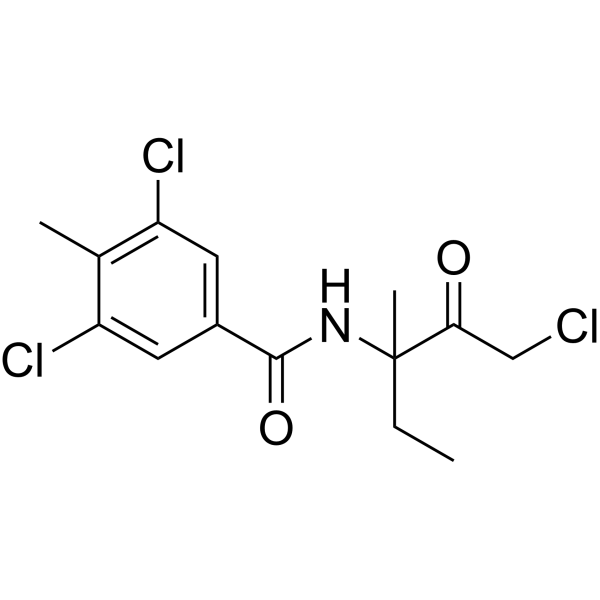
Zoxamide

Based on 1 Customer Validation
Zoxamide (RH-7281) is an oomycete Fungicide and covalent β-tubulin inhibitor. RH-7281 inhibits the assembly of tubulin into microtubules in vitro. Zoxamide binds covalently to β-tubulin, disrupting microtubule assembly and the cytoskeleton. Zoxamide blocks nuclear division in germinated hyphae of Phytophthora capsici and inhibits hyphal growth of Phytophthora capsici.
For research use only. We do not sell to patients.
- Purity : 99.05%
- CAS No.: 156052-68-5
- Formula: C14H16Cl3NO2
- Molecular Weight:336.64
-
Storage:Powder -20°C, 3 years , 4°C, 2 years ; In solvent -80°C, 6 months , -20°C, 1 month

To place orders, for customer services and technical support, please contact: MedChemExpress USA
Tel: 609-228-6898 E-mail: [email protected] [email protected]


-
 Biological Activity
-
Chemical Information
- Protocols
- Purity & Documentation
- References
-
 Help & FAQs




Biological Activity
Description
In Vitro
Studies show that all field-collected isolates of Phytophthora cactorum are sensitive to zoxamide (0.02-1.0 mg/L; 6 days), with a mean EC50 value of 0.14 mg/L for inhibiting radial mycelial growth[1].
Zoxamide (0-1 ppm) rapidly and potently inhibits nuclear division in Phytophthora capsici seedlings[2].
Zoxamide (0.05 ppm; 30 min) completely disrupts the microtubule cytoskeleton in germ tubes of *Phytophthora capsici*, eliminating detectable microtubule filaments[2].
Zoxamide (5-30 μM; 1-8 h) inhibits in vitro microtubule assembly of tubulin isolated from bovine brain in a dose-dependent manner, and its inhibitory potency increases with prolonged pre-incubation time[2].
Zoxamide (16 h) potently inhibits the mycelial growth of *Phytophthora capsici* in microtiter plate assays, with an EC50 of 0.0031 ppm[2].
MedChemExpress (MCE) has not independently confirmed the accuracy of these methods. They are for reference only. Further protocols information, click here.


Chemical Information
-
CAS No. 156052-68-5
-
Appearance Solid
-
Molecular Weight 336.64
-
Formula C14H16Cl3NO2
-
Color White to off-white
-
SMILES
O=C(NC(C)(CC)C(CCl)=O)C1=CC(Cl)=C(C)C(Cl)=C1
-
Synonyms
RH-7281
-
Shipping
Room temperature in continental US; may vary elsewhere.
-
Storage
Powder -20°C 3 years 4°C 2 years In solvent -80°C 6 months -20°C 1 month

Protocols
-
Filamentous Fungal Mold Culture and Sporulation
Filamentous fungal mold culture and sporulation assays grow hyphae under defined nutritional and environmental conditions until asexual spores, commonly conidia, are produced; the main readouts are colony growth, sporulation onset, conidial yield, conidial morphology, viability, and, when relevant, downstream infectivity or stress phenotype.
-
Phalloidin F-actin cytoskeleton staining
Phalloidin F-actin staining detects polymerized filamentous actin in fixed and permeabilized specimens by using fluorescent phalloidin or phalloidin-derived phallotoxins that bind actin filaments and generate a fluorescence microscopy readout corresponding to F-actin organization, including stress fibers, cortical actin, filament bundles, and tissue-specific actin networks. Phalloidin stabilizes F-actin by reducing actin subunit dissociation from filament ends, and fluorescent phallotoxins were established as tools for visualizing actin-containing structures in eukaryotic cells.


Purity & Documentation
-
Data Sheet (267 KB)
-
SDS (537 KB)
- English - EN (537 KB)
- Français - FR (537 KB)
- Deutsch - DE (537 KB)
- Norwegian - NO (537 KB)
- Español - ES (537 KB)
- Swedish - SV (537 KB)
- Italian - IT (537 KB)
- Korean - KR (537 KB)
- Portuguese - PT (537 KB)
-
Handling Instructions (2659 KB)
References

Calculators
Concentration (start) × Volume (start) = Concentration (final) × Volume (final)


Zoxamide Related Classifications
HY-120921 Related Classifications
 Powered by Bioz