



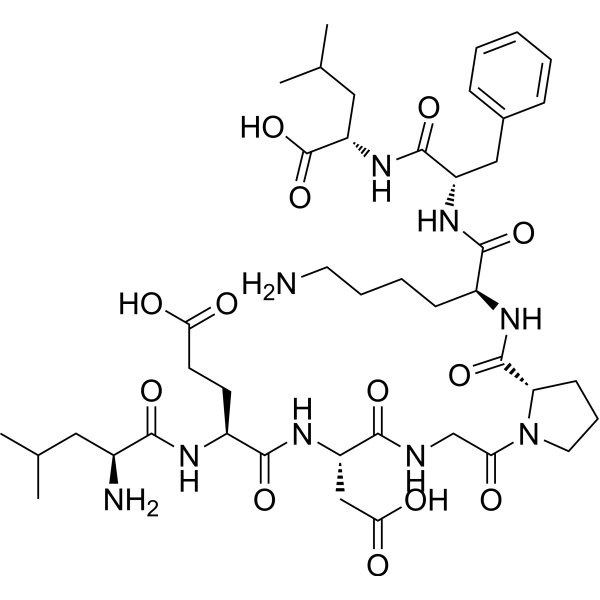
Thymoctonan
Thymoctonan (THF-γ2) is the immunomodulatory octapeptide, thymic humoral factor γ2. Thymoctonan has the half-life less than 6 min at 37 °C in blood from human, rat and mouse.
For research use only. We do not sell to patients.
- CAS No.: 107489-37-2
- Formula: C43H67N9O13
- Molecular Weight:918.04
-
Storage:
Please store the product under the recommended conditions in the Certificate of Analysis.

To place orders, for customer services and technical support, please contact: MedChemExpress USA
Tel: 609-228-6898 E-mail: [email protected] [email protected]


-
 Biological Activity
-
Chemical Information
- Protocols
- Purity & Documentation
- References
-
 Help & FAQs


All Endogenous Metabolite Isoforms
More

Biological Activity
Description
In Vitro
The main fragments formed from THF-γ2 were found to be Glu-Asp-Gly-Pro-Lys-Phe-Leu (2-8), Asp-Gly-Pro-Lys-Phe-Leu (3-8) and Glu-Asp-Gly-Pro-Lys (2-6) in human and in rat blood and 2-8 and 2-6 in mouse blood[1].
MedChemExpress (MCE) has not independently confirmed the accuracy of these methods. They are for reference only.


Chemical Information
-
CAS No. 107489-37-2
-
Molecular Weight 918.04
-
Formula C43H67N9O13
-
SMILES
O=C(N[C@@H](CCC(O)=O)C(N[C@@H](CC(O)=O)C(NCC(N1[C@@H](CCC1)C(N[C@@H](CCCCN)C(N[C@@H](CC2=CC=CC=C2)C(N[C@@H](CC(C)C)C(O)=O)=O)=O)=O)=O)=O)=O)[C@H](CC(C)C)N
-
Sequence Shortening
LEDGPKFL
-
Shipping
Room temperature in continental US; may vary elsewhere.
-
Storage
Please store the product under the recommended conditions in the Certificate of Analysis.


Purity & Documentation
References

Calculators
Concentration (start) × Volume (start) = Concentration (final) × Volume (final)


Thymoctonan Related Classifications
HY-125301 Related Classifications
 Powered by Bioz