



L-Ascorbic acid sodium salt (Standard)
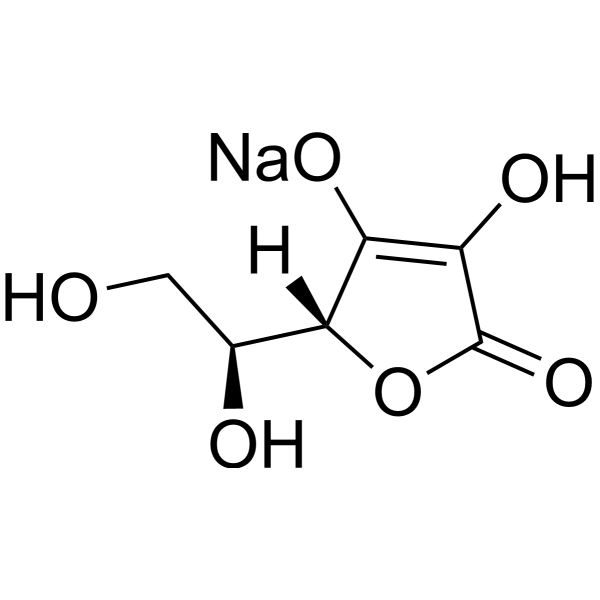
L-Ascorbic acid (sodium salt) (Standard) is the analytical standard of L-Ascorbic acid (sodium salt). This product is intended for research and analytical applications. L-Ascorbic acid sodium salt (Sodium ascorbate), an electron donor, is an endogenous antioxidant agent. L-Ascorbic acid sodium salt selectively inhibits Cav3.2 channels with an IC50 of 6.5 μM. L-Ascorbic acid sodium salt is also a collagen deposition enhancer and an elastogenesis inhibitor.
For research use only. We do not sell to patients.
- Purity : 98%
- CAS No.: 134-03-2
- Formula: C₆H₇NaO₆
- Molecular Weight:198.11
-
Storage:
Please store the product under the recommended conditions in the Certificate of Analysis.


To place orders, for customer services and technical support, please contact: MedChemExpress USA
Tel: 609-228-6898 E-mail: [email protected] [email protected]


-
 Product Information
-
Chemical Information
- Purity & Documentation
-
 Help & FAQs


-
HY-B0166A
L-Ascorbic acid sodium saltCalcium Channel Inhibitor -
HY-16637
Folic acidB complex -
HY-B0511
BiotinVitamin B7 -
HY-B0143
NiacinB3 vitamin -
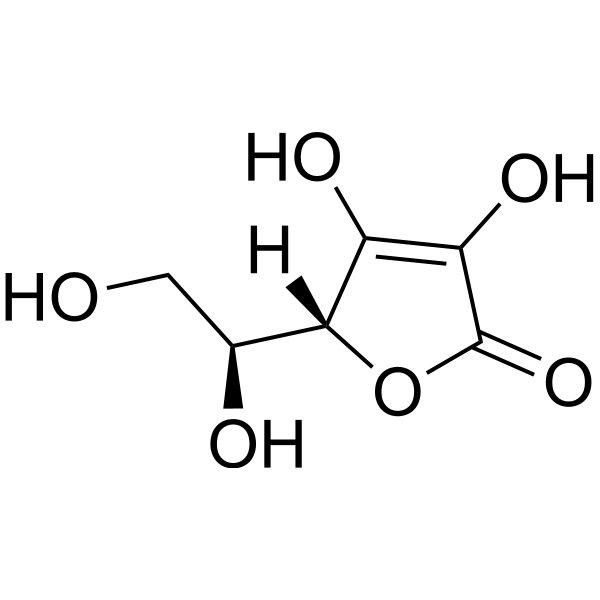
HY-B0166
L-Ascorbic acidAntioxidant -

HY-16637R
Folic acid (Standard)B complex -
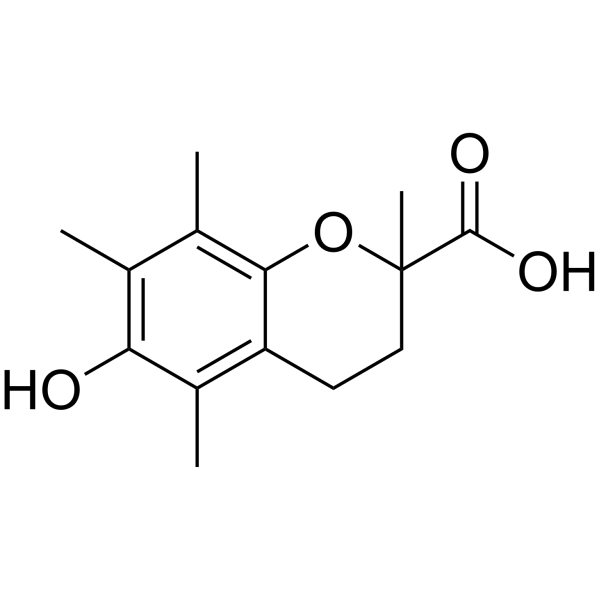
HY-101445
TroloxAntioxidant -
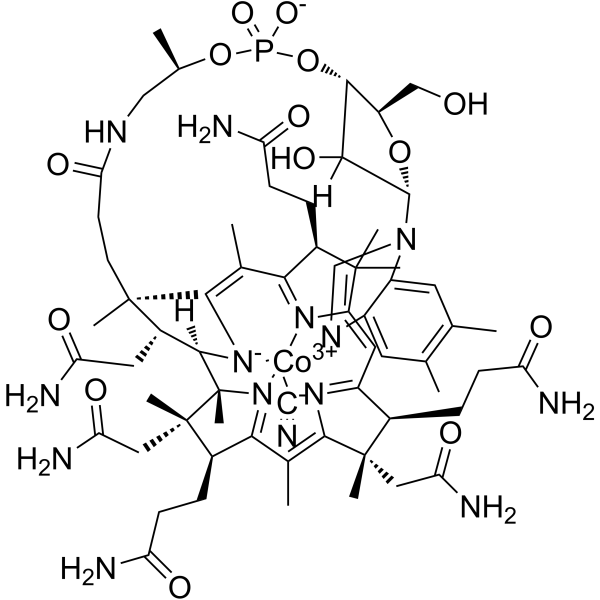
HY-B0315
Vitamin B12Endogenous Metabolite -
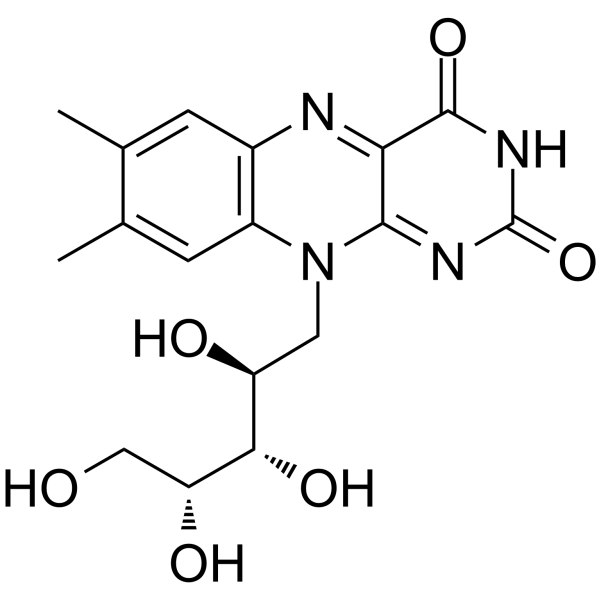
HY-B0456
RiboflavinVitamin B2 -

HY-B1342
Vitamin A -
HY-N0684
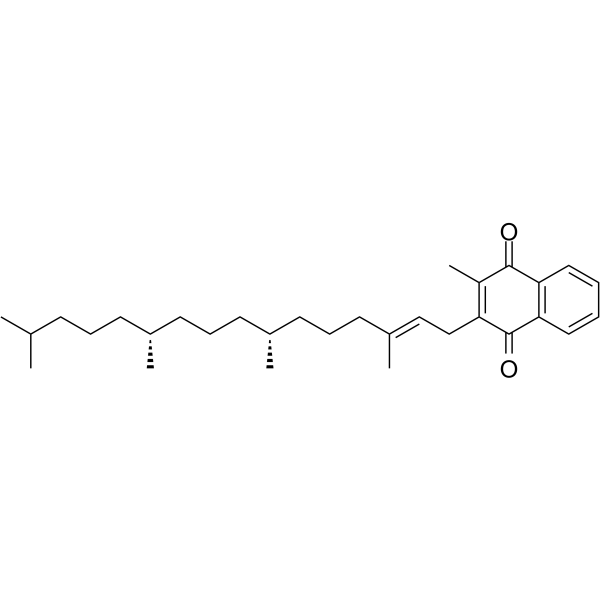
Vitamin K1Endogenous Metabolite -

HY-B0143R
Niacin (standard)B3 vitamin


Product Information
Information
Application
The compound is the grade of analytical standard, which is the reference standard supplied assay. It is commonly used in qualitative, quantitative and methodological research experiments in HPLC, GC and MS.


Chemical Information
-
CAS No. 134-03-2
-
Molecular Weight 198.11
-
Formula C₆H₇NaO₆
-
SMILES
O[C@@H](CO)[C@]1([H])C(O[Na])=C(O)C(O1)=O
-
Synonyms
Sodium ascorbate (Standard); Sodium L-ascorbate (Standard); Vitamin C sodium salt (Standard)
-
Structure Classification
-
Initial Source
-
Shipping
Room temperature in continental US; may vary elsewhere.
-
Storage
Please store the product under the recommended conditions in the Certificate of Analysis.


Purity & Documentation
References
[1]. Hinek A, et al. Sodium L-ascorbate enhances elastic fibers deposition by fibroblasts from normal and pathologic human skin. J Dermatol Sci. 2014 Sep;75(3):173-82. [Content Brief]
[2]. Aleksander Hinek, et al. Sodium L-ascorbate enhances elastic fibers deposition by fibroblasts from normal and pathologic human skin. J Dermatol Sci. 2014 Sep;75(3):173-82. [Content Brief]
[3]. Michael T Nelson, et al. Molecular mechanisms of subtype-specific inhibition of neuronal T-type calcium channels by ascorbate. J Neurosci. 2007 Nov 14;27(46):12577-83. [Content Brief]
[4]. Yang X, et al. Mouse melanoma cell line B16F10-derived conditioned medium inhibits sodium L-ascorbate-induced B16F10 cell apoptosis. Nan Fang Yi Ke Da Xue Xue Bao. 2012 Feb;32(2):146-50. [Content Brief]
[5]. Morimura K, et al. Lack of urinary bladder carcinogenicity of sodium L-ascorbate in human c-Ha-ras proto-oncogene transgenic rats. Toxicol Pathol. 2005;33(7):764-7. [Content Brief]
[6]. Takagi H, et al. Limited tumor-initiating activity of phenylethyl isothiocyanate by promotion with sodium L-ascorbate in a rat two-stage urinary bladder carcinogenesis model. Cancer Lett. 2005 Mar 10;219(2):147-53. [Content Brief]

Calculators
Concentration (start) × Volume (start) = Concentration (final) × Volume (final)


L-Ascorbic acid sodium salt (Standard) Related Classifications
HY-B0166AR Related Classifications
 Powered by Bioz