



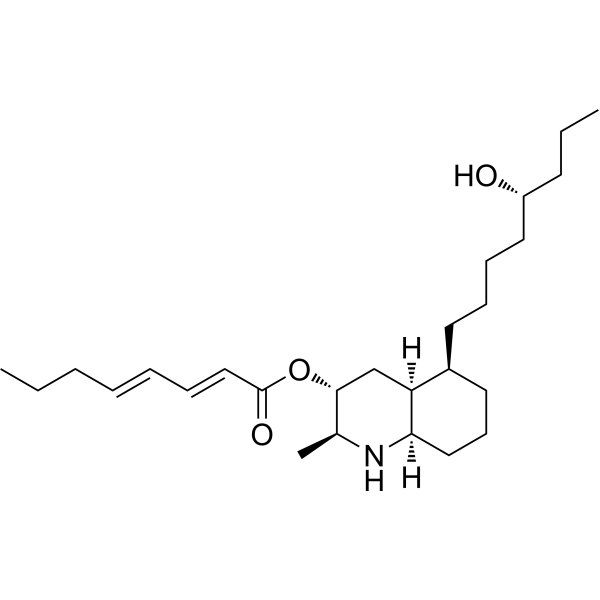
Lepadin H
Lepadin H is a ferroptosis inducer and apoptosis inducer with in vitro cytotoxicity and in vivo antitumor efficacy against cancer cells. Lepadin H reduces GPX4 and SLC7A11 levels, increases p53 and ACSL4 expression, drives lipid hydroperoxide production, elevates reactive oxygen species (ROS) levels, reduces cellular glutathione (GSH) levels, induces lipid peroxidation and G2/M phase cell cycle arrest, and suppresses clonogenic growth and migration of cancer cells.Lepadin H can be used for the research of melanoma.
For research use only. We do not sell to patients.
- CAS No.: 412328-25-7
- Formula: C26H45NO3
- Molecular Weight:419.64
-
Storage:
Please store the product under the recommended conditions in the Certificate of Analysis.

To place orders, for customer services and technical support, please contact: MedChemExpress USA
Tel: 609-228-6898 E-mail: [email protected] [email protected]


-
 Biological Activity
-
Chemical Information
- Purity & Documentation
- References
-
 Help & FAQs




Biological Activity
Description
IC50 & Target
[1]|
ACSL4 |
GPX4 |
Cellular Effect
|
Cell Line

|
Type | Value | Description | References |
|---|---|---|---|---|
| A549 | IC50 |
4.68 μM
Compound: Lepadin H
|
Cytotoxicity against human A549 cells incubated for 72 hrs by MTT assay
Cytotoxicity against human A549 cells incubated for 72 hrs by MTT assay
|
[PMID: 37578947] |
| B16-F10 | IC50 |
3.14 μM
Compound: Lepadin H
|
Cytotoxicity against mouse B16-F10 cells incubated for 72 hrs by MTT assay
Cytotoxicity against mouse B16-F10 cells incubated for 72 hrs by MTT assay
|
[PMID: 37578947] |
| HeLa | IC50 |
2.52 μM
Compound: Lepadin H
|
Cytotoxicity against human HeLa cells incubated for 72 hrs by MTT assay
Cytotoxicity against human HeLa cells incubated for 72 hrs by MTT assay
|
[PMID: 37578947] |
| HepG2 | IC50 |
6.2 μM
Compound: Lepadin H
|
Cytotoxicity against human HepG2 cells incubated for 72 hrs by MTT assay
Cytotoxicity against human HepG2 cells incubated for 72 hrs by MTT assay
|
[PMID: 37578947] |
| L02 | IC50 |
12.49 μM
Compound: Lepadin H
|
Cytotoxicity against human L02 cells incubated for 72 hrs by MTT assay
Cytotoxicity against human L02 cells incubated for 72 hrs by MTT assay
|
[PMID: 37578947] |
| MCF7 | IC50 |
5.03 μM
Compound: Lepadin H
|
Cytotoxicity against human MCF7 cells incubated for 72 hrs by MTT assay
Cytotoxicity against human MCF7 cells incubated for 72 hrs by MTT assay
|
[PMID: 37578947] |
| MDA-MB-231 | IC50 |
8.51 μM
Compound: Lepadin H
|
Cytotoxicity against human MDA-MB-231 cells incubated for 72 hrs by MTT assay
Cytotoxicity against human MDA-MB-231 cells incubated for 72 hrs by MTT assay
|
[PMID: 37578947] |
| NCI-H1155 | IC50 |
7.06 μM
Compound: Lepadin H
|
Cytotoxicity against human NCI-H1155 cells incubated for 72 hrs by MTT assay
Cytotoxicity against human NCI-H1155 cells incubated for 72 hrs by MTT assay
|
[PMID: 37578947] |
| NCI-H1355 | IC50 |
9.3 μM
Compound: Lepadin H
|
Cytotoxicity against human NCI-H1355 cells incubated for 72 hrs by MTT assay
Cytotoxicity against human NCI-H1355 cells incubated for 72 hrs by MTT assay
|
[PMID: 37578947] |
| SH-SY5Y | IC50 |
5.8 μM
Compound: Lepadin H
|
Cytotoxicity against human SH-SY5Y cells incubated for 72 hrs by MTT assay
Cytotoxicity against human SH-SY5Y cells incubated for 72 hrs by MTT assay
|
[PMID: 37578947] |
| SK-OV-3 | IC50 |
8.02 μM
Compound: Lepadin H
|
Cytotoxicity against human SK-OV-3 cells incubated for 72 hrs by MTT assay
Cytotoxicity against human SK-OV-3 cells incubated for 72 hrs by MTT assay
|
[PMID: 37578947] |
| SMMC-7721 | IC50 |
4.09 μM
Compound: Lepadin H
|
Cytotoxicity against human SMMC-7721 cells incubated for 72 hrs by MTT assay
Cytotoxicity against human SMMC-7721 cells incubated for 72 hrs by MTT assay
|
[PMID: 37578947] |
In Vitro
Lepadin H (72 h) potently inhibits the viability of 10 human cancer cell lines and 1 normal human cell line (L02) with IC50 values ranging from 2.52 μM (HeLa) to 12.49 μM (L02) after 72 h incubation[1].
Lepadin H (5-9 μM; 24 h) inhibits clonogenic growth of HeLa cells in a dose-dependent manner, with complete inhibition at 8 and 9 μM after 24 h treatment[1].
Lepadin H (0.625-10 μM; 24 h) potently suppresses HeLa cell migration in a dose-dependent manner when treated for 24 h at concentrations from 0.625 to 10 μM[1].
Lepadin H (4-10 μM; 24 h) induces dose-dependent apoptosis in HeLa cells, with ~70% apoptotic cells at 10 μM after 24 h treatment, and upregulates cleaved-PARP expression[1].
Lepadin H (4-12 μM; 24 h) causes dose-dependent G2/M phase cell cycle arrest in HeLa cells and upregulates p53 and p21 protein expression after 24 h treatment[1].
Lepadin H (6-20 μM; 0.5-1 h) increases intracellular ROS levels in HeLa cells in a dose- and time-dependent manner[1].
Lepadin H (10-12 μM; 4 h) significantly increases lipid peroxidation in HeLa cells, with ~55% and ~73% lipid peroxidation observed at 10 and 12 μM after 4 h treatment, respectively[1].
Lepadin H (2.5-20 μM; 24 h) induces ferroptosis in HeLa cells via the p53-SLC7A11-GPX4 pathway, as evidenced by reduced GSH levels, characteristic mitochondrial ultrastructural changes, upregulated ACSL4 expression, downregulated SLC7A11 and GPX4 expression[1].
Lepadin H (6 μM; 24 h) alters the transcriptome and proteome of HeLa cells, with significant enrichment of ferroptosis-related pathways and downregulation of ferroptosis-associated gene SLC7A11[1].
MedChemExpress (MCE) has not independently confirmed the accuracy of these methods. They are for reference only.
-
Cell Line:HeLa
-
Concentration:5 μM, 6 μM, 7 μM, 8 μM, 9 μM
-
Incubation Time:24 h
-
Result:Completely eliminated colony formation at 8 and 9 μM.
Strongly reduced colony numbers at 7 μM.
Showed partial inhibition of colony growth at 5 and 6 μM compared to control.
-
Cell Line:HeLa
-
Concentration:0.625 μM, 1.25 μM, 2.5 μM, 5 μM, 10 μM
-
Incubation Time:24 h
-
Result:Significantly inhibited cell migration at all tested concentrations in a dose-dependent manner.
Showed the strongest inhibition at 10 μM.
-
Cell Line:HeLa
-
Concentration:4 μM, 6 μM, 8 μM, 10 μM
-
Incubation Time:24 h
-
Result:Induced apoptosis in ~70% of cells at 10 μM.
Induced dose-dependent increase in apoptotic cell percentages at 4, 6, 8, and 10 μM.
Markedly increased cleaved-PARP protein levels at 10 μM.
-
Cell Line:HeLa
-
Concentration:4 μM, 6 μM, 8 μM, 10 μM, 12 μM
-
Incubation Time:24 h
-
Result:Induced dose-dependent G2/M phase cell cycle arrest with increasing percentages of cells in G2/M phase at 4 to 12 μM.
Upregulated p53 and p21 protein levels in a dose-dependent manner at 4, 6, 8, and 10 μM.
In Vivo
MedChemExpress (MCE) has not independently confirmed the accuracy of these methods. They are for reference only.
-
Animal Model:C57BL/6J (female, 8 weeks old, subcutaneous injection of 1 × 10⁷ B16F10 cells)[1]
-
Dosage:30 mg/kg
-
Administration:i.p.; daily; 14 consecutive days
-
Result:Reduced tumor volume from ~1500 mm3 to <500 mm3 (a greater than three-fold reduction).
Significantly decreased tumor weight relative to controls.
Showed no significant changes in mouse body weight, organ indexes, or histologic tissue damage in heart, liver, spleen, lung, kidney, or thymus.


Chemical Information
-
CAS No. 412328-25-7
-
Molecular Weight 419.64
-
Formula C26H45NO3
-
SMILES
CCC[C@@H](O)CCCC[C@@H]1[C@@]2([H])[C@](CCC1)([H])N[C@H]([C@@H](C2)OC(/C=C/C=C/CCC)=O)C
-
Structure Classification
-
Initial Source
-
Shipping
Room temperature in continental US; may vary elsewhere.
-
Storage
Please store the product under the recommended conditions in the Certificate of Analysis.


Purity & Documentation
References

Calculators
Concentration (start) × Volume (start) = Concentration (final) × Volume (final)


Lepadin H Related Classifications
HY-155852 Related Classifications
 Powered by Bioz
Keywords
- Lepadin H
- 412328-25-7
- Ferroptosis
- Apoptosis
- ACSL Family
- Glutathione Peroxidase
- Reactive Oxygen Species (ROS)
- ferroptosis
- melanoma
- tumor protein p53
- apoptosis
- acyl-CoA synthetase long chain family member 4
- HeLa
- reactive oxygen species
- solute carrier family 7 member 11
- glutathione peroxidase 4
- lipid peroxidation
- Inhibitor
- inhibitor
- inhibit