



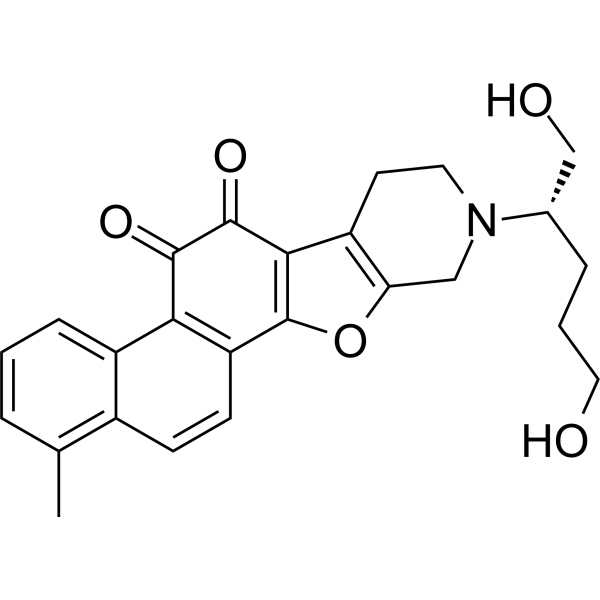
NLRP3-IN-16
NLRP3-IN-16 is a potent and selective NLRP3 inflammasome inhibitor. NLRP3-IN-16 inhibits IL-1β release with an IC50 of 0.065 μM. NLRP3-IN-16 can be used for the research of inflammation.
연구목적의 판매만을 진행합니다. 환자를 대상으로 한 판매는 하지 않습니다.
- CAS No.: 2906872-59-9
- 화학식: C25H25NO5
- 분자량:419.47
-
보관:
Please store the product under the recommended conditions in the Certificate of Analysis.

To place orders, for customer services and technical support, please contact: MedChemExpress USA
Tel: 609-228-6898 E-mail: [email protected] [email protected]


-
 Biological Activity
-
Chemical Information
- Protocol
- 순도&문서
- References
-
 Help & FAQs




Biological Activity
제품 설명
IC50 & Target
[1]|
NLRP3 inflammasome |
Cellular Effect
|
Cell Line

|
Type | Value | Description | References |
|---|---|---|---|---|
| Peritoneal macrophage | IC50 |
0.065 μM
Compound: 12d
|
Antiinflammatory activity against LPS-stimulated mouse peritoneal macrophage assessed as inhibition of IL-1beta secretion treated for 3 hrs followed by ATP addition measured after 30 mins by ELISA method
Antiinflammatory activity against LPS-stimulated mouse peritoneal macrophage assessed as inhibition of IL-1beta secretion treated for 3 hrs followed by ATP addition measured after 30 mins by ELISA method
|
[PMID: 36786612] |
In Vitro
NLRP3-IN-16 (Compound 12d) inhibits IL-1β release with an IC50 of 0.065 μM (ELISA assay)[1].
NLRP3-IN-16 (2 μM, 3 h) inhibits the secretion of IL-1β (p17) and caspase-1 (p20) in mice peritoneal macrophages (PMs)[1].
NLRP3-IN-16 inhibits the formation of the NLRP3 inflammasome complex by inhibiting ASC oligomerization[1].
NLRP3-IN-16 shows metabolic stability in both human and mouse liver microsomes (T1/2: 223.5 min; Clint: 6.2act μL/min/mg)[1].
MedChemExpress (MCE) has not independently confirmed the accuracy of these methods. They are for reference only. Further protocols information, click here.
-
Cell Line:Mice peritoneal macrophages(PMs)
-
Concentration:2 μM
-
Incubation Time:3 h
-
Result:Inhibited the secretion of IL-1β (p17) and caspase-1 (p20), without affecting pro-IL-1β and pro-caspase-1.
In Vivo
MedChemExpress (MCE) has not independently confirmed the accuracy of these methods. They are for reference only.
-
Animal Model:LPS-induced inflammatory septic mouse model[1]
-
Dosage:50 mg/kg
-
Administration:i.p.
-
Result:Decreased the release of IL-1β in mouse serum.
Relieved thickening of the alveolar wall in lung.
-
Animal Model:Mice[1]
-
Dosage:20 or 5 mg/kg
-
Administration:p.o. or i.v.
-
Result:Pharmacokinetic profile of NLRP3-IN-15 (compound 12a).
parameter dose (mg/kg) T1/2 (h) Tmax (h) F (%) PO 20 2.725 0.222 5.0 IV 5 2.772 0.083


Chemical Information
-
CAS No. 2906872-59-9
-
분자량 419.47
-
화학식 C25H25NO5
-
SMILES
CC1=C2C=CC3=C(C2=CC=C1)C(C(C4=C3OC5=C4CCN(C5)[C@@H](CCCO)CO)=O)=O
-
선적
Room temperature in continental US; may vary elsewhere.
-
보관
Please store the product under the recommended conditions in the Certificate of Analysis.

Protocol
-
Cell Cytotoxicity Assay
Cytotoxicity assays are usually based on the assessment of cell membrane damage, which can also be indirectly detected by measuring cell viability. Detection methods include MTT assay, CKK-8 assay, LDH assay and ATP assay, etc.
-
Research Protocol for Inflammation-related Diseases
The NLRP3 inflammasome is a cytosolic innate immune signaling platform that integrates priming signals and danger-signal activation to promote caspase-1 activation, maturation of IL-1β and IL-18, and gasdermin D-mediated pyroptotic cell death. The core experimental logic is to determine whether inflammatory disease phenotypes are driven by increased NLRP3 expression, ASC-containing inflammasome assembly, caspase-1 cleavage, GSDMD cleavage, and extracellular release of IL-1β/IL-18 rather than by nonspecific cell injury alone. The pathway is strongly linked to inflammation-related disease phenotypes because monosodium urate crystals activate NALP3/NLRP3 inflammasome signaling in gout-like crystal inflammation, cholesterol crystals activate NLRP3 inflammasomes in atherogenesis models, and DSS-induced intestinal inflammation has been reported to involve NLRP3 inflammasome activity. However, experimental colitis studies also show context-dependent protective effects of NLRP3 inflammasome co
-
Pyroptosis Solutions
Pyroptosis is a lytic inflammatory cell-death pathway executed by gasdermin pores, most classically through inflammasome-mediated activation of caspase-1, cleavage of gasdermin D, membrane pore formation, LDH release, and secretion of IL-1β and IL-18. The canonical pathway is commonly modeled by priming cells with an inflammatory signal such as LPS to induce pro-IL-1β and inflammasome components, followed by an activation signal such as ATP or nigericin to activate NLRP3, ASC speck formation, caspase-1 cleavage, GSDMD cleavage, cytokine release, and pyroptotic membrane rupture. The non-canonical pathway is triggered when cytosolic LPS activates mouse caspase-11 or human caspase-4/5, leading to GSDMD cleavage and pyroptosis, and this can secondarily activate NLRP3-dependent IL-1β release. Pyroptosis is linked to inflammatory injury, infection, cancer, liver disease, ocular disease, placental inflammation, and other disease phenotypes, but unresolved questions include which gasdermin fam


순도&문서
References

Calculators
Concentration (start) × Volume (start) = Concentration (final) × Volume (final)


NLRP3-IN-16 Related Classifications
HY-149123 Related Classifications
 Powered by Bioz