



Phenoxybenzamine hydrochloride (Standard)

Based on 1 Customer Validation
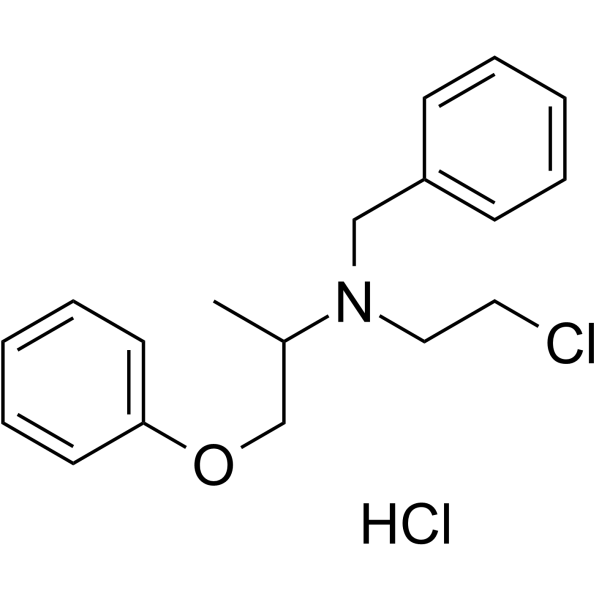
Phenoxybenzamine (hydrochloride) (Standard) is the analytical standard of Phenoxybenzamine (hydrochloride). This product is intended for research and analytical applications. Phenoxybenzamine hydrochloride is a nonselective, irreversible, orally active α-adrenoceptor antagonist that is commonly used for the research of hypertension, specifically caused by pheochromocytoma. Phenoxybenzamine hydrochloride also shows antitumor activity.
For research use only. We do not sell to patients.
- Purity : 99.53%
- CAS No.: 63-92-3
- Formula: C18H23Cl2NO
- Molecular Weight:340.29
-
Storage:
Please store the product under the recommended conditions in the Certificate of Analysis.


To place orders, for customer services and technical support, please contact: MedChemExpress USA
Tel: 609-228-6898 E-mail: [email protected] [email protected]


-
 Product Information
-
Chemical Information
- Purity & Documentation
-
 Help & FAQs





Product Information
Information
Application
The compound is the grade of analytical standard, which is the reference standard supplied assay. It is commonly used in qualitative, quantitative and methodological research experiments in HPLC, GC and MS.


Chemical Information
-
CAS No. 63-92-3
-
Appearance Solid
-
Molecular Weight 340.29
-
Formula C18H23Cl2NO
-
Color White to off-white
-
SMILES
CC(COC1=CC=CC=C1)N(CCCl)CC2=CC=CC=C2.Cl
-
Shipping
Room temperature in continental US; may vary elsewhere.
-
Storage
Please store the product under the recommended conditions in the Certificate of Analysis.


Purity & Documentation
-
SDS (252 KB)
- English - EN (252 KB)
- Français - FR (252 KB)
- Deutsch - DE (252 KB)
- Norwegian - NO (252 KB)
- Español - ES (252 KB)
- Swedish - SV (252 KB)
- Italian - IT (252 KB)
- Korean - KR (252 KB)
- Portuguese - PT (252 KB)
-
Handling Instructions (2659 KB)
References
[1]. Habbe N, et al. Urapidil in the preoperative treatment of pheochromocytomas: a safe and cost-effective method. World J Surg. 2013 May;37(5):1141-6. [Content Brief]
[2]. Lin XB, et al. Anti-tumor activity of phenoxybenzamine hydrochloride on malignant glioma cells. Tumour Biol. 2016 Mar;37(3):2901-8. [Content Brief]
[3]. Rau TF, et al. Phenoxybenzamine is neuroprotective in a rat model of severe traumatic brain injury. Int J Mol Sci. 2014 Jan 20;15(1):1402-17. [Content Brief]

Calculators
Concentration (start) × Volume (start) = Concentration (final) × Volume (final)


Phenoxybenzamine hydrochloride (Standard) Related Classifications
HY-B0431AR Related Classifications
 Powered by Bioz