



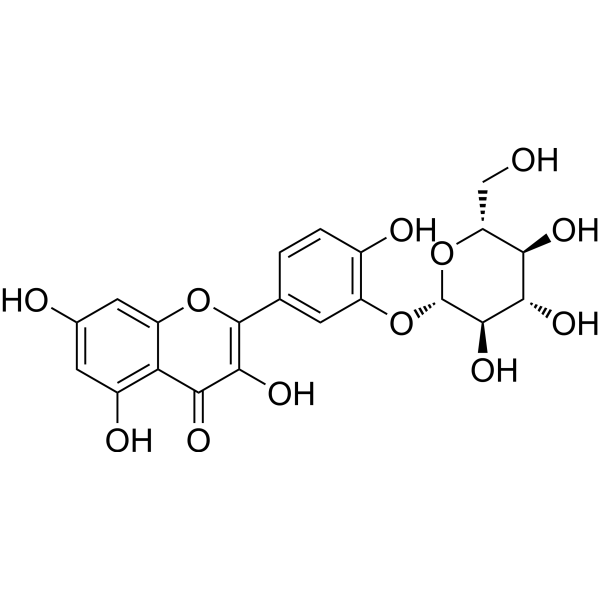
Quercetin-3'-O-glucoside
Based on 1 publication(s) in Google Scholar
Quercetin-3'-O-glucoside is an orally active flavonoid glycoside. Quercetin-3'-O-glucoside reduces liver glucose-6-phosphatase activity, alters serum insulin and glucose levels, and regulates the activities of antioxidant enzymes in the liver and kidney. Quercetin-3'-O-glucoside inhibits DNA topoisomerase II, induces S-phase cell cycle arrest and caspase-3-mediated apoptosis in hepatocellular carcinoma cells. Quercetin-3'-O-glucoside selectively inhibits EGFR-mediated signaling pathways targeting AKT, ERK1/2, FAK and MEK1/2. Quercetin-3'-O-glucoside inhibits growth factor-induced migration and invasion in pancreatic cancer cells. Quercetin-3'-O-glucoside exerts free radical scavenging effects. Quercetin-3'-O-glucoside is applicable to research related to pancreatic cancer, diabetes, hepatocellular carcinoma and malignant tumors.
For research use only. We do not sell to patients.
- Purity : 98.48%
- CAS No.: 19254-30-9
- Formula: C21H20O12
- Molecular Weight:464.38
-
Storage:Powder -20°C, 3 years ; In solvent -80°C, 6 months , -20°C, 1 month

To place orders, for customer services and technical support, please contact: MedChemExpress USA
Tel: 609-228-6898 E-mail: [email protected] [email protected]


-
 Biological Activity
-
Chemical Information
-
Solvent & Solubility
- Purity & Documentation
- References
-
 Help & FAQs


Publications Citing Use of MedChemExpress (MCE) Quercetin-3'-O-glucoside
MoreAll Topoisomerase Isoforms
MoreAll Caspase Isoforms
More

Biological Activity
Description
IC50 & Target
[1]|
Caspase 3 |
In Vitro
Quercetin-3-O-glucoside (1-1000 nM; 72 h) exhibits no significant cytotoxicity toward CFPAC-1, Panc-1, SNU-213 human pancreatic cancer cells, or HUVEC normal cells following 72 h of treatment at concentrations up to 1000 nM[1].
Quercetin-3-O-glucoside (50-1000 nM; 6 h) dose-dependently inhibits EGF-induced migration of SNU-213 (up to 45% reduction) and CFPAC-1 (up to 30% reduction) human pancreatic cancer cells after 6 h of treatment, with no effect on PDGF-induced migration or basal migration of HUVEC normal cells[1].
Quercetin-3-O-glucoside (10-100 nM; 1 h pre-incubation, 10 min EGF stimulation) dose-dependently inhibits EGF-induced activation of the EGFR-mediated FAK, AKT, MEK1/2, and ERK1/2 signaling pathway in SNU-213 and CFPAC-1 human pancreatic cancer cells following 1 h pre-incubation and 10 min EGF stimulation[1].
Quercetin-3'-O-glucoside (1, 10, 50, 100, 150, 200 μM; 24, 48, 72 h) inhibits the growth of HepG2 cells in a dose- and time-dependent manner, with 200 μM inducing 50% inhibition at 24 h and 50, 100 μM inducing up to 98% inhibition at 48 and 72 h[3].
Quercetin-3'-O-glucoside (100 μM; 6, 12, 18, 24, 48 h) reduces HepG2 cell membrane integrity in a time-dependent manner, causing 93% cell damage after 48 h of incubation[3].
Quercetin-3'-O-glucoside (100 μM; 24 h) blocks HepG2 cell cycle progression in the S phase after 24 h of incubation, hindering DNA synthesis[3].
Quercetin-3'-O-glucoside (100 μM; 24, 48, 72 h) induces severe morphological changes, including apoptotic body formation, in HepG2 cells after 48 and 72 h of incubation, with changes also observed after 24 h[3].
Quercetin-3'-O-glucoside (100 μM; 24, 48 h) activates caspase-3 in HepG2 cells in vitro in a time-dependent manner, with greater activity observed after 48 h of incubation compared to 24 h[3].
Quercetin-3'-O-glucoside (100-1000 μg/mL; 16 h) exhibits low cytotoxicity to McCoy cells, with an IC50 of 215.2 μg/mL[4].
Quercetin-3'-O-glucoside (100-500 μg/mL; 1 week) exhibits high phytotoxicity against Lactuca sativa L. CV. Varamin seeds, with an IC50 of 282.78 μg/mL for germination inhibition[4].
Quercetin-3'-O-glucoside (100 μg/mL; 24 h (bacteria), 48 h (yeast)) has no antibacterial or antifungal activity against tested bacterial and yeast strains[4].
Quercetin-3'-O-glucoside (50-100000 nM) inhibits growth factor-induced migration in SNU-213 human pancreatic adenocarcinoma cells, with dose-dependent activity against bFGF-induced migration[6].
Quercetin-3'-O-glucoside (100-500 nM; 1 h pre-treatment; combined with gemcitabine) inhibits bFGF-induced activation of the FAK and ERK1/2 signaling pathways in SNU-213 human pancreatic adenocarcinoma cells[6].
MedChemExpress (MCE) has not independently confirmed the accuracy of these methods. They are for reference only.
-
Cell Line:SNU-213, CFPAC-1 human pancreatic cancer cells
-
Concentration:10 nM, 50 nM, 100 nM
-
Incubation Time:1 h pre-incubation; 10 min EGF-stimulation
-
Result:Dose-dependently inhibited EGF-induced phosphorylation of EGFR (Tyr1068), FAK (Tyr397), AKT (Ser473), MEK1/2 (Ser217/221), and ERK1/2 (Thr202/Tyr204) in both SNU-213 and CFPAC-1 cells.
-
Cell Line:Human hepatocellular carcinoma HepG2 cells
-
Concentration:1, 10, 50, 100, 150, 200 μM
-
Incubation Time:24 h; 48 h; 72 h
-
Result:Induced dose- and time-dependent cell growth inhibition.
Induced 50% cell growth inhibition at 200 μM after 24 h.
Induced up to 98% cell growth inhibition at 50 and 100 μM after 48 and 72 h.
-
Cell Line:human hepatocellular carcinoma HepG2 cells
-
Concentration:100 μM
-
Incubation Time:24 h
-
Result:Significantly increased the population of cells in the S phase.
Decreased the G1/G0 phase population compared to controls.
-
Cell Line:human hepatocellular carcinoma HepG2 cells
-
Concentration:100 μM
-
Incubation Time:24, 48, 72 h
-
Result:Induced apoptosis in treated cells, with most cells showing annexin V-only (green) staining (apoptotic cells).
Resulted in fewer cells showing annexin V and propidium iodide (yellow) staining (late apoptotic cells) or propidium iodide-only (red) staining (necrotic cells).
In Vivo
Quercetin-3-O-glucoside (10-200 μM; incorporated into NGM culture medium; continuous exposure from L1 larval stage) extends the mean lifespan of wild-type Caenorhabditis elegans by up to 23% at doses of 10 μM and 25 μM, while reducing mean lifespan by 17% at a dose of 200 μM[5].
MedChemExpress (MCE) has not independently confirmed the accuracy of these methods. They are for reference only.


Chemical Information
-
CAS No. 19254-30-9
-
Appearance Solid
-
Molecular Weight 464.38
-
Formula C21H20O12
-
Color Off-white to light yellow
-
SMILES
O=C1C2=C(O)C=C(O)C=C2OC(C3=CC(O[C@@H]4O[C@@H]([C@H]([C@@H]([C@H]4O)O)O)CO)=C(C=C3)O)=C1O
-
Structure Classification
-
Initial Source
-
Shipping
Room temperature in continental US; may vary elsewhere.
-
Storage
Powder -20°C 3 years In solvent -80°C 6 months -20°C 1 month


Publications (1)
-
Journal Impact Factor
-
Most Recent
-
Food Chem
Flavonoid-mediated metabolic underpinning quality variation in red bud-sport pear mutants. [Abstract]2025 Oct 15:489:144992. PMID: 40466530


Solvent & Solubility
In Vitro:
DMSO : 100 mg/mL (215.34 mM; Need ultrasonic; Hygroscopic DMSO has a significant impact on the solubility of product, please use newly opened DMSO)
Please refer to the solubility information to select the appropriate solvent. Once prepared, please aliquot and store the solution to prevent product inactivation from repeated freeze-thaw cycles.
Storage method and period of stock solution: -80°C, 6 months; -20°C, 1 month. When stored at -80°C, please use it within 6 months. When stored at -20°C, please use it within 1 month.
Please refer to the solubility information to select the appropriate solvent. Once prepared, please aliquot and store the solution to prevent product inactivation from repeated freeze-thaw cycles.
Storage method and period of stock solution: -80°C, 6 months; -20°C, 1 month. When stored at -80°C, please use it within 6 months. When stored at -20°C, please use it within 1 month.
Concentration (start) × Volume (start) = Concentration (final) × Volume (final)
In Vivo:
Select the appropriate dissolution method based on your experimental animal and administration route.
- For the following dissolution methods, please ensure to first prepare a clear stock solution using an In Vitro approach and then sequentially add co-solvents:
- To ensure reliable experimental results, the clarified stock solution can be appropriately stored based on storage conditions. As for the working solution for In Vivo experiments, it is recommended to prepare freshly and use it on the same day.
- The percentages shown for the solvents indicate their volumetric ratio in the final prepared solution. If precipitation or phase separation occurs during preparation, heat and/or sonication can be used to aid dissolution.
Add each solvent one by one: 10% DMSO 40% PEG300 5% Tween-80 45% Saline
Solubility: ≥ 2.5 mg/mL (5.38 mM); Clear solution
This protocol yields a clear solution of ≥ 2.5 mg/mL (saturation unknown).
Taking 1 mL working solution as an example, add 100 μL DMSO stock solution (25.0 mg/mL) to 400 μL PEG300, and mix evenly; then add 50 μL Tween-80 and mix evenly; then add 450 μL Saline to adjust the volume to 1 mL.
Preparation of Saline: Dissolve 0.9 g sodium chloride in ddH₂O and dilute to 100 mL to obtain a clear Saline solution.
Add each solvent one by one: 10% DMSO 90% (20% SBE-β-CD in Saline)
Solubility: ≥ 2.5 mg/mL (5.38 mM); Clear solution
This protocol yields a clear solution of ≥ 2.5 mg/mL (saturation unknown).
Taking 1 mL working solution as an example, add 100 μL DMSO stock solution (25.0 mg/mL) to 900 μL 20% SBE-β-CD in Saline, and mix evenly.
Preparation of 20% SBE-β-CD in Saline (4°C, storage for one week): 2 g SBE-β-CD powder is dissolved in 10 mL Saline, completely dissolve until clear.
In Vivo Dissolution Calculator
Please enter the basic information of animal experiments:
-
-
-
-
Recommended: Prepare an additional quantity of animals to account for potential losses during experiments.
Please enter your animal formula composition:
-
%DMSO +
Recommended: Keep the proportion of DMSO in working solution below 2% if your animal is weak.
-
%+
-
+%Tween-80 + +
-
%Saline +
The co-solvents required include: DMSO, . All of co-solvents are available by MedChemExpress (MCE). , Tween 80. All of co-solvents are available by MedChemExpress (MCE).
Working solution concentration: 0.22 mg/mL
Method for preparing stock solution: mg drug dissolved in μL DMSO. Stock solution concentration: mg/mL.
1. Take μL DMSO stock solution;
2. Add μL .
μL , mix evenly;
3. Then add μL Tween 80, mix evenly;
4. Then add μL
Please ensure that the stock solution in the first step is dissolved to a clear state, and add co-solvents in sequence. You can use ultrasonic heating (ultrasonic cleaner, recommended frequency 20-40 kHz), vortexing, etc. to assist dissolution.


Purity & Documentation
-
Data Sheet (285 KB)
-
SDS (251 KB)
- English - EN (251 KB)
- Français - FR (251 KB)
- Deutsch - DE (251 KB)
- Norwegian - NO (251 KB)
- Español - ES (251 KB)
- Swedish - SV (251 KB)
- Italian - IT (251 KB)
- Korean - KR (251 KB)
- Portuguese - PT (251 KB)
-
Handling Instructions (2659 KB)
References
[1]. Lee J, et al. Quercetin 3-O-glucoside suppresses epidermal growth factor-induced migration by inhibiting EGFR signaling in pancreatic cancer cells. Tumour Biol. 2015;36(12):9385-9393. [Content Brief]
[2]. Panda S, et al. Antidiabetic and antioxidative effects of Annona squamosa leaves are possibly mediated through quercetin-3-O-glucoside. Biofactors. 2007;31(3-4):201-210. [Content Brief]
[3]. Sudan S, et al. Quercetin-3-O-glucoside induces human DNA topoisomerase II inhibition, cell cycle arrest and apoptosis in hepatocellular carcinoma cells. Anticancer Res. 2014;34(4):1691-1699. [Content Brief]
[4]. Razavi SM, et al. Biological activity of quercetin-3-O-glucoside, a known plant flavonoid. Bioorg Khim. 2009 May-Jun;35(3):414-6. [Content Brief]
[5]. Dueñas M, et al. Deglycosylation is a key step in biotransformation and lifespan effects of quercetin-3-O-glucoside in Caenorhabditis elegans. Pharmacol Res. 2013;76:41-48. [Content Brief]
[6]. Lee J, et al. Quercetin-3-O-glucoside suppresses pancreatic cancer cell migration induced by tumor-deteriorated growth factors in vitro. Oncol Rep. 2016;35(4):2473-2479. [Content Brief]


Complete Stock Solution Preparation Table
Please refer to the solubility information to select the appropriate solvent. Once prepared, please aliquot and store the solution to prevent product inactivation from repeated freeze-thaw cycles.
Storage method and period of stock solution: -80°C, 6 months; -20°C, 1 month. When stored at -80°C, please use it within 6 months. When stored at -20°C, please use it within 1 month.
| Optional Solvent | Concentration Solvent Mass | 1 mg | 5 mg | 10 mg | 25 mg |
|---|---|---|---|---|---|
| DMSO | 1 mM | 2.1534 mL | 10.7670 mL | 21.5341 mL | 53.8352 mL |
| 5 mM | 0.4307 mL | 2.1534 mL | 4.3068 mL | 10.7670 mL | |
| 10 mM | 0.2153 mL | 1.0767 mL | 2.1534 mL | 5.3835 mL | |
| 15 mM | 0.1436 mL | 0.7178 mL | 1.4356 mL | 3.5890 mL | |
| 20 mM | 0.1077 mL | 0.5384 mL | 1.0767 mL | 2.6918 mL | |
| 25 mM | 0.0861 mL | 0.4307 mL | 0.8614 mL | 2.1534 mL | |
| 30 mM | 0.0718 mL | 0.3589 mL | 0.7178 mL | 1.7945 mL | |
| 40 mM | 0.0538 mL | 0.2692 mL | 0.5384 mL | 1.3459 mL | |
| 50 mM | 0.0431 mL | 0.2153 mL | 0.4307 mL | 1.0767 mL | |
| 60 mM | 0.0359 mL | 0.1795 mL | 0.3589 mL | 0.8973 mL | |
| 80 mM | 0.0269 mL | 0.1346 mL | 0.2692 mL | 0.6729 mL | |
| 100 mM | 0.0215 mL | 0.1077 mL | 0.2153 mL | 0.5384 mL |


Quercetin-3'-O-glucoside Related Classifications
HY-N12445 Related Classifications
 Powered by Bioz