



Acetylcholinesterase/ACHE Protein, Mouse (HEK293, His)
Based on 1 Customer Validation
Acetylcholinesterase (ACHE) proteins exhibit multiple functions, including acetylcholinesterase activity and protein self-association. It regulates acetylcholine processing, receptor signaling and recycling. Acetylcholinesterase/ACHE Protein, Mouse (HEK293, His) is the recombinant mouse-derived Acetylcholinesterase/ACHE protein, expressed by HEK293 , with C-10*His labeled tag.
- Species: Mouse
- Source: HEK293
-
Storage:Stored at -20°C for 2 years from date of receipt. After reconstitution, it is stable at 4°C for 1 week or -20°C for longer (with carrier protein). It is recommended to freeze aliquots at -20°C or -80°C for extended storage.


To place orders, for customer services and technical support, please contact: MedChemExpress USA
Tel: 609-228-6898 E-mail: [email protected] [email protected]


-
 Biological Activity
-
Technical Parameters
-
Product Properties
- Documentation
- Help & FAQs




Biological Activity
Description
Acetylcholinesterase (ACHE) proteins exhibit multiple functions, including acetylcholinesterase activity and protein self-association. It regulates acetylcholine processing, receptor signaling and recycling. Acetylcholinesterase/ACHE Protein, Mouse (HEK293, His) is the recombinant mouse-derived Acetylcholinesterase/ACHE protein, expressed by HEK293 , with C-10*His labeled tag.
Background
Acetylcholinesterase (ACHE) protein, with its diverse functional repertoire, exhibits acetylcholinesterase activity, identical protein binding activity, and the ability for protein self-association. Its involvement in positive regulation of cold-induced thermogenesis positions it upstream of critical processes such as acetylcholine catabolic processes, acetylcholine receptor signaling pathways, and the regulation of receptor recycling. ACHE is found in various cellular components, including the basement membrane, cell surface, and neuromuscular junction. Its expression spans across multiple structures, including the alimentary system, genitourinary system, musculature, nervous system, and sensory organs. Notably, human orthologs of ACHE are implicated in significant health conditions such as Alzheimer's disease, epilepsy, and myasthenia gravis, highlighting the importance of this protein in various physiological contexts. Broad expression patterns further emphasize its fundamental role in multiple tissues, particularly in the cerebellum and thymus.
Verified Bioactivity
Measured by its ability to cleave Acetylthiocholine. The specific activity is > 250 nmoL/min/μg, as measured under the described conditions.
MCE Validation Data
-
Purity - SDS-PAGE
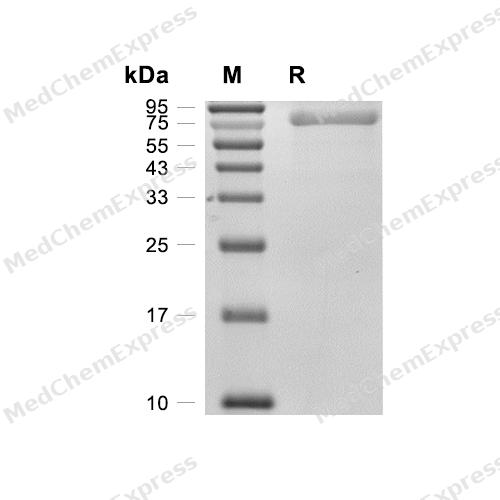
Purity - SDS-PAGE

Assay Procedure
Materials
Assay buffer: 0.1 M sodium phosphate with 0.05% Brij-35, pH 7.5
Acetylcholinesterase/ACHE Protein, Mouse (HEK293, His) (HY-P72811)
DTNB (HY-15915): Dissolve in DMSO to make a 10 mM solution, then dilute with buffer to 100 μM
Substrate mixture: First dilute ATC in DMSO to 20 mM, then dilute ATC to 200 μM with 100 μM DTNB to prepare the substrate mixture
Assay Procedure
1. Dilute Mouse ACHE protein to 0.02 μg/mL with buffer;
2. Add 50 μL of 0.02 μg/mL Mouse ACHE protein buffer to a 96-well plate, then add 50 μL of substrate to start the reaction. Include three replicates per group and a blank control containing 50 μL of buffer and 50 μL of substrate mixture.
3. Zero the microplate reader using the OD value of the blank group, and read the absorbance at 405 nm in kinetic mode for 5 minutes.
4. Calculate the specific activity:
| Specific Activity (pmol/min/μg) = | Adjusted Vmax* (OD/min) × Well Volume (L) × 109 nmol/mol |
| Ext. Coeff **(M-1cm-1) × Path Corr.*** (cm) × Amount of Enzyme (μg) |
**Extinction coefficient (abbrev.: Ext. Coeff): 13260 M-1cm-1
*** Path correction (abbrev.: Path Corr.): 0.32 cm
Mouse ACHE: 0.001 μg
DTNB: 50 μM
ATC: 100 μM


Technical Parameters
-
Species Mouse
-
Source HEK293
-
Tag C-10*His
-
Accession
P21836-1/NP_033729.1 (E32-L614)
-
Molecular Construction
-
N-term
-
ACHE (E32-L614)
Accession # P21836-1/NP_033729.1 -
10*His
-
C-term
-
-
Protein Length
Full Length of Isoform-1
-
Synonyms
ACHE; Apoptosis-Related Acetylcholinesterase; Prev. YT; ARACHE; Acetylcholinesterase; N-ACHE; Acetylcholinesterase (Cartwright Blood Group); ACEE; Yt Blood Group; AChE; N-Terminal Extended Acetylcholinesterase; Acetylcholinesterase (Yt Blood Group); Carbo
-
AA Sequence
EGREDPQLLVRVRGGQLRGIRLKAPGGPVSAFLGIPFAEPPVGSRRFMPPEPKRPWSGVLDATTFQNVCYQYVDTLYPGFEGTEMWNPNRELSEDCLYLNVWTPYPRPASPTPVLIWIYGGGFYSGAASLDVYDGRFLAQVEGAVLVSMNYRVGTFGFLALPGSREAPGNVGLLDQRLALQWVQENIAAFGGDPMSVTLFGESAGAASVGMHILSLPSRSLFHRAVLQSGTPNGPWATVSAGEARRRATLLARLVGCPPGGAGGNDTELIACLRTRPAQDLVDHEWHVLPQESIFRFSFVPVVDGDFLSDTPEALINTGDFQDLQVLVGVVKDEGSYFLVYGVPGFSKDNESLISRAQFLAGVRIGVPQASDLAAEAVVLHYTDWLHPEDPTHLRDAMSAVVGDHNVVCPVAQLAGRLAAQGARVYAYIFEHRASTLTWPLWMGVPHGYEIEFIFGLPLDPSLNYTTEERIFAQRLMKYWTNFARTGDPNDPRDSKSPQWPPYTTAAQQYVSLNLKPLEVRRGLRAQTCAFWNRFLPKLLSATDTLDEAERQWKAEFHRWSSYMVHWKNQFDHYSKQERCSDL
-
Molecular Weight
Approximately 80 kDa, based on SDS-PAGE under reducing conditions, due to the glycosylation.
-
Glycosylation
Yes
-
Purity
≥ 95%, as determined by reducing SDS-PAGE.


Product Properties
Lyophilized powder.
Lyophilized from a 0.2 μm filtered solution of PBS, pH 7.4. Normally 5 % - 8 % trehalose, mannitol and 0.01% Tween 80 are added as protectants before lyophilization.
<1 EU/μg, determined by LAL method.
It is not recommended to reconstitute to a concentration less than 100 μg/mL in ddH2O.
Stored at -20°C for 2 years from date of receipt. After reconstitution, it is stable at 4°C for 1 week or -20°C for longer (with carrier protein). It is recommended to freeze aliquots at -20°C or -80°C for extended storage.
Room temperature in continental US; may vary elsewhere.


Documentation
-
Data Sheet (239 KB)
-
SDS (251 KB)
- English - EN (251 KB)
- Français - FR (251 KB)
- Deutsch - DE (251 KB)
- Norwegian - NO (251 KB)
- Español - ES (251 KB)
- Swedish - SV (251 KB)
- Italian - IT (251 KB)
- Korean - KR (251 KB)
- Portuguese - PT (251 KB)
-
Handling Instructions (2659 KB)

Calculators
Concentration (start) × Volume (start) = Concentration (final) × Volume (final)


 Powered by Bioz

