



Aldolase C Protein, Human (HEK293, His)

Based on 1 Customer Validation
Aldolase C Protein, Human (HEK293, His) is a recombinant human Fructose-bisphosphate aldolase C produced in HEK293 cells, with a His tag at the C-terminus. Aldolase C (ALDOC), which belongs to the aldolase family, is found in normal brain tissue and is responsible for the repair of injured tissue.
- Species: Human
- Source: HEK293
-
Storage:Stored at -80°C for 1 year from date of receipt. It is stable at -20°C for 3 months after opening. It is recommended to freeze aliquots at -80°C for extended storage. Avoid repeated freeze-thaw cycles.


To place orders, for customer services and technical support, please contact: MedChemExpress USA
Tel: 609-228-6898 E-mail: [email protected] [email protected]


-
 Biological Activity
-
Technical Parameters
-
Product Properties
- Documentation
- References
- Help & FAQs




Biological Activity
Description
Aldolase C Protein, Human (HEK293, His) is a recombinant human Fructose-bisphosphate aldolase C produced in HEK293 cells, with a His tag at the C-terminus. Aldolase C (ALDOC), which belongs to the aldolase family, is found in normal brain tissue and is responsible for the repair of injured tissue[1].
Background
The aldolases family is one of the main enzymes involved in the process of glycolysis. Aldolase C (ALDOC) is found in normal brain tissue and is responsible for the repair of injured tissue [1].
Verified Bioactivity
The specific activity is >4 U/mg. One unit will convert 1.0 µmol of fructose 1,6-diphosphate to dihydroxyacetone phosphate and glyceraldehydes 3- phosphate per minute at pH 7.5 at 37 °C.
MCE Validation Data
-
Purity - SDS-PAGE
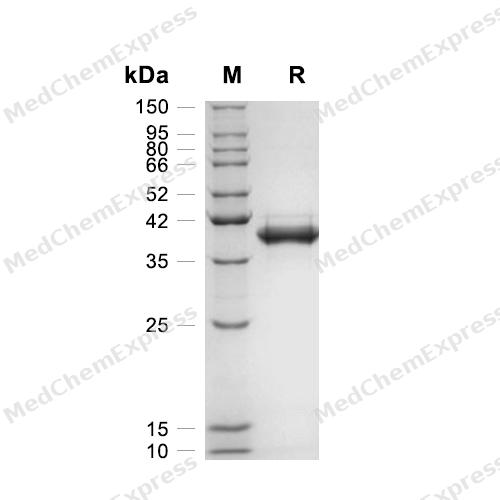
Purity - SDS-PAGE

Assay Procedure
Materials
Aldolase C Protein, Human (HEK293, His) (HY-P7478): Dissolve in deionized water to a concentration of 10 μg/mL.
Substrate: Fructose 1,6-bisphosphate. Accurately weigh 16.24 mg and dissolve in 1 mL of deionized water to a concentration of 40 mM.
NADH: Accurately weigh 5.672 mg of solid powder and dissolve in 1 mL of deionized water to a concentration of 8 mM.
Procedure
1. Serially dilute NADH to the following concentrations: 0, 0.0150625, 0.03125, 0.0625, 0.125, 0.25, 0.5, 1, 2 mM. Add 200 μL per well to a 96-well plate with three replicates.
2. Measure the absorbance at 340 nm using a microplate reader. Plot a standard curve with the amount of NADH as the abscissa and OD value as the ordinate.
3. Dilute the substrate to 40 mM and set aside.
4. Mix 50 μL of 40 mM substrate with 50 μL of 1 mM NADH, add to the 96-well plate in advance, and set three replicates.
5. Dilute the protein to 0.01 mg/mL. Initiate the reaction by adding 100 μL per well.
6. Zero the microplate reader using the OD value of the blank group, and read the absorbance at 340 nm for 10 min in kinetic mode.
7. Define one enzyme activity unit (U) as the amount that consumes 1 μmol of NADH per minute. Calculate the specific enzyme activity:
Specific Activity (U/mg) = | ΔnNADH (μmol) |
| Reaction time (min) x amount of enzyme (mg) |
Per Well:
Human Aldolase C: 1 μg
Substrate: 10 mM
NADH: 0.2 mM


Technical Parameters
-
Species Human
-
Source HEK293
-
Tag C-6*His
-
Accession
P09972 (P2-Y364)
-
Molecular Construction
-
N-term
-
Aldolase C (P2-Y364)
Accession # P09972 -
6*His
-
C-term
-
-
Protein Length
Full Length
-
Synonyms
ALDOC; Fructose-1,6-Biphosphate Triosephosphate Lyase; Aldolase, Fructose-Bisphosphate C; Epididymis Secretory Sperm Binding Protein; Aldolase C, Fructose-Bisphosphate; Fructose-Bisphosphate Aldolase; Fructose-Bisphosphate Aldolase C; Fructoaldolase C; Brain-Type Aldolase; Aldolase 3; ALDC
-
AA Sequence
PHSYPALSAEQKKELSDIALRIVAPGKGILAADESVGSMAKRLSQIGVENTEENRRLYRQVLFSADDRVKKCIGGVIFFHETLYQKDDNGVPFVRTIQDKGIVVGIKVDKGVVPLAGTDGETTTQGLDGLSERCAQYKKDGADFAKWRCVLKISERTPSALAILENANVLARYASICQQNGIVPIVEPEILPDGDHDLKRCQYVTEKVLAAVYKALSDHHVYLEGTLLKPNMVTPGHACPIKYTPEEIAMATVTALRRTVPPAVPGVTFLSGGQSEEEASFNLNAINRCPLPRPWALTFSYGRALQASALNAWRGQRDNAGAATEEFIKRAEVNGLAAQGKYEGSGEDGGAAAQSLYIANHAY
-
Molecular Weight
Approximately 42 kDa, based on SDS-PAGE under reducing conditions.
-
Purity
≥ 95%, as determined by reducing SDS-PAGE.


Product Properties
Solution
1.Supplied as a 0.22 μm filtered solution of 20 mM Tris-HCl, 100 mM NaCl, 50% glycerol, pH 8.0.
Note: For SPR assay, please replace the buffer. Primary amine components (e.g., Tris, imidazole) can affect protein-coupled chips.
<1 EU/μg, determined by LAL method.
Stored at -80°C for 1 year from date of receipt. It is stable at -20°C for 3 months after opening. It is recommended to freeze aliquots at -80°C for extended storage. Avoid repeated freeze-thaw cycles.
Shipping with dry ice.


Documentation
-
Data Sheet (263 KB)
-
SDS (252 KB)
- English - EN (252 KB)
- Français - FR (252 KB)
- Deutsch - DE (252 KB)
- Norwegian - NO (252 KB)
- Español - ES (252 KB)
- Swedish - SV (252 KB)
- Italian - IT (252 KB)
- Korean - KR (252 KB)
- Portuguese - PT (252 KB)
-
Handling Instructions (2659 KB)


References

Calculators
Concentration (start) × Volume (start) = Concentration (final) × Volume (final)


 Powered by Bioz

