



Aldolase B Protein, Human (GST)

Based on 1 Customer Validation
Aldolase B protein catalyzes fructose 1,6-bisphosphate to trisaccharide phosphate during glycolysis and performs reverse aldol addition during gluconeogenesis. Aldolase B Protein, Human (GST) is the recombinant human-derived Aldolase B protein, expressed by E. coli , with N-GST labeled tag.
- Species: Human
- Source: E. coli
-
Storage:Stored at -20°C for 2 years from date of receipt. After reconstitution, it is stable at 4°C for 1 week or -20°C for longer (with carrier protein). It is recommended to freeze aliquots at -20°C or -80°C for extended storage.


To place orders, for customer services and technical support, please contact: MedChemExpress USA
Tel: 609-228-6898 E-mail: [email protected] [email protected]


-
 Biological Activity
-
Technical Parameters
-
Product Properties
- Documentation
- Help & FAQs




Biological Activity
Description
Aldolase B protein catalyzes fructose 1,6-bisphosphate to trisaccharide phosphate during glycolysis and performs reverse aldol addition during gluconeogenesis. Aldolase B Protein, Human (GST) is the recombinant human-derived Aldolase B protein, expressed by E. coli , with N-GST labeled tag.
Background
Aldolase B protein serves a pivotal role in glycolysis by catalyzing the aldol cleavage of fructose 1,6-bisphosphate into dihydroxyacetone phosphate and D-glyceraldehyde 3-phosphate, as well as the reverse stereospecific aldol addition reaction in gluconeogenesis. Additionally, in fructolysis, it metabolizes fructose 1-phosphate, derived from the phosphorylation of dietary fructose by fructokinase, into dihydroxyacetone phosphate and D-glyceraldehyde. Beyond its enzymatic function, Aldolase B acts as an adapter and functions as a tumor suppressor by stabilizing a ternary complex with G6PD and TP53, inhibiting G6PD activity. This regulatory mechanism helps maintain control over oxidative pentose phosphate metabolism, contributing to the overall balance of cellular metabolic pathways.
Verified Bioactivity
The specific activity is >4 U/mg. One unit will convert 1.0 µmol of fructose 1,6-diphosphate to dihydroxyacetone phosphate and glyceraldehydes 3- phosphate per minute at pH 7.5 at 37°C in the presence.
MCE Validation Data
-
Purity - SDS-PAGE
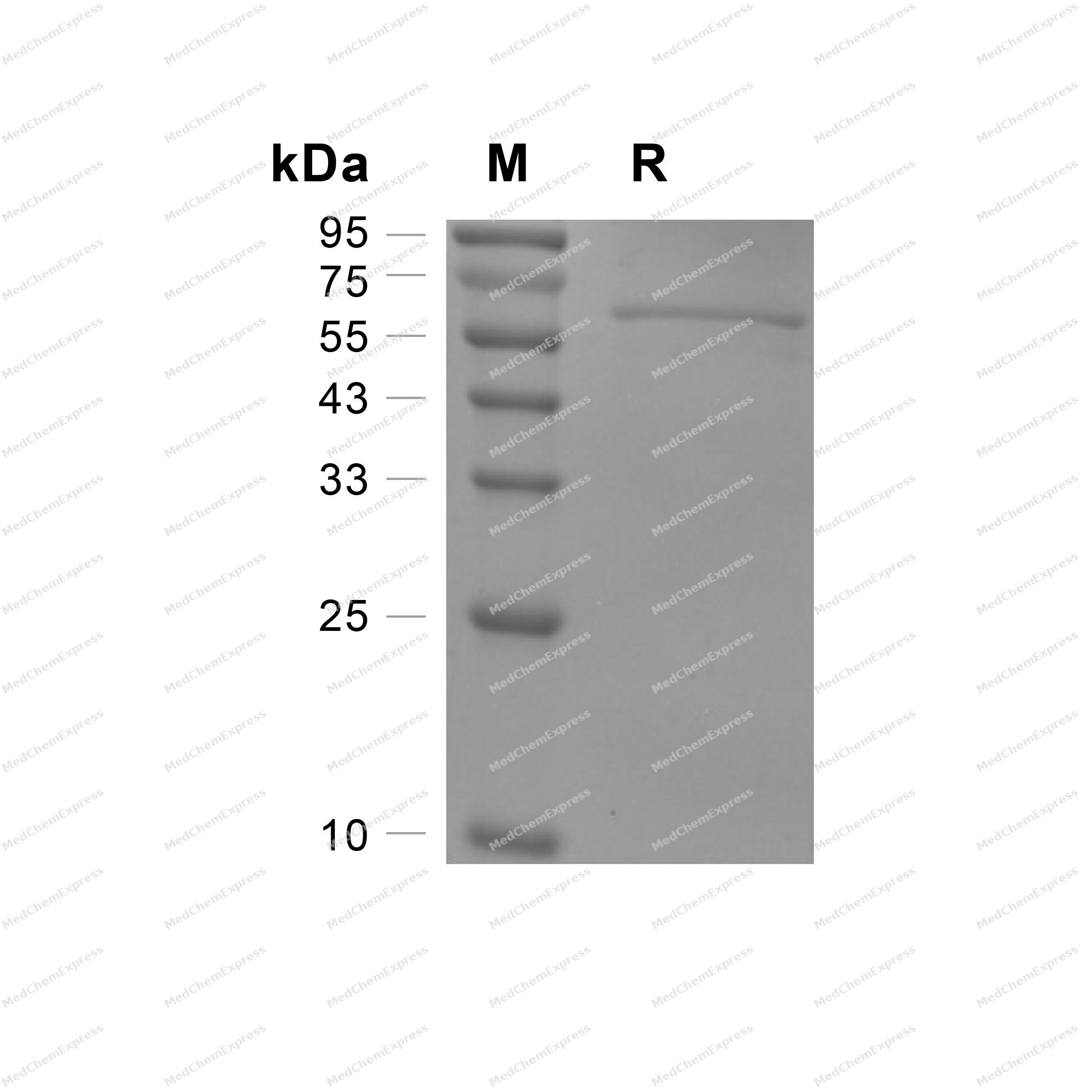
Purity - SDS-PAGE

Assay Procedure
Materials
Assay buffer: 50 mM Tris-HCl (containing 0.1 mM EDTA), pH 7.4
Substrate solution: 50 mM sodium fructose-1,6-bisphosphate (prepared using assay buffer)
Coenzyme solution: 10 mM β-NADH (prepared fresh with ice-cold ultrapure water)
Coupling enzyme complex: α-Glycerophosphate Dehydrogenase-Triose Phosphate Isomerase (α-GDH-TPI)
Aldolase B Protein, Human (GST) (HY-P74419A)
Procedure
1. Preparation of reaction working solution (per well, total reaction volume 172 μL; prepare an additional 10% volume to compensate for losses)
Component — Volume per well (μL) — Final concentration
Fructose-1,6-bisphosphate (50 mM)——20 μL——50 mM
NADH (10 mM) —— 4 μL —— 0.2 mM
α-GDH-TPI (100 U/mL) —— 2 μL —— 1 U/mL
Assay buffer —— 146 μL—— /
2. Add reaction working solution: Add 172 μL of reaction working solution to each detection well of the 96-well UV plate.
3. Pre-incubation: Place the 96-well UV plate in a pre-warmed microplate reader set to 37°C and incubate for 5-10 minutes to equilibrate the system temperature.
4. Add assay protein: Resuspend protein in sterile water to 200 μg/mL. Prepare 10 μg/mL Aldolase B protein in assay buffer. Quickly add 28 μL of each sample to the wells. Use assay buffer without protein for the control group.
5. Kinetic Monitoring: Immediately return the plate to the microplate reader and initiate absorbance monitoring at 340 nm. Read every 30 seconds for 10 minutes.
6. Calculate Enzyme Activity:
Enzyme activity definition: One enzyme activity unit (U) is defined as the consumption of 1 μmol of NADH per minute.
Enzyme Activity Formula:
Specific Activity (U/mg) = | ΔA/min x Vr |
| ε x d x Vs x Cpr |
Vr: Total reaction volume = 0.2 mL
ε: NADH molar extinction coefficient = 6.22 L?mmol-1?cm-1
d: Optical path length of 96-well UV plate = 0.1 cm
Vs: Sample volume = 0.028 mL
Cpr: Aldolase protein concentration (mg/mL)


Technical Parameters
-
Species Human
-
Source E. coli
-
Tag N-GST
-
Accession
P05062 (A2-Y364)
-
Gene ID229
-
Molecular Construction
-
N-term
-
GST
-
Aldolase B (A2-Y364)
Accession # P05062 -
C-term
-
-
Protein Length
Full Length
-
Synonyms
ALDOB; ALDB; Aldolase, Fructose-Bisphosphate B; Aldolase B, Fructose-Bisphosphatase; Aldolase B, Fructose-Bisphosphate; Fructose-Bisphosphate Aldolase; Fructose-Bisphosphate Aldolase B; Aldolase 2; Liver-Type Aldolase; ALDO2
-
AA Sequence
AHRFPALTQEQKKELSEIAQSIVANGKGILAADESVGTMGNRLQRIKVENTEENRRQFREILFSVDSSINQSIGGVILFHETLYQKDSQGKLFRNILKEKGIVVGIKLDQGGAPLAGTNKETTIQGLDGLSERCAQYKKDGVDFGKWRAVLRIADQCPSSLAIQENANALARYASICQQNGLVPIVEPEVIPDGDHDLEHCQYVTEKVLAAVYKALNDHHVYLEGTLLKPNMVTAGHACTKKYTPEQVAMATVTALHRTVPAAVPGICFLSGGMSEEDATLNLNAINLCPLPKPWKLSFSYGRALQASALAAWGGKAANKEATQEAFMKRAMANCQAAKGQYVHTGSSGAASTQSLFTACYTY
-
Predicted Molecular Mass
64.8 kDa
-
Molecular Weight
Approximately 65 kDa, based on SDS-PAGE under reducing conditions.
-
Purity
≥ 90%, as determined by reducing SDS-PAGE.


Product Properties
Lyophilized powder
Lyophilized from a 0.22 μm filtered solution of PBS, pH 7.4 or PBS, pH 7.4, 8% trehalose.
<1 EU/μg, determined by LAL method.
It is not recommended to reconstitute to a concentration less than 100 μg/mL in ddH2O. For long term storage it is recommended to add a carrier protein (0.1% BSA, 5% HSA, 10% FBS or 5% Trehalose).
Stored at -20°C for 2 years from date of receipt. After reconstitution, it is stable at 4°C for 1 week or -20°C for longer (with carrier protein). It is recommended to freeze aliquots at -20°C or -80°C for extended storage.
Room temperature in continental US; may vary elsewhere.


Documentation
-
Data Sheet (237 KB)
-
SDS (251 KB)
- English - EN (251 KB)
- Français - FR (251 KB)
- Deutsch - DE (251 KB)
- Norwegian - NO (251 KB)
- Español - ES (251 KB)
- Swedish - SV (251 KB)
- Italian - IT (251 KB)
- Korean - KR (251 KB)
- Portuguese - PT (251 KB)
-
Handling Instructions (2659 KB)

Calculators
Concentration (start) × Volume (start) = Concentration (final) × Volume (final)


 Powered by Bioz

