



Annexin A1/ANXA1 Protein, Mouse (His)
Based on 2 publication(s) in Google Scholar
Annexin A1 (ANXA1) plays multifaceted roles in innate and adaptive immune responses.It acts as an effector of glucocorticoid-mediated responses, downregulating early inflammation.Annexin A1/ANXA1 Protein, Mouse (His) is the recombinant mouse-derived Annexin A1/ANXA1 protein, expressed by E.coli , with N-6*His labeled tag.
- Species: Mouse
- Source: E. coli
-
Storage:Stored at -20°C for 2 years from date of receipt. After reconstitution, it is stable at 4°C for 1 week or -20°C for longer (with carrier protein). It is recommended to freeze aliquots at -20°C or -80°C for extended storage.


To place orders, for customer services and technical support, please contact: MedChemExpress USA
Tel: 609-228-6898 E-mail: [email protected] [email protected]


-
 Biological Activity
-
Technical Parameters
-
Product Properties
- Documentation
- Help & FAQs




Biological Activity
Description
Annexin A1 (ANXA1) plays multifaceted roles in innate and adaptive immune responses.It acts as an effector of glucocorticoid-mediated responses, downregulating early inflammation.Annexin A1/ANXA1 Protein, Mouse (His) is the recombinant mouse-derived Annexin A1/ANXA1 protein, expressed by E.coli , with N-6*His labeled tag.
Background
Annexin A1 (ANXA1) emerges as a multifaceted player in the innate immune response, acting as both an effector of glucocorticoid-mediated responses and a regulator of the inflammatory process. Exhibiting potent anti-inflammatory activity, ANXA1 contributes to the glucocorticoid-mediated down-regulation of the early phase of the inflammatory response. Beyond its role in the innate immune system, ANXA1 significantly impacts the adaptive immune response by enhancing signaling cascades triggered by T-cell activation, thereby regulating the differentiation and proliferation of activated T-cells. It promotes T-cell differentiation into Th1 cells while negatively regulating differentiation into Th2 cells. Additionally, ANXA1 plays a pivotal role in hormone exocytosis regulation through the activation of formyl peptide receptors and reorganization of the actin cytoskeleton. With a high affinity for Ca(2+), ANXA1 can bind up to eight Ca(2+) ions and demonstrates Ca(2+)-dependent interactions with phospholipid membranes. Functionally, ANXA1 contributes to the formation of phagocytic cups and phagosomes, playing a crucial role in phagocytosis by mediating the Ca(2+)-dependent interaction between phagosomes and the actin cytoskeleton. Moreover, ANXA1 promotes chemotaxis of granulocytes and monocytes through activation of formyl peptide receptors, leading to the rearrangement of the actin cytoskeleton, cell polarization, and cell migration. Beyond its immune functions, ANXA1 plays a vital role in the resolution of inflammation and wound healing, acting through neutrophil N-formyl peptide receptors to enhance the release of CXCL2.
Verified Bioactivity
Measured by its ability to inhibit TNF-alpha secretion by RAW264.7 mouse macrophage cells. 0.3 μg/mL Mouse Annexin A1 can effectively inhibit TNF-alpha secretion in the presence of 100 ng/mL LPS.
MCE Validation Data
-
Purity - SDS-PAGE
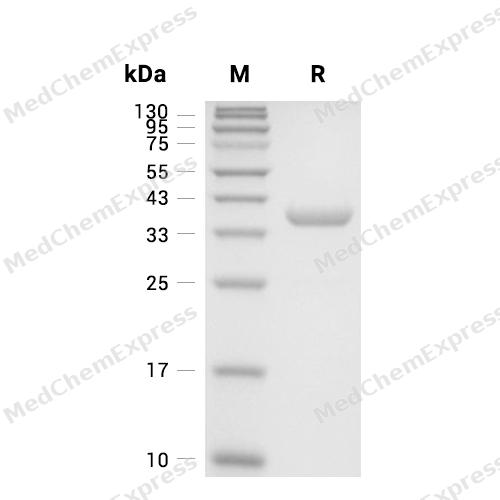
Purity - SDS-PAGE
-
Bioactivity - Cell-Based Assay
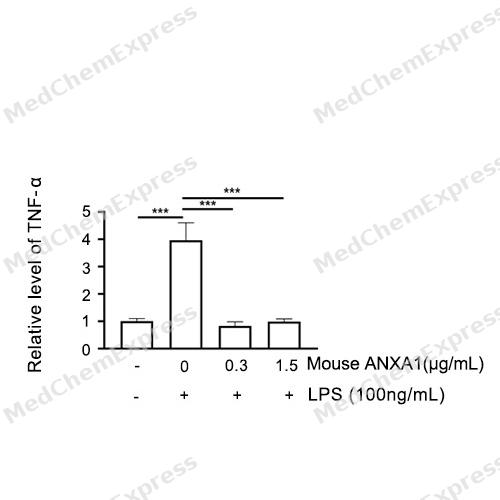
Bioactivity - Cell-Based Assay


Publications (2)
-
Journal Impact Factor
-
Most Recent
-
Signal Transduct Target Ther
Single-cell transcriptional dissection illuminates an evolution of immunosuppressive microenvironment during pancreatic ductal adenocarcinoma metastasis. [Abstract]2025 Jun 9;10(1):182. PMID: 40484878 -
Nat Commun
Resistance to anti-LAG-3 plus anti-PD-1 therapy in head and neck cancer is mediated by Sox9+ tumor cells interaction with Fpr1+ neutrophils. [Abstract]2025 Apr 28;16(1):3975. PMID: 40295483


Technical Parameters
-
Species Mouse
-
Source E. coli
-
Tag N-6*His
-
Accession
P10107 (A2-N346)
-
Molecular Construction
-
N-term
-
6*His
-
ANXA1 (A2-N346)
Accession # P10107 -
C-term
-
-
Protein Length
Full Length
-
Synonyms
ANXA1; Annexin-1; Prev. ANX1; Annexin I (Lipocortin I); Prev. LPC1; ANXA1 Protein; Phospholipase A2 Inhibitory Protein; Lipocortin I; Chromobindin-9; Annexin I; Calpactin II; Annexin; Calpactin-2; P35; Annexin A1; Epididymis Secretory Sperm Binding Protei
-
AA Sequence
AMVSEFLKQARFLENQEQEYVQAVKSYKGGPGSAVSPYPSFNVSSDVAALHKAIMVKGVDEATIIDILTKRTNAQRQQIKAAYLQENGKPLDEVLRKALTGHLEEVVLAMLKTPAQFDADELRGAMKGLGTDEDTLIEILTTRSNEQIREINRVYREELKRDLAKDITSDTSGDFRKALLALAKGDRCQDLSVNQDLADTDARALYEAGERRKGTDVNVFTTILTSRSFPHLRRVFQNYGKYSQHDMNKALDLELKGDIEKCLTTIVKCATSTPAFFAEKLYEAMKGAGTRHKALIRIMVSRSEIDMNEIKVFYQKKYGISLCQAILDETKGDYEKILVALCGGN
-
Molecular Weight
Approximately 40 kDa, based on SDS-PAGE under reducing conditions.
-
Purity
≥ 90%, as determined by reducing SDS-PAGE.


Product Properties
Lyophilized powder
1.Lyophilized from a 0.22 μm filtered solution of PBS, 6% trehalose.
2.Lyophilized from a 0.22 μm filtered solution of 20 mM Tris-HCl, 0.5 M NaCl, 6% trehalose, pH 8.0.
3.Lyophilized from a 0.22 μm filtered solution of PBS, pH 7.4, 6% trehalose.
Please refer to the lot-specific COA for specific buffer information.
Note: For SPR assay, please replace the buffer. Primary amine components (e.g., Tris, imidazole) can affect protein-coupled chips.
<1 EU/μg, determined by LAL method.
It is not recommended to reconstitute to a concentration less than 100 μg/mL in ddH2O.
Stored at -20°C for 2 years from date of receipt. After reconstitution, it is stable at 4°C for 1 week or -20°C for longer (with carrier protein). It is recommended to freeze aliquots at -20°C or -80°C for extended storage.
Room temperature in continental US; may vary elsewhere.


Documentation
-
Data Sheet (238 KB)
-
SDS (252 KB)
- English - EN (252 KB)
- Français - FR (252 KB)
- Deutsch - DE (252 KB)
- Norwegian - NO (252 KB)
- Español - ES (252 KB)
- Swedish - SV (252 KB)
- Italian - IT (252 KB)
- Korean - KR (252 KB)
- Portuguese - PT (252 KB)
-
Handling Instructions (2659 KB)

Calculators
Concentration (start) × Volume (start) = Concentration (final) × Volume (final)


 Powered by Bioz

