



APT-1/LYPLA1 Protein, Human (His)

Based on 1 Customer Validation
The APT-1/LYPLA1 protein is an acylprotein thioesterase that hydrolyzes fatty acids from S-acylated cysteine residues in proteins, including G alpha proteins and HRAS. It also depalmitoylates KCNMA1 and potentially ADRB2 while acting as a lysophospholipase, hydrolyzing lysophosphatidylcholine (lyso-PC) and other lysophospholipids (lyso-PE, lyso-PI, lyso-PS). APT-1/LYPLA1 Protein, Human (His) is the recombinant human-derived APT-1/LYPLA1 protein, expressed by E. coli , with N-6*His labeled tag.
- Species: Human
- Source: E. coli
-
Storage:Stored at -80°C for 1 year from date of receipt. It is stable at -20°C for 3 months after opening. It is recommended to freeze aliquots at -80°C for extended storage. Avoid repeated freeze-thaw cycles.


To place orders, for customer services and technical support, please contact: MedChemExpress USA
Tel: 609-228-6898 E-mail: [email protected] [email protected]


-
 Biological Activity
-
Technical Parameters
-
Product Properties
- Documentation
- Help & FAQs




Biological Activity
Description
The APT-1/LYPLA1 protein is an acylprotein thioesterase that hydrolyzes fatty acids from S-acylated cysteine residues in proteins, including G alpha proteins and HRAS. It also depalmitoylates KCNMA1 and potentially ADRB2 while acting as a lysophospholipase, hydrolyzing lysophosphatidylcholine (lyso-PC) and other lysophospholipids (lyso-PE, lyso-PI, lyso-PS). APT-1/LYPLA1 Protein, Human (His) is the recombinant human-derived APT-1/LYPLA1 protein, expressed by E. coli , with N-6*His labeled tag.
Background
APT-1/LYPLA1 protein functions as an acyl-protein thioesterase, catalyzing the hydrolysis of fatty acids from S-acylated cysteine residues within proteins, including trimeric G alpha proteins and HRAS. Additionally, it exhibits depalmitoylating activity towards KCNMA1 and potentially ADRB2. Acting as a lysophospholipase, APT-1/LYPLA1 hydrolyzes lysophosphatidylcholine (lyso-PC) and other lysophospholipids such as lyso-PE, lyso-PI, and lyso-PS, with a higher affinity for thioesterase activity. This protein significantly contributes to blood coagulation by recognizing and cleaving plasma phospholipids, generating lysophospholipids that serve as substrates for ENPP2, ultimately producing lysophosphatidic acid (LPA).
Verified Bioactivity
The enzyme activity of this recombinant protein is testing in progress, we cannot offer a guarantee yet.
MCE Validation Data
-
Purity - SDS-PAGE
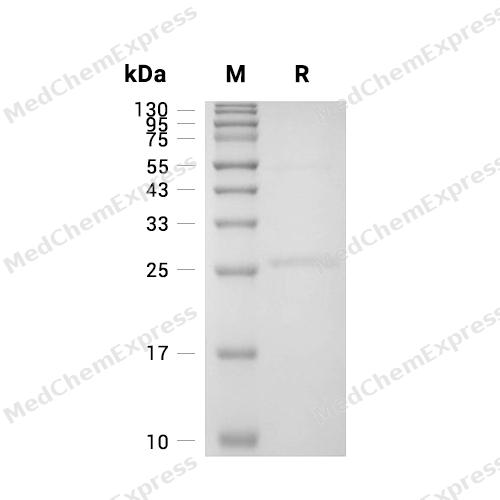
Purity - SDS-PAGE


Technical Parameters
-
Species Human
-
Source E. coli
-
Tag N-6*His
-
Accession
O75608 (M1-D230)
-
Molecular Construction
-
N-term
-
6*His
-
APT-1 (M1-D230)
Accession # O75608 -
C-term
-
-
Protein Length
Full Length
-
Synonyms
LYPLA1; Palmitoyl-Protein Hydrolase; Lysophospholipase 1; APT1; Acyl-Protein Thioesterase 1; LysoPLA I; Lysophospholipase I; LPL-I; APT-1; HAPT1; LPL1; Lysophospholipid-Specific Lysophospholipase
-
AA Sequence
MCGNNMSTPLPAIVPAARKATAAVIFLHGLGDTGHGWAEAFAGIRSSHIKYICPHAPVRPVTLNMNVAMPSWFDIIGLSPDSQEDESGIKQAAENIKALIDQEVKNGIPSNRIILGGFSQGGALSLYTALTTQQKLAGVTALSCWLPLRASFPQGPIGGANRDISILQCHGDCDPLVPLMFGSLTVEKLKTLVNPANVTFKTYEGMMHSSCQQEMMDVKQFIDKLLPPID
-
Predicted Molecular Mass
26.8 kDa
-
Molecular Weight
Approximately 25 kDa, based on SDS-PAGE under reducing conditions.
-
Purity
≥ 95%, as determined by reducing SDS-PAGE.


Product Properties
Solution
1.Supplied as a 0.22 μm filter solution of 20 mM Tris-HCl, 100 mM NaCl, 1 mM DTT, 10% glycerol, pH 8.0.
2.Supplied as a 0.22 μm filter solution of 20 mM Tris-HCl, 150 mM NaCl, 8% glycerol, 5% trehalose, 2 mM DTT, 0.5 mM EDTA, 0.05% Tween 20, pH 8.2.
Please refer to the lot-specific COA for specific buffer information.
Note: For SPR assay, please replace the buffer. Primary amine components (e.g., Tris, imidazole) can affect protein-coupled chips.
<1 EU/μg, determined by LAL method.
Stored at -80°C for 1 year from date of receipt. It is stable at -20°C for 3 months after opening. It is recommended to freeze aliquots at -80°C for extended storage. Avoid repeated freeze-thaw cycles.
Shipping with dry ice.


Documentation
-
Data Sheet (236 KB)
-
SDS (251 KB)
- English - EN (251 KB)
- Français - FR (251 KB)
- Deutsch - DE (251 KB)
- Norwegian - NO (251 KB)
- Español - ES (251 KB)
- Swedish - SV (251 KB)
- Italian - IT (251 KB)
- Korean - KR (251 KB)
- Portuguese - PT (251 KB)
-
Handling Instructions (2659 KB)

Calculators
Concentration (start) × Volume (start) = Concentration (final) × Volume (final)


 Powered by Bioz

