



CD105/Endoglin Protein, Mouse (HEK293, His, solution)
Based on 1 Customer Validation
CD105/Endoglin is an important endothelial glycoprotein that controls angiogenesis and ensures the structural integrity of the adult vasculature. It affects vascular endothelial cell migration and has important implications for extraembryonic and embryonic heart development. CD105/Endoglin Protein, Mouse (HEK293, His, solution) is the recombinant mouse-derived CD105/Endoglin protein, expressed by HEK293 , with C-His labeled tag.
- Species: Mouse
- Source: HEK293
-
Storage:Stored at -80°C for 1 year from date of receipt. It is stable at -20°C for 3 months after opening. It is recommended to freeze aliquots at -80°C for extended storage. Avoid repeated freeze-thaw cycles.


To place orders, for customer services and technical support, please contact: MedChemExpress USA
Tel: 609-228-6898 E-mail: [email protected] [email protected]


-
 Biological Activity
-
Technical Parameters
-
Product Properties
- Documentation
- Help & FAQs




Biological Activity
Description
CD105/Endoglin is an important endothelial glycoprotein that controls angiogenesis and ensures the structural integrity of the adult vasculature. It affects vascular endothelial cell migration and has important implications for extraembryonic and embryonic heart development. CD105/Endoglin Protein, Mouse (HEK293, His, solution) is the recombinant mouse-derived CD105/Endoglin protein, expressed by HEK293 , with C-His labeled tag.
Background
CD105/Endoglin, a vascular endothelium glycoprotein, plays a crucial role in angiogenesis regulation, contributing to the normal structure and integrity of adult vasculature. Essential for maintaining the structural integrity of the vasculature, CD105/Endoglin also influences the migration of vascular endothelial cells. Its significance extends to extraembryonic angiogenesis and embryonic heart development, underscoring its essential role in vascular development. CD105/Endoglin may modulate endothelial cell responses to blood flow, impacting vascular remodeling and the establishment of normal vascular morphology during angiogenesis. Functioning as a TGF-beta coreceptor, it is involved in the TGF-beta/BMP signaling cascade, leading to the activation of SMAD transcription factors. Furthermore, CD105/Endoglin interacts with various molecules, including TGFB1, GDF2, ACVRL1, BMP10, DYNLT4, and ARRB2, highlighting its multifaceted involvement in cellular processes. The protein forms homodimers through disulfide linkages and engages in heteromeric complexes with TGF-beta signaling receptors. Additionally, CD105/Endoglin binds TGFB1 and TGFB2 with high affinity, further emphasizing its intricate role in molecular interactions.
Verified Bioactivity
Measured by its ability to inhibit BMP9-induced alkaline phosphatase production by MC3T3E1 mouse chondrogenic cells. The ED50 for this effect is typically 25-100 ng/mL in the presence of 2 ng/mL of recombinant human BMP9.
MCE Validation Data
-
Purity - SDS-PAGE
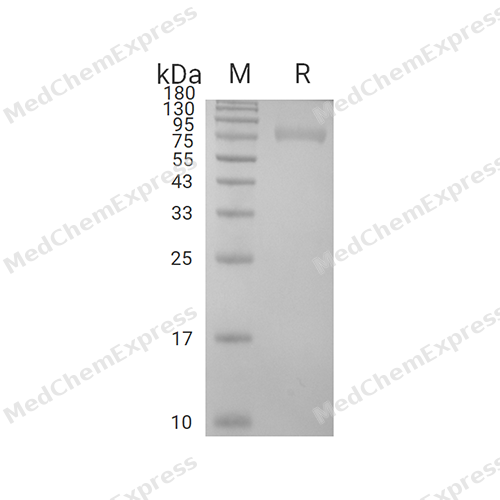
Purity - SDS-PAGE


Technical Parameters
-
Species Mouse
-
Source HEK293
-
Tag C-His
-
Accession
Q63961 (R28-G581)
-
Molecular Construction
-
N-term
-
CD105 (R28-G581)
Accession # Q63961 -
His
-
C-term
-
-
Protein Length
Extracellular Domain
-
Synonyms
ENG; CD105 Antigen; Prev. ORW1; Endoglin (Osler-Rendu-Weber Syndrome 1); Prev. ORW; Osler-Rendu-Weber Syndrome 1; END; Soluble Endoglin; HHT1; ENG Protein; Endoglin; CD105
-
AA Sequence
RVGCDLQPVDPTRGEVTFTTSQVSEGCVAQAANAVREVHVLFLDFPGMLSHLELTLQASKQNGTETQEVFLVLVSNKNVFVKFQAPEIPLHLAYDSSLVIFQGQPRVNITVLPSLTSRKQILDWAATKGAITSIAALDDPQSIVLQLGQDPKAPFLCLPEAHKDMGATLEWQPRAQTPVQSCRLEGVSGHKEAYILRILPGSEAGPRTVTVMMELSCTSGDAILILHGPPYVSWFIDINHSMQILTTGEYSVKIFPGSKVKGVELPDTPQGLIAEARKLNASIVTSFVELPLVSNVSLRASSCGGVFQTTPAPVVTTPPKDTCSPVLLMSLIQPKCGNQVMTLALNKKHVQTLQCTITGLTFWDSSCQAEDTDDHLVLSSAYSSCGMKVTAHVVSNEVIISFPSGSPPLRKKVQCIDMDSLSFQLGLYLSPHFLQASNTIELGQQAFVQVSVSPLTSEVTVQLDSCHLDLGPEGDMVELIQSRTAKGSCVTLLSPSPEGDPRFSFLLRVYMVPTPTAGTLSCNLALRPSTLSQEVYKTVSMRLNIVSPDLSGKG
-
Predicted Molecular Mass
61.2 kDa
-
Molecular Weight
Approximately 65-80 kDa, based on SDS-PAGE under reducing conditions, due to the glycosylation.
-
Glycosylation
Yes
-
Purity
≥ 95%, as determined by reducing SDS-PAGE.


Product Properties
Solution
Supplied as a 0.22 μm filtered solution of PBS, pH 7.4.
<1 EU/μg, determined by LAL method.
Stored at -80°C for 1 year from date of receipt. It is stable at -20°C for 3 months after opening. It is recommended to freeze aliquots at -80°C for extended storage. Avoid repeated freeze-thaw cycles.
Shipping with dry ice.


Documentation
-
Data Sheet (239 KB)
-
SDS (252 KB)
- English - EN (252 KB)
- Français - FR (252 KB)
- Deutsch - DE (252 KB)
- Norwegian - NO (252 KB)
- Español - ES (252 KB)
- Swedish - SV (252 KB)
- Italian - IT (252 KB)
- Korean - KR (252 KB)
- Portuguese - PT (252 KB)
-
Handling Instructions (2659 KB)

Calculators
Concentration (start) × Volume (start) = Concentration (final) × Volume (final)


 Powered by Bioz

