



CD98 Protein, Human (HEK293, His)

Based on 1 Customer Validation
The CD98 protein acts as a chaperone, promoting the biogenesis and trafficking of functional transporter heterodimers to the plasma membrane. It forms heterodimers with various SLC7 family transporters and affects the substrate specificity of amino acid antiporters. CD98 Protein, Human (HEK293, His) is the recombinant human-derived CD98 protein, expressed by HEK293 , with N-His labeled tag.
- Species: Human
- Source: HEK293
-
Storage:Stored at -20°C for 2 years from date of receipt. After reconstitution, it is stable at 4°C for 1 week or -20°C for longer (with carrier protein). It is recommended to freeze aliquots at -20°C or -80°C for extended storage.


To place orders, for customer services and technical support, please contact: MedChemExpress USA
Tel: 609-228-6898 E-mail: [email protected] [email protected]


-
 Biological Activity
-
Technical Parameters
-
Product Properties
- Documentation
- Help & FAQs




Biological Activity
Description
The CD98 protein acts as a chaperone, promoting the biogenesis and trafficking of functional transporter heterodimers to the plasma membrane. It forms heterodimers with various SLC7 family transporters and affects the substrate specificity of amino acid antiporters. CD98 Protein, Human (HEK293, His) is the recombinant human-derived CD98 protein, expressed by HEK293 , with N-His labeled tag.
Background
CD98 protein functions as a chaperone that aids in the biogenesis and trafficking of functional transporter heterodimers to the plasma membrane. It forms heterodimers with various SLC7 family transporters, including SLC7A5, SLC7A6, SLC7A7, SLC7A8, SLC7A10, and SLC7A11, acting as amino acid antiporters with substrate specificity determined by the SLC7A subunit. For instance, the heterodimer SLC3A2/SLC7A11 functions as an antiporter by mediating the exchange of extracellular anionic L-cystine and intracellular L-glutamate. Additionally, SLC3A2/SLC7A5, when associated with LAPTM4B, is recruited to lysosomes, promoting leucine uptake and mTORC1 activation. CD98 is essential for plasma membrane localization, stability, and transport activity of various SLC7 transporters. Moreover, it plays a pivotal role in modulating integrin-related signaling, contributing to cell spreading, migration, and tumor progression. In the context of hepatitis C virus (HCV) infection, the SLC3A2 and SLC7A5/LAT1 complex facilitates viral entry into host cells and increases L-leucine uptake, thereby enhancing mTORC1 signaling activation and contributing to HCV-mediated pathogenesis.
Verified Bioactivity
1.Immobilized CD98, Human His Tag at 0.5 μg/mL (100μl/well) on the plate. Dose response curve for Anti-CD98 Antibody, mFc Tag with the EC50 of 11.1 ng/mL determined by ELISA.
2.Immobilized Human CD98 at 2 μg/mL (100 μL/well) can bind Anti-CD98 Antibody. The ED50 for this effect is 0.03379 nM.
MCE Validation Data
-
Purity - SDS-PAGE
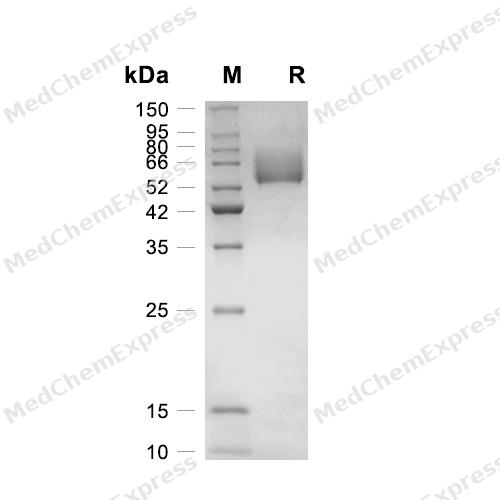
Purity - SDS-PAGE
-
Bioactivity - ELISA
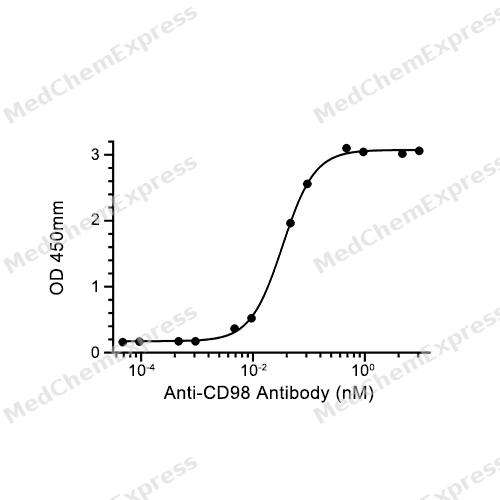
Bioactivity - ELISA


Technical Parameters
-
Species Human
-
Source HEK293
-
Tag N-His
-
Accession
P08195-1 (R206-A630)
-
Molecular Construction
-
N-term
-
His
-
CD98 (R206-A630)
Accession # P08195-1 -
C-term
-
-
Protein Length
Extracellular Domain
-
Synonyms
SLC3A2; Solute Carrier Family 3 (Activators Of Dibasic And Neutral Amino Acid Transport), Member 2; Prev. MDU1; Solute Carrier Family 3 (Amino Acid Transporter Heavy Chain), Member 2; 4F2 Cell-Surface Antigen Heavy Chain; Monoclonal Antibody 44D7; Lymphoc
-
AA Sequence
RAPRCRELPAQKWWHTGALYRIGDLQAFQGHGAGNLAGLKGRLDYLSSLKVKGLVLGPIHKNQKDDVAQTDLLQIDPNFGSKEDFDSLLQSAKKKSIRVILDLTPNYRGENSWFSTQVDTVATKVKDALEFWLQAGVDGFQVRDIENLKDASSFLAEWQNITKGFSEDRLLIAGTNSSDLQQILSLLESNKDLLLTSSYLSDSGSTGEHTKSLVTQYLNATGNRWCSWSLSQARLLTSFLPAQLLRLYQLMLFTLPGTPVFSYGDEIGLDAAALPGQPMEAPVMLWDESSFPDIPGAVSANMTVKGQSEDPGSLLSLFRRLSDQRSKERSLLHGDFHAFSAGPGLFSYIRHWDQNERFLVVLNFGDVGLSAGLQASDLPASASLPAKADLLLSTQPGREEGSPLELERLKLEPHEGLLLRFPYAA
-
Molecular Weight
Approximately 55-75 kDa, based on SDS-PAGE under reducing conditions, due to the glycosylation.
-
Glycosylation
Yes
-
Purity
≥ 95%, as determined by reducing SDS-PAGE.


Product Properties
Lyophilized powder
Lyophilized from a 0.2 μm filtered solution of 20 mM PB, 150 mM NaCl, pH 7.4.
<1 EU/μg, determined by LAL method.
It is not recommended to reconstitute to a concentration less than 100 μg/mL in ddH2O.
Stored at -20°C for 2 years from date of receipt. After reconstitution, it is stable at 4°C for 1 week or -20°C for longer (with carrier protein). It is recommended to freeze aliquots at -20°C or -80°C for extended storage.
Room temperature in continental US; may vary elsewhere.


Documentation
-
Data Sheet (262 KB)
-
SDS (251 KB)
- English - EN (251 KB)
- Français - FR (251 KB)
- Deutsch - DE (251 KB)
- Norwegian - NO (251 KB)
- Español - ES (251 KB)
- Swedish - SV (251 KB)
- Italian - IT (251 KB)
- Korean - KR (251 KB)
- Portuguese - PT (251 KB)
-
Handling Instructions (2659 KB)

Calculators
Concentration (start) × Volume (start) = Concentration (final) × Volume (final)


 Powered by Bioz

