



CXCR3 Protein, Human (His)

Based on 1 Customer Validation
CXCR3 Protein, Human (His) is the recombinant human-derived CXCR3, expressed by E. coli , with C-His tag.
- Species: Human
- Source: E. coli
-
Storage:Stored at -20°C for 2 years from date of receipt. After reconstitution, it is stable at 4°C for 1 week or -20°C for longer (with carrier protein). It is recommended to freeze aliquots at -20°C or -80°C for extended storage.


To place orders, for customer services and technical support, please contact: MedChemExpress USA
Tel: 609-228-6898 E-mail: [email protected] [email protected]


-
 Biological Activity
-
Technical Parameters
-
Product Properties
- Documentation
- Help & FAQs




Biological Activity
Description
CXCR3 Protein, Human (His) is the recombinant human-derived CXCR3, expressed by E. coli , with C-His tag.
Background
The CXCR3 Protein functions as a receptor for the C-X-C chemokines CXCL9, CXCL10, and CXCL11, mediating the proliferation, survival, and angiogenic activity of human mesangial cells (HMC) through a heterotrimeric G-protein signaling pathway. Additionally, it binds to CCL21, potentially promoting cell chemotaxis response. CXCR3 also serves as a receptor for the C-X-C chemokine CXCL4, playing a role in mediating the inhibitory activities of CXCL9, CXCL10, and CXCL11 on the proliferation, survival, and angiogenic activity of human microvascular endothelial cells (HMVEC) through a cAMP-mediated signaling pathway. Interestingly, CXCR3 does not promote cell chemotaxis response but, upon interaction with CXCL4 or CXCL10, activates the p38MAPK pathway, contributing to the inhibition of angiogenesis. Notably, overexpression of CXCR3 in renal cancer cells down-regulates the expression of the anti-apoptotic protein HMOX1 and promotes apoptosis, indicating its involvement in modulating cellular processes relevant to cancer biology.
MCE Validation Data
-
Purity - SDS-PAGE
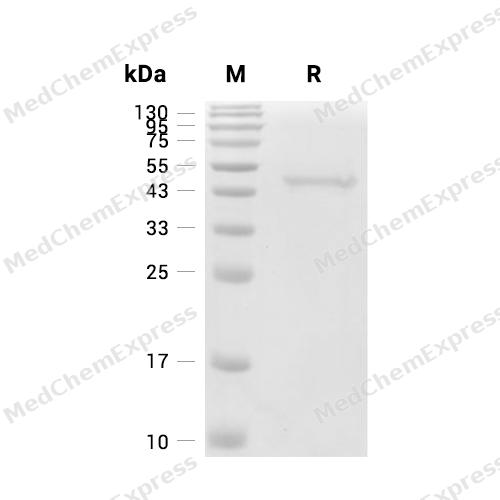
Purity - SDS-PAGE


Technical Parameters
-
Species Human
-
Source E. coli
-
Tag C-10*His
-
Accession
P49682-1 (M1-L368)
-
Gene ID2833
-
Protein Length
Full Length of Isoform-1
-
Synonyms
CXCR3; Chemokine (C-X-C Motif) Receptor 3; Prev. GPR9; Chemokine Receptor 3 Isoform 2; CKR-L2; Chemokine Receptor 3; Interferon-Inducible Protein 10 Receptor; CD183 Antigen; C-X-C Chemokine Receptor Type 3; Mig Receptor; G Protein-Coupled Receptor 9; CXCR
-
AA Sequence
MVLEVSDHQVLNDAEVAALLENFSSSYDYGENESDSCCTSPPCPQDFSLNFDRAFLPALYSLLFLLGLLGNGAVAAVLLSRRTALSSTDTFLLHLAVADTLLVLTLPLWAVDAAVQWVFGSGLCKVAGALFNINFYAGALLLACISFDRYLNIVHATQLYRRGPPARVTLTCLAVWGLCLLFALPDFIFLSAHHDERLNATHCQYNFPQVGRTALRVLQLVAGFLLPLLVMAYCYAHILAVLLVSRGQRRLRAMRLVVVVVVAFALCWTPYHLVVLVDILMDLGALARNCGRESRVDVAKSVTSGLGYMHCCLNPLLYAFVGVKFRERMWMLLLRLGCPNQRGLQRQPSSSRRDSSWSETSEASYSGL
-
Predicted Molecular Mass
42 kDa
-
Molecular Weight
Approximately 44 kDa, based on SDS-PAGE under reducing conditions.
-
Structure/Form
monomer & dimer
-
Purity
≥ 95%, as determined by reducing SDS-PAGE.


Product Properties
Lyophilized powder.
Lyophilized from a 0.22 μm filtered solution of PBS, pH 7.4, 0.05% Brij-78, 6% trehalose.
<1 EU/μg, determined by LAL method.
It is not recommended to reconstitute to a concentration less than 100 μg/mL in ddH2O.
Stored at -20°C for 2 years from date of receipt. After reconstitution, it is stable at 4°C for 1 week or -20°C for longer (with carrier protein). It is recommended to freeze aliquots at -20°C or -80°C for extended storage.
Room temperature in continental US; may vary elsewhere.


Documentation
-
Data Sheet (237 KB)
-
SDS (252 KB)
- English - EN (252 KB)
- Français - FR (252 KB)
- Deutsch - DE (252 KB)
- Norwegian - NO (252 KB)
- Español - ES (252 KB)
- Swedish - SV (252 KB)
- Italian - IT (252 KB)
- Korean - KR (252 KB)
- Portuguese - PT (252 KB)
-
Handling Instructions (2659 KB)

Calculators
Concentration (start) × Volume (start) = Concentration (final) × Volume (final)


 Powered by Bioz

