



Fas Ligand Protein, Human (HEK293, N-His)

Based on 1 Customer Validation
Fas Ligand (CD178; APTL) is a ligand to TNFRSF6/FAS/CD95, transduces the apoptotic signal to regulate cytotoxic T-cell-mediated apoptosis, natural killer cell-mediated apoptosis and in T-cell development. Human Fas Ligand exhibits 4 isoforms, the soluble form (130-281 a.a.) of which plays an important role in the activation-induced cell death (AICD) of T lymphocytes Jurkat cells. However the membrane-bound isoform could be responsible for its inflammatory activity. Fas Ligand Protein, Human (HEK293, His) has a total length of 148 amino acids (P134-L281), is expressed in HEK392 cells with N-terminal 6*His-tag.
- Species: Human
- Source: HEK293
-
Storage:Stored at -20°C for 2 years from date of receipt. After reconstitution, it is stable at 4°C for 1 week or -20°C for longer (with carrier protein). It is recommended to freeze aliquots at -20°C or -80°C for extended storage.


To place orders, for customer services and technical support, please contact: MedChemExpress USA
Tel: 609-228-6898 E-mail: [email protected] [email protected]


-
 Biological Activity
-
Technical Parameters
-
Product Properties
- Documentation
- Help & FAQs




Biological Activity
Description
Fas Ligand (CD178; APTL) is a ligand to TNFRSF6/FAS/CD95, transduces the apoptotic signal to regulate cytotoxic T-cell-mediated apoptosis, natural killer cell-mediated apoptosis and in T-cell development[1]. Human Fas Ligand exhibits 4 isoforms, the soluble form (130-281 a.a.) of which plays an important role in the activation-induced cell death (AICD) of T lymphocytes Jurkat cells[3]. However the membrane-bound isoform could be responsible for its inflammatory activity[4]. Fas Ligand Protein, Human (HEK293, His) has a total length of 148 amino acids (P134-L281), is expressed in HEK392 cells with N-terminal 6*His-tag.
Background
Fas Ligand (FasL; FASLG; CD95L), is a ligand for TNFRSF6/FAS belonging to the tumor necrosis factor (TNF). FasL is a type II transmembrane protein, riggering apoptosis of lymphocytes[1].
FasL is expressed on a variety of cell types, including T cells, natural killer (NK) cells, monocytes, neutrophils, breast epithelial cells, and vascular endothelial cells[3].
FasL exerts different biological activity by cleaved into 4 isoforms including membrane form, soluble form, ADAM10-processed FasL form (APL) and SPPL2A-processed FasL form (SPA). Among them, the membrane-bound form and a soluble form generated by proteolytic action of matrix metalloproteinases (MMP)[3].
FasL or soluble FasL binding to Fas results in receptor aggregation and in the interaction of a protein called Fas-associated death domain with the Fas cytoplasmic tail. The interaction triggers a cascade of intracellular events, including the activation of the IL-1-converting enzyme-like cysteine protease (caspase 8), that ultimately leads to nucleoprotein cleavage, DNA fragmentation, and cell apoptosis[6].
The loss of function due to mutations in murine FasL, murine Fas, human Fas, or human FasL leads to lymphoproliferation, lymphadenopathy, and autoimmune diseases[1][3].
Meanwhile, defective activation-induced cell death (AICD) results in spontaneous mutation of Fas and FasL genes in mice with lupus-like autoimmune disease[3].
Human Fas Ligand also involves in Jurkat cell apoptosis and binds TNFRSF6B/DcR3 to bolck apoptosis, which is a decoy receptor of apoptosis termination[3].
FasL is widely found in different animals, while the sequence in Human is different from Rat and Mouse with similarity of 77.26% and 78.06%, respectively.
In Vitro
Human soluble FasL (4000 units/mL; 18 hr) induces neutrophil infiltration[4].
Human membrane-bound FasL (4000 units/mL; 18 hr) is found to induce IL-1β release in plastic adherent macrophages separated from 4-day PEC instead of recombinant mouse soluble FasL (WX1)[4].
Soluble FasL (0.1-10 nM) of human induces chemotaxis of mouse neutrophils in vitro at concentrations incapable of inducing cell apoptosis.[6].
In Vivo
Purified human soluble FasL (0-10 ng; i.p.; single dose) does not show neutrophil chemotactic activity in vivo in ddY mice[4].
Expressing membrane-bound FasL (FFL, FDC2) but not soluble FasL (FFS) rejects tumor cells quickly than the control in wild-type mice[4].
Verified Bioactivity
Measured by its ability to induce apoptosis of Jurkat human acute T cell leukemia cells in the presence of 10 µg/mL of a cross-linking antibody His-Tag Monoclonal antibody. The ED50 for this effect is 0.3-1.5 ng/mL.
MCE Validation Data
-
Purity - SDS-PAGE
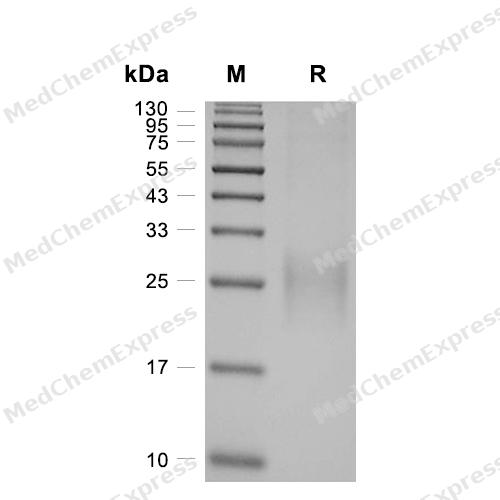
Purity - SDS-PAGE
-
Bioactivity - Cell-Based Assay
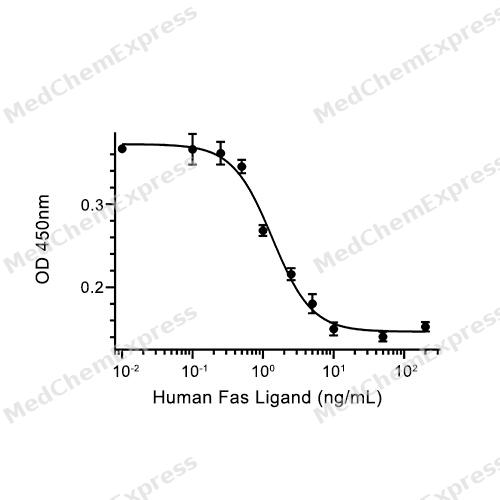
Bioactivity - Cell-Based Assay


Technical Parameters
-
Species Human
-
Source HEK293
-
Tag N-6*His
-
Accession
P48023-1 (P134-L281)
-
Gene ID356
-
Molecular Construction
-
N-term
-
6*His
-
Fas Ligand (P134-L281)
Accession # P48023 -
C-term
-
-
Protein Length
Full Length of FASLG, soluble form
-
Synonyms
FASLG; TNLG1A; Prev. APT1LG1; CD95L; Prev. TNFSF6; APTL; FasL; Tumor Necrosis Factor (Ligand) Superfamily, Member 6; Tumor Necrosis Factor Ligand Superfamily Member 6; Mutant Tumor Necrosis Factor Family Member 6; Fas Antigen Ligand; Apoptosis (APO-1) Antigen Ligand 1; CD95 Ligand; Tumor Necrosis Factor Ligand 1A; CD178; CD178 Antigen; Fas Ligand (TNF Superfamily, Member 6); ALPS1B; Apoptosis Antigen Ligand; FASL; Fas Ligand; CD95-L
-
AA Sequence
PSPPPEKKELRKVAHLTGKSNSRSMPLEWEDTYGIVLLSGVKYKKGGLVINETGLYFVYSKVYFRGQSCNNLPLSHKVYMRNSKYPQDLVMMEGKMMSYCTTGQMWARSSYLGAVFNLTSADHLYVNVSELSLVNFEESQTFFGLYKL
-
Predicted Molecular Mass
17.71 kDa
-
Molecular Weight
Approximately 23-30 kDa, based on SDS-PAGE under reducing conditions.
-
Glycosylation
Yes
-
Purity
≥ 95%, as determined by reducing SDS-PAGE.


Product Properties
Lyophilized powder
Lyophilized from a 0.22 μm filtered solution of PBS, pH 6.5.
<1 EU/μg, determined by LAL method.
It is not recommended to reconstitute to a concentration less than 100 μg/mL in ddH2O. For long term storage it is recommended to add a carrier protein (0.1% BSA, 5% HSA, 10% FBS or 5% Trehalose).
Stored at -20°C for 2 years from date of receipt. After reconstitution, it is stable at 4°C for 1 week or -20°C for longer (with carrier protein). It is recommended to freeze aliquots at -20°C or -80°C for extended storage.
Room temperature in continental US; may vary elsewhere.


Documentation
-
Data Sheet (237 KB)
-
SDS (252 KB)
- English - EN (252 KB)
- Français - FR (252 KB)
- Deutsch - DE (252 KB)
- Norwegian - NO (252 KB)
- Español - ES (252 KB)
- Swedish - SV (252 KB)
- Italian - IT (252 KB)
- Korean - KR (252 KB)
- Portuguese - PT (252 KB)
-
Handling Instructions (2659 KB)

Calculators
Concentration (start) × Volume (start) = Concentration (final) × Volume (final)


 Powered by Bioz

