



FGF-17 Protein, Human (HEK293, His)
Based on 1 publication(s) in Google Scholar
FGF-17 Protein plays a crucial role in embryonic development, serving as a signaling molecule for brain induction and patterning. Its presence is vital for normal brain development, emphasizing its significance in shaping embryogenesis intricacies. FGF-17 interacts with FGFR3 and FGFR4, underscoring its involvement in signaling cascades that precisely orchestrate developmental events in the embryonic brain. FGF-17 Protein, Human (HEK293, His) is the recombinant human-derived FGF-17 protein, expressed by HEK293 , with C-6*His labeled tag.
- Species: Human
- Source: HEK293
-
Storage:Stored at -20°C for 2 years from date of receipt. After reconstitution, it is stable at 4°C for 1 week or -20°C for longer (with carrier protein). It is recommended to freeze aliquots at -20°C or -80°C for extended storage.


To place orders, for customer services and technical support, please contact: MedChemExpress USA
Tel: 609-228-6898 E-mail: [email protected] [email protected]


-
 Biological Activity
-
Technical Parameters
-
Product Properties
- Documentation
- Help & FAQs




Biological Activity
Description
FGF-17 Protein plays a crucial role in embryonic development, serving as a signaling molecule for brain induction and patterning. Its presence is vital for normal brain development, emphasizing its significance in shaping embryogenesis intricacies. FGF-17 interacts with FGFR3 and FGFR4, underscoring its involvement in signaling cascades that precisely orchestrate developmental events in the embryonic brain. FGF-17 Protein, Human (HEK293, His) is the recombinant human-derived FGF-17 protein, expressed by HEK293 , with C-6*His labeled tag.
Background
FGF-17 Protein assumes a crucial role in regulating embryonic development and serves as a signaling molecule in the induction and patterning of the embryonic brain. Its presence is essential for normal brain development, emphasizing its significance in shaping the intricate processes of embryogenesis. Notably, FGF-17 interacts with FGFR3 and FGFR4, underscoring its involvement in intricate signaling cascades that contribute to the precise orchestration of developmental events in the embryonic brain.
Verified Bioactivity
Measured in a cell proliferation assay using NIH-3T3 mouse fibroblast cells. The ED50 for this effect is 95.74 ng/mL in the presence of 1 µg/mL heparin,corresponding to a specific activity is 2.04×10⁵ units/mg.
MCE Validation Data
-
Bioactivity - Cell-Based Assay
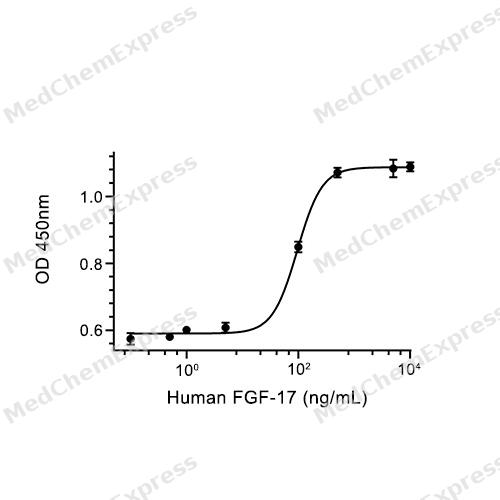
Bioactivity - Cell-Based Assay


Publications (1)
-
Journal Impact Factor
-
Most Recent
-
Carbohydr Res
A structurally defined galactoglucan from Arisaema erubescens with a multi-target tumor-associated protein binding domain. [Abstract]2025 Nov 29:560:109781. PMID: 41344200


Technical Parameters
-
Species Human
-
Source HEK293
-
Tag C-6*His
-
Accession
O60258 (T23-T216)
-
Molecular Construction
-
N-term
-
FGF-17 (T23-T216)
Accession # O60258 -
6*His
-
C-term
-
-
Protein Length
Full Length of Mature Protein
-
Synonyms
FGF17; FGF-17; Fibroblast Growth Factor 17; HH20; FGF-13
-
AA Sequence
TQGENHPSPNFNQYVRDQGAMTDQLSRRQIREYQLYSRTSGKHVQVTGRRISATAEDGNKFAKLIVETDTFGSRVRIKGAESEKYICMNKRGKLIGKPSGKSKDCVFTEIVLENNYTAFQNARHEGWFMAFTRQGRPRQASRSRQNQREAHFIKRLYQGQLPFPNHAEKQKQFEFVGSAPTRRTKRTRRPQPLT
-
Predicted Molecular Mass
22.6 kDa
-
Molecular Weight
Approximately 31 kDa, based on SDS-PAGE under reducing conditions.
-
Glycosylation
Yes
-
Purity
≥ 95%, as determined by reducing SDS-PAGE.


Product Properties
Lyophilized powder.
Lyophilized from a 0.22 μm filtered solution of PBS, pH 7.4.
<1 EU/μg, determined by LAL method.
It is not recommended to reconstitute to a concentration less than 100 μg/mL in ddH2O. For long term storage it is recommended to add a carrier protein (0.1% BSA, 5% HSA, 10% FBS or 5% Trehalose).
Stored at -20°C for 2 years from date of receipt. After reconstitution, it is stable at 4°C for 1 week or -20°C for longer (with carrier protein). It is recommended to freeze aliquots at -20°C or -80°C for extended storage.
Room temperature in continental US; may vary elsewhere.


Documentation
-
Data Sheet (236 KB)
-
SDS (251 KB)
- English - EN (251 KB)
- Français - FR (251 KB)
- Deutsch - DE (251 KB)
- Norwegian - NO (251 KB)
- Español - ES (251 KB)
- Swedish - SV (251 KB)
- Italian - IT (251 KB)
- Korean - KR (251 KB)
- Portuguese - PT (251 KB)
-
Handling Instructions (2659 KB)

Calculators
Concentration (start) × Volume (start) = Concentration (final) × Volume (final)


 Powered by Bioz

