



Notum Protein, Human (C330S, CHO, His)
Based on 1 publication(s) in Google Scholar
Notum Protein serves as a crucial negative regulator of the Wnt signaling pathway, playing a specific role in mediating the depalmitoleoylation of WNT proteins. The process of serine palmitoleoylation of WNT proteins is essential for their efficient binding to frizzled receptors, and Notum's carboxylesterase activity is instrumental in modulating this aspect of the Wnt signaling cascade. Notum Protein, Human (C330S, CHO, His) is the recombinant human-derived Notum protein, expressed by CHO , with C-His labeled tag.
- Species: Human
- Source: CHO
-
Storage:Stored at -20°C for 2 years from date of receipt. After reconstitution, it is stable at 4°C for 1 week or -20°C for longer (with carrier protein). It is recommended to freeze aliquots at -20°C or -80°C for extended storage.


To place orders, for customer services and technical support, please contact: MedChemExpress USA
Tel: 609-228-6898 E-mail: [email protected] [email protected]


-
 Biological Activity
-
Technical Parameters
-
Product Properties
- Documentation
- Help & FAQs




Biological Activity
Description
Notum Protein serves as a crucial negative regulator of the Wnt signaling pathway, playing a specific role in mediating the depalmitoleoylation of WNT proteins. The process of serine palmitoleoylation of WNT proteins is essential for their efficient binding to frizzled receptors, and Notum's carboxylesterase activity is instrumental in modulating this aspect of the Wnt signaling cascade. Notum Protein, Human (C330S, CHO, His) is the recombinant human-derived Notum protein, expressed by CHO , with C-His labeled tag.
Background
Notum is a carboxylesterase that functions as a critical negative regulator of the Wnt signaling pathway. This enzyme plays a specific role in mediating the depalmitoleoylation of WNT proteins. The serine palmitoleoylation of WNT proteins is essential for their efficient binding to frizzled receptors, which is a crucial step in Wnt signaling activation. By catalyzing the removal of palmitoleate moieties from WNT proteins, Notum attenuates Wnt signaling, contributing to the fine-tuned regulation of this pathway. It has to emphasize Notum's significance in modulating Wnt signaling by targeting the lipid modifications of WNT proteins, highlighting its role as a key regulatory factor in this essential cellular pathway.
Verified Bioactivity
Measured by its esterase activity. The specific activity is 1118.156 pmol/min/µg, as measured under the described conditions.
MCE Validation Data
-
Purity - SDS-PAGE
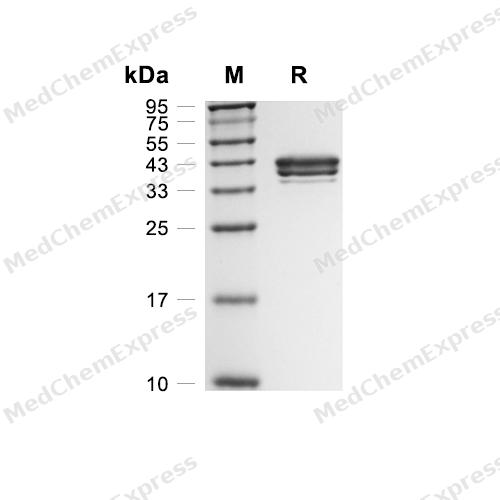
Purity - SDS-PAGE


Publications (1)
-
Journal Impact Factor
-
Most Recent
-
Phytomedicine
Bioactive components of Jiedu Sangen decoction against colorectal cancer: A novel and comprehensive research strategy for natural drug development. [Abstract]2025 Jul:142:156795. PMID: 40279966


Technical Parameters
-
Species Human
-
Source CHO
-
Tag C-6*His
-
Accession
Q6P988 (S81-T451, C330S)
-
Molecular Construction
-
N-term
-
Notum (S81-T451, C330S)
Accession # Q6P988 -
His
-
C-term
-
-
Protein Length
Partial
-
Synonyms
NOTUM; HNOTUM; Notum, Palmitoleoyl-Protein Carboxylesterase; Notum Pectinacetylesterase Homolog (Drosophila); [Wnt Protein] O-Palmitoleoyl-L-Serine Hydrolase; Notum Pectinacetylesterase Homolog; Palmitoleoyl-Protein Carboxylesterase NOTUM; Protein Notum H
-
AA Sequence
SAQQLNEDLRLHLLLNTSVTCNDGSPAGYYLKESRGSRRWLLFLEGGWYCFNRENCDSRYDTMRRLMSSRDWPRTRTGTGILSSQPEENPYWWNANMVFIPYCSSDVWSGASSKSEKNEYAFMGALIIQEVVRELLGRGLSGAKVLLLAGSSAGGTGVLLNVDRVAEQLEKLGYPAIQVRGLADSGWFLDNKQYRHTDCVDTITCAPTEAIRRGIRYWNGVVPERCRRQFQEGEEWNCFFGYKVYPTLRSPVFVVQWLFDEAQLTVDNVHLTGQPVQEGLRLYIQNLGRELRHTLKDVPASFAPACLSHEIIIRSHWTDVQVKGTSLPRALHCWDRSLHDSHKASKTPLKGCPVHLVDSCPWPHCNPSCPT
-
Molecular Weight
Approximately 38-45 kDa, based on SDS-PAGE under reducing conditions.
-
Glycosylation
Yes
-
Purity
≥ 95%, as determined by reducing SDS-PAGE.


Product Properties
Lyophilized powder.
Lyophilized from a 0.22 μm filtered solution of PBS.
<1 EU/μg, determined by LAL method.
It is not recommended to reconstitute to a concentration less than 100 μg/mL in ddH2O. For long term storage it is recommended to add a carrier protein (0.1% BSA, 5% HSA, 10% FBS or 5% Trehalose).
Stored at -20°C for 2 years from date of receipt. After reconstitution, it is stable at 4°C for 1 week or -20°C for longer (with carrier protein). It is recommended to freeze aliquots at -20°C or -80°C for extended storage.
Room temperature in continental US; may vary elsewhere.


Documentation
-
Data Sheet (237 KB)
-
SDS (251 KB)
- English - EN (251 KB)
- Français - FR (251 KB)
- Deutsch - DE (251 KB)
- Norwegian - NO (251 KB)
- Español - ES (251 KB)
- Swedish - SV (251 KB)
- Italian - IT (251 KB)
- Korean - KR (251 KB)
- Portuguese - PT (251 KB)
-
Handling Instructions (2659 KB)

Calculators
Concentration (start) × Volume (start) = Concentration (final) × Volume (final)


 Powered by Bioz

