



Fractalkine/CX3CL1 Protein, Human
Based on 4 publication(s) in Google Scholar
Fractalkine/CX3CL1 Protein, Human is found to be associated with inflammatory diseases such as rheumatoid arthritis (RA), rheumatoid vasculitis (RV).
- Species: Human
- Source: E. coli
-
Storage:Stored at -20°C for 2 years from date of receipt. After reconstitution, it is stable at 4°C for 1 week or -20°C for longer (with carrier protein). It is recommended to freeze aliquots at -20°C or -80°C for extended storage.


To place orders, for customer services and technical support, please contact: MedChemExpress USA
Tel: 609-228-6898 E-mail: [email protected] [email protected]


-
 Biological Activity
-
Technical Parameters
-
Product Properties
- Documentation
- References
- Help & FAQs




Biological Activity
Description
Fractalkine/CX3CL1 Protein, Human is found to be associated with inflammatory diseases such as rheumatoid arthritis (RA), rheumatoid vasculitis (RV).
Background
Fractalkine/CX3CL1 exists in two forms: as a membrane-anchored or as a shed 80-95K glycoprotein. Fractalkine/CX3CL1 is expressed in monocytes during inflammatory conditions. Fractalkine/CX3CL1 is also expressed in macrophages, fibroblasts, endothelial, and dendritic cells in rheumatoid arthritis (RA) synovial tissue. CX3CL1 is associated with the development of different diseases such as rheumatoid arthritis (RA), rheumatoid vasculitis (RV), Sjögren’s syndrome (SS), systemic lupus erythematosus (SLE), scleroderma, multiple sclerosis, and atherosclerosis[1].
Verified Bioactivity
1.Full biological activity determined by a chemotaxis bioassay using human T-lymphocytes is in a concentration of 5.0-10 ng/mL.
2.Measured by its ability to chemoattract THP-1 cells. The ED50 for this effect is 7.841 ng/mL, corresponding to a specific activity is 1.275×10⁵ U/mg.
3.Measured by its ability to chemoattract BaF3 mouse pro-B cells transfected with mouse CX3CR1. The ED50 for this effect is 1.0-10.0 ng/mL.
MCE Validation Data
-
Purity - SDS-PAGE
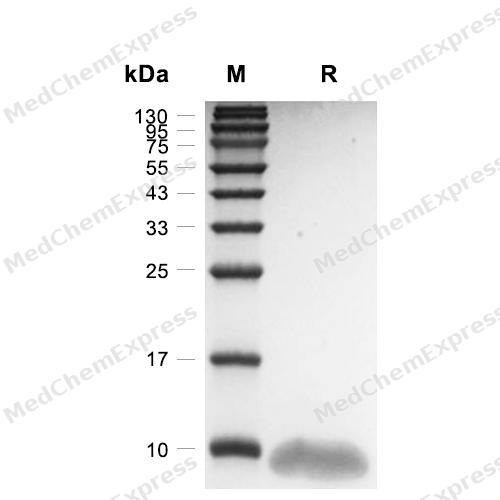
Purity - SDS-PAGE
-
Bioactivity - Cell-Based Assay
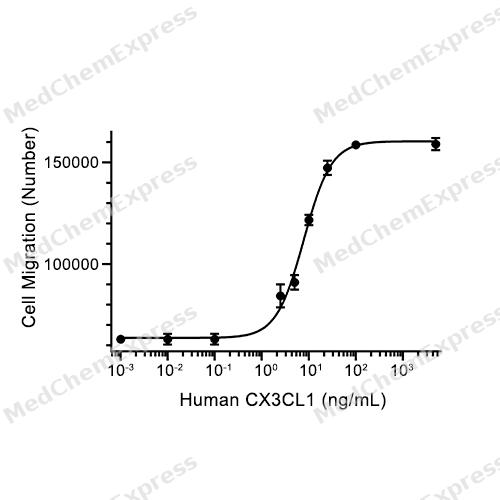
Bioactivity - Cell-Based Assay


Publications (4)
-
Journal Impact Factor
-
Most Recent
-
Adv Sci (Weinh)
TREM2-Mediated Cholesterol Efflux in Macrophages Inhibits Anti-Tumor Immunity via Limitation of CD4+ T and NK Cells. [Abstract]2025 Oct 20:e06995. PMID: 41114464 -
CNS Neurosci Ther
PVT1 promotes proliferation and macrophage immunosuppressive polarization through STAT1 and CX3CL1 regulation in glioblastoma multiforme. [Abstract]2024 Jan;30(1):e14566. PMID: 38287522 -
Placenta
High expression of CX3CL1/CX3CR1 at the mother-fetus interface of preeclampsia inhibits trophoblast invasion and migration. [Abstract]2024 Aug 21:156:30-37. PMID: 39236525 -


Technical Parameters
-
Species Human
-
Source E. coli
-
Tag Tag Free
-
Accession
P78423 (Q25-G100)
-
Molecular Construction
-
N-term
-
Fractalkine (Q25-G100)
Accession # P78423 -
C-term
-
-
Protein Length
Full Length of Chemokine and involved in interaction with ITGAV:ITGB3 and ITGA4:ITGB1 Region
-
Synonyms
CX3CL1; NTN; Prev. SCYD1; CX3C Membrane-Anchored Chemokine; Chemokine (C-X3-C Motif) Ligand 1; Small-Inducible Cytokine D1; Fractalkine; C-X3-C Motif Chemokine 1; Neurotactin; NTT; C3Xkine; Small Inducible Cytokine Subfamily D (Cys-X3-Cys), Member-1; ABCD
-
AA Sequence
QHHGVTKCNITCSKMTSKIPVALLIHYQQNQASCGKRAIILETRQHRLFCADPKEQWVKDAMQHLDRQAAALTRNG
-
Predicted Molecular Mass
8.6 kDa
-
Molecular Weight
Approximately 9-10 kDa, based on SDS-PAGE under reducing conditions.
-
Purity
≥ 95%, as determined by reducing SDS-PAGE.


Product Properties
Lyophilized powder.
1.Lyophilized from a 0.22 μm filtered solution of 20 mM PB, 50 mM NaCl, pH 7.4.
2.Lyophilized from a 0.22 μm filtered solution of PBS, pH 7.4, 8% trehalose.
Please refer to the lot-specific COA for specific buffer information.
<1 EU/μg, determined by LAL method.
It is not recommended to reconstitute to a concentration less than 100 μg/mL in ddH2O. For long term storage it is recommended to add a carrier protein (0.1% BSA, 5% HSA, 10% FBS or 5% Trehalose).
Stored at -20°C for 2 years from date of receipt. After reconstitution, it is stable at 4°C for 1 week or -20°C for longer (with carrier protein). It is recommended to freeze aliquots at -20°C or -80°C for extended storage.
Room temperature in continental US; may vary elsewhere.


Documentation
-
Data Sheet (261 KB)
-
SDS (252 KB)
- English - EN (252 KB)
- Français - FR (252 KB)
- Deutsch - DE (252 KB)
- Norwegian - NO (252 KB)
- Español - ES (252 KB)
- Swedish - SV (252 KB)
- Italian - IT (252 KB)
- Korean - KR (252 KB)
- Portuguese - PT (252 KB)
-
Handling Instructions (2659 KB)


References

Calculators
Concentration (start) × Volume (start) = Concentration (final) × Volume (final)


 Powered by Bioz

