



Frizzled-5 Protein, Human (HEK293, His)

Based on 1 Customer Validation
Frizzled-5 protein is a receptor for Wnt proteins (WNT2, WNT10B, WNT5A), which can activate WNT7A and promote the formation of synapses in neurons. It participates in the canonical Wnt/β-catenin pathway, activating disheveled proteins, inhibiting GSK-3 kinase, and triggering Wnt target genes. Frizzled-5 Protein, Human (HEK293, His) is the recombinant human-derived Frizzled-5 protein, expressed by HEK293 , with C-His labeled tag.
- Species: Human
- Source: HEK293
-
Storage:Stored at -80°C for 1 year from date of receipt. It is stable at -20°C for 3 months after opening. It is recommended to freeze aliquots at -80°C for extended storage. Avoid repeated freeze-thaw cycles.


To place orders, for customer services and technical support, please contact: MedChemExpress USA
Tel: 609-228-6898 E-mail: [email protected] [email protected]


-
 Biological Activity
-
Technical Parameters
-
Product Properties
- Documentation
- Help & FAQs




Biological Activity
Description
Frizzled-5 protein is a receptor for Wnt proteins (WNT2, WNT10B, WNT5A), which can activate WNT7A and promote the formation of synapses in neurons. It participates in the canonical Wnt/β-catenin pathway, activating disheveled proteins, inhibiting GSK-3 kinase, and triggering Wnt target genes. Frizzled-5 Protein, Human (HEK293, His) is the recombinant human-derived Frizzled-5 protein, expressed by HEK293 , with C-His labeled tag.
Background
Frizzled-5 Protein functions as a receptor for Wnt proteins, including WNT2, WNT10B, and WNT5A, although it does not activate WNT2B or WNT4 in vitro, and the in vivo context may vary due to potential differences in coexpression. In neurons, the activation of WNT7A by Frizzled-5 promotes synapse formation. It actively participates in the canonical Wnt/beta-catenin signaling pathway, leading to the activation of disheveled proteins, inhibition of GSK-3 kinase, nuclear accumulation of beta-catenin, and subsequent activation of Wnt target genes. Frizzled-5 may also engage a secondary signaling pathway involving PKC and calcium fluxes, the integration of which with the canonical pathway remains unclear, given PKC's apparent requirement for Wnt-mediated inactivation of GSK-3 kinase. This versatile receptor likely plays a role in transduction and intercellular transmission of polarity information during tissue morphogenesis and in differentiated tissues. Additionally, Frizzled-5 is implicated in yolk sac angiogenesis and placental vascularization, and its homodimerization is promoted by the binding of unsaturated fatty acid molecules via the FZ domain. Notably, Frizzled-5 interacts with WNT2B, WNT7A, and GOPC, contributing to its diverse range of cellular functions.
MCE Validation Data
-
Purity - SDS-PAGE
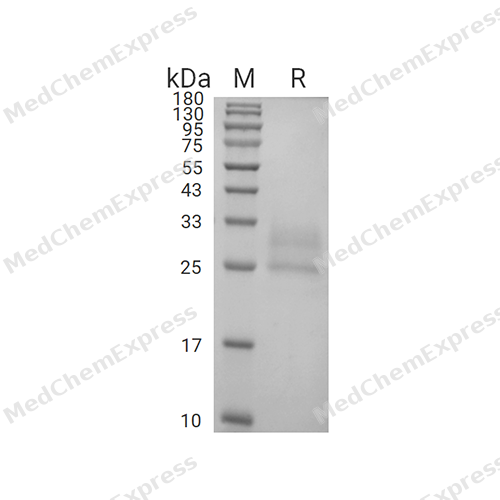
Purity - SDS-PAGE


Technical Parameters
-
Species Human
-
Source HEK293
-
Tag C-His
-
Accession
Q13467 (A27-P167)
-
Molecular Construction
-
N-term
-
Frizzled-5 (A27-P167)
Accession # Q13467 -
His
-
C-term
-
-
Protein Length
Partial Extracellular Domain
-
Synonyms
FZD5; FzE5; Prev. C2orf31; Chromosome 2 Open Reading Frame 31; HFZ5; Frizzled (Drosophila) Homolog 5; Frizzled 5, Seven Transmembrane Spanning Receptor; Frizzled Homolog 5 (Drosophila); Frizzled Family Receptor 5; Wnt Receptor; DKFZP434E2135; MCOPCB11; Fr
-
AA Sequence
ASKAPVCQEITVPMCRGIGYNLTHMPNQFNHDTQDEAGLEVHQFWPLVEIQCSPDLRFFLCSMYTPICLPDYHKPLPPCRSVCERAKAGCSPLMRQYGFAWPERMSCDRLPVLGRDAEVLCMDYNRSEATTAPPRPFPAKP
-
Predicted Molecular Mass
17.6 kDa
-
Molecular Weight
Approximately 25-30 kDa, based on SDS-PAGE under reducing conditions, due to the glycosylation.
-
Glycosylation
Yes
-
Purity
≥ 95%, as determined by reducing SDS-PAGE.


Product Properties
Solution
Supplied as a 0.22 μm filtered solution of PBS, pH 7.4.
<1 EU/μg, determined by LAL method.
Stored at -80°C for 1 year from date of receipt. It is stable at -20°C for 3 months after opening. It is recommended to freeze aliquots at -80°C for extended storage. Avoid repeated freeze-thaw cycles.
Shipping with dry ice.


Documentation
-
Data Sheet (236 KB)
-
SDS (254 KB)
- English - EN (254 KB)
- Français - FR (254 KB)
- Deutsch - DE (254 KB)
- Norwegian - NO (254 KB)
- Español - ES (254 KB)
- Swedish - SV (254 KB)
- Italian - IT (254 KB)
- Korean - KR (254 KB)
- Portuguese - PT (254 KB)
-
Handling Instructions (2659 KB)

Calculators
Concentration (start) × Volume (start) = Concentration (final) × Volume (final)


 Powered by Bioz

