



GH/Somatotropin Protein, Mouse
Based on 2 publication(s) in Google Scholar
GH/Somatotropin Protein, Mouse is a peptide hormone that stimulates growth, cell reproduction, and cell regeneration, which can be used for the growth disorders research.
- Species: Mouse
- Source: E. coli
-
Storage:Stored at -20°C for 2 years from date of receipt. After reconstitution, it is stable at 4°C for 1 week or -20°C for longer (with carrier protein). It is recommended to freeze aliquots at -20°C or -80°C for extended storage.


To place orders, for customer services and technical support, please contact: MedChemExpress USA
Tel: 609-228-6898 E-mail: [email protected] [email protected]


-
 Biological Activity
-
Technical Parameters
-
Product Properties
- Documentation
- References
- Help & FAQs





Biological Activity
Description
GH/Somatotropin Protein, Mouse is a peptide hormone that stimulates growth, cell reproduction, and cell regeneration, which can be used for the growth disorders research.
Background
Growth Hormone (Somatotropin) is a peptide hormone that stimulates growth, cell reproduction, and cell regeneration, which can be used for the treatment of growth disorders in children[1]. Growth Hormone is a stress hormone that stimulates production of IGF-1 and raises the concentration of glucose and free fatty acids[2]. Growth Hormone exerts some of its effects by binding to receptors on target cells, where it activates the MAPK/ERK pathway[3].
Verified Bioactivity
1.Measured in a cell proliferation assay using Nb2-11 rat lymphoma cells. The ED50 for this effect is ≤0.1051 ng/mL, corresponding to a specific activity is ≥9.515×10⁶ U/mg.
2.Immobilized Recombinant Mouse GHR (C-Fc) at 2 μg/mL (100 μL/well) can bind Recombinant Mouse GH. Biotinylated by NHS-biotin prior to testing.The ED50 of Recombinant Mouse GH is 1.0-5.0 ng/mL.
MCE Validation Data
-
Purity - SDS-PAGE
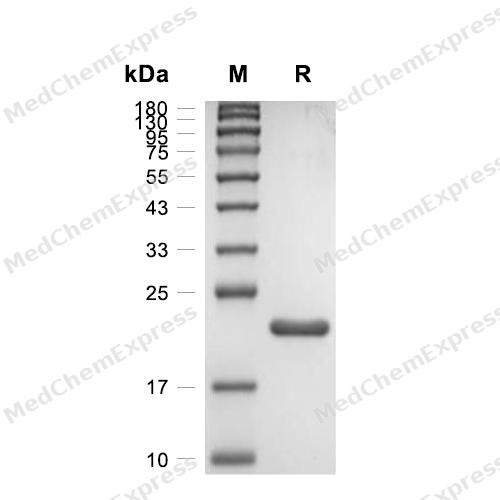
Purity - SDS-PAGE
-
Bioactivity - Cell-Based Assay
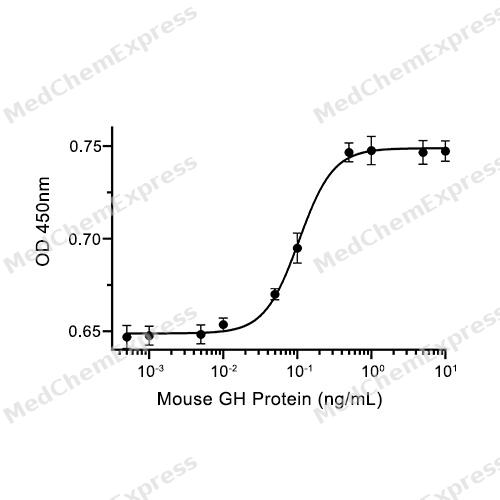
Bioactivity - Cell-Based Assay


Publications (2)
-
Journal Impact Factor
-
Most Recent
-
Mol Ther
The novel adipokine Placin regulates glucose homeostasis via insulin secretion and IGF1 receptor signaling. [Abstract]2026 May 12:S1525-0016(26)00393-X. PMID: 42130086 -
Stem Cell Res Ther
LNGFR promoting osteogenic differentiation of ectomesenchyme stem cells via activation of GHR-JAK-STAT/IGF1 signaling pathway. [Abstract]2026 May 9;17(1):238. PMID: 42106838


Technical Parameters
-
Species Mouse
-
Source E. coli
-
Tag Tag Free
-
Accession
P06880 (F27-F216)
-
Molecular Construction
-
N-term
-
GH (F27-F216)
Accession # P06880 -
C-term
-
-
Protein Length
Full Length of Mature Protein
-
Synonyms
GH1; Growth Hormone 1 Variant 2; Growth Hormone 1; Growth Hormone 1 Variant 1; GH-N; Growth Hormone 1 Isoform 1; GH; HCG1749481, Isoform CRA_aa; Pituitary Growth Hormone; Growth Hormone 1 Isoform 2; Somatotropin; HCG1749481, Isoform CRA_s; HGH-N; HCG17494
-
AA Sequence
FPAMPLSSLFSNAVLRAQHLHQLAADTYKEFERAYIPEGQRYSIQNAQAAFCFSETIPAPTGKEEAQQRTDMELLRFSLLLIQSWLGPVQFLSRIFTNSLMFGTSDRVYEKLKDLEEGIQALMQELEDGSPRVGQILKQTYDKFDANMRSDDALLKNYGLLSCFKKDLHKAETYLRVMKCRRFVESSCAF
-
Molecular Weight
Approximately 20 kDa, based on SDS-PAGE under reducing conditions.
-
Purity
≥ 95%, as determined by reducing SDS-PAGE.


Product Properties
Lyophilized powder
1.Lyophilized from a 0.22 μm filtered solution of 20 mM HEPES, 4% sucrose, 4% mannitol, 0.02% Tween 80, pH 8.0.
2.Lyophilized from a 0.22 μm filtered solution of 50 mM Tris-HCl, 500 mM NaCl, pH 8.0, 8% trehalose.
Please refer to the lot-specific COA for specific buffer information.
Note: For SPR assay, please replace the buffer. Primary amine components (e.g., Tris, imidazole) can affect protein-coupled chips.
<1 EU/μg, determined by LAL method.
It is not recommended to reconstitute to a concentration less than 100 μg/mL in ddH2O.
Stored at -20°C for 2 years from date of receipt. After reconstitution, it is stable at 4°C for 1 week or -20°C for longer (with carrier protein). It is recommended to freeze aliquots at -20°C or -80°C for extended storage.
Room temperature in continental US; may vary elsewhere.


Documentation
-
Data Sheet (263 KB)
-
SDS (254 KB)
- English - EN (254 KB)
- Français - FR (254 KB)
- Deutsch - DE (254 KB)
- Norwegian - NO (254 KB)
- Español - ES (254 KB)
- Swedish - SV (254 KB)
- Italian - IT (254 KB)
- Korean - KR (254 KB)
- Portuguese - PT (254 KB)
-
Handling Instructions (2659 KB)


References
[1]. Takeda A, et al. Recombinant human growth hormone for the treatment of growth disorders in children: a systematic review and economic evaluation. Health Technol Assess. 2010 Sep;14(42):1-209, iii-iv. [Content Brief]
[2]. Ranabir S, et al. Stress and hormones. Indian J Endocrinol Metab. 2011 Jan;15(1):18-22. [Content Brief]

Calculators
Concentration (start) × Volume (start) = Concentration (final) × Volume (final)


 Powered by Bioz

