



Group XV phospholipase A2/Pla2g15, Mouse (His, myc)

Based on 1 Customer Validation
Group XV phospholipase A2 (Pla2g15) exhibits dual calcium-dependent phospholipase and O-acyltransferase activities that contribute to glycerophospholipid homeostasis and acyl remodeling in acidic cellular compartments. Group XV phospholipase A2/Pla2g15, Mouse (His, myc) is the recombinant mouse-derived Group XV phospholipase A2/Pla2g15, expressed by E. coli , with N-His, C-Myc labeled tag.
- Species: Mouse
- Source: E. coli
-
Storage:Stored at -20°C for 2 years from date of receipt. After reconstitution, it is stable at 4°C for 1 week or -20°C for longer (with carrier protein). It is recommended to freeze aliquots at -20°C or -80°C for extended storage.


To place orders, for customer services and technical support, please contact: MedChemExpress USA
Tel: 609-228-6898 E-mail: [email protected] [email protected]


-
 Biological Activity
-
Technical Parameters
-
Product Properties
- Documentation
- Help & FAQs




Biological Activity
Description
Group XV phospholipase A2 (Pla2g15) exhibits dual calcium-dependent phospholipase and O-acyltransferase activities that contribute to glycerophospholipid homeostasis and acyl remodeling in acidic cellular compartments. Group XV phospholipase A2/Pla2g15, Mouse (His, myc) is the recombinant mouse-derived Group XV phospholipase A2/Pla2g15, expressed by E. coli , with N-His, C-Myc labeled tag.
Background
Group XV phospholipase A2 (Pla2g15) exhibits dual calcium-independent phospholipase and O-acyltransferase activities, potentially contributing to glycerophospholipid homeostasis and the remodeling of acyl groups in acidic cellular compartments. The enzyme catalyzes the hydrolysis of the ester bond of the fatty acyl group at sn-1 or sn-2 positions of phospholipids, demonstrating both phospholipase A1 and A2 activities, and transfers it to the hydroxyl group at the first carbon of lipophilic alcohols through O-acyltransferase activity. Pla2g15 prefers fatty acyl donors such as phosphatidylcholines, phosphatidylethanolamines, phosphatidylglycerols, and phosphatidylserines, favoring sn-2 over sn-1 deacylation of unsaturated fatty acyl groups. Additionally, it selectively hydrolyzes the sn-1 fatty acyl group of truncated oxidized phospholipids, potentially participating in the detoxification of reactive oxidized phospholipids during oxidative stress. Pla2g15 plays a vital role in phospholipid degradation in alveolar macrophages, suggesting implications in pulmonary surfactant clearance. At neutral pH, it hydrolyzes the sn-1 fatty acyl group of lysophosphatidylcholines.
Verified Bioactivity
The enzyme activity of this recombinant protein is testing in progress, we cannot offer a guarantee yet.
MCE Validation Data
-
Purity - SDS-PAGE
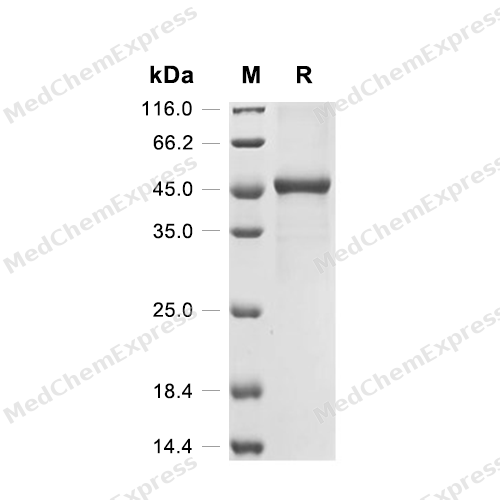
Purity - SDS-PAGE


Technical Parameters
-
Species Mouse
-
Source E. coli
-
Tag N-His;C-Myc
-
Accession
Q8VEB4 (A34-P412)
-
Molecular Construction
-
N-term
-
10*His
-
Pla2g15 (A34-P412)
Accession # Q8VEB4 -
C-term
-
-
Protein Length
Full Length of Mature Protein
-
Synonyms
PLA2G15; 1-O-Acylceramide Synthase; Prev. LYPLA3; LPLA2; LLPL; ACS; GXVPLA2; CDNA FLJ57757, Highly Similar To 1-O-Acylceramide Synthase; Lysophospholipase 3 (Lysosomal Phospholipase A2); CDNA FLJ58003, Highly Similar To 1-O-Acylceramide Synthase; Lysosoma
-
AA Sequence
AQRHPPVVLVPGDLGNQLEAKLDKPKVVHYLCSKKTDSYFTLWLNLELLLPVIIDCWIDNIRLVYNRTSRATQFPDGVDVRVPGFGETFSMEFLDPSKRNVGSYFYTMVESLVGWGYTRGEDVRGAPYDWRRAPNENGPYFLALREMIEEMYQMYGGPVVLVAHSMGNVYMLYFLQRQPQVWKDKYIHAFVSLGAPWGGVAKTLRVLASGDNNRIPVIGPLKIREQQRSAVSTSWLLPYNHTWSHEKVFVYTPTTNYTLRDYHRFFRDIGFEDGWFMRQDTEGLVEAMTPPGVELHCLYGTGVPTPNSFYYESFPDRDPKICFGDGDGTVNLESVLQCQAWQSRQEHRVSLQELPGSEHIEMLANATTLAYLKRVLLEP
-
Predicted Molecular Mass
50.5 kDa
-
Purity
≥ 90%, as determined by reducing SDS-PAGE.


Product Properties
Lyophilized powder
Lyophilized from a 0.22 μm filtered solution of PBS, 6% trehalose, pH 7.4.
<1 EU/μg, determined by LAL method.
It is not recommended to reconstitute to a concentration less than 100 μg/mL in ddH2O. For long term storage it is recommended to add a carrier protein (0.1% BSA, 5% HSA, 10% FBS or 5% Trehalose).
Stored at -20°C for 2 years from date of receipt. After reconstitution, it is stable at 4°C for 1 week or -20°C for longer (with carrier protein). It is recommended to freeze aliquots at -20°C or -80°C for extended storage.
Room temperature in continental US; may vary elsewhere.


Documentation
-
Data Sheet (238 KB)
-
SDS (254 KB)
- English - EN (254 KB)
- Français - FR (254 KB)
- Deutsch - DE (254 KB)
- Norwegian - NO (254 KB)
- Español - ES (254 KB)
- Swedish - SV (254 KB)
- Italian - IT (254 KB)
- Korean - KR (254 KB)
- Portuguese - PT (254 KB)
-
Handling Instructions (2659 KB)

Calculators
Concentration (start) × Volume (start) = Concentration (final) × Volume (final)


 Powered by Bioz

