



HB-EGF Protein, Human (HEK293, His)
Based on 1 publication(s) in Google Scholar
HB-EGF protein is a multifunctional growth factor that is regulated through EGFR, ERBB2 and ERBB4 and is critical for cardiac valve formation and cardiac function. It promotes smooth muscle cell proliferation and may contribute to macrophage-mediated cell proliferation. HB-EGF Protein, Human (HEK293, His) is the recombinant human-derived HB-EGF protein, expressed by HEK293 , with C-6*His labeled tag.
- Species: Human
- Source: HEK293
-
Storage:Stored at -20°C for 2 years from date of receipt. After reconstitution, it is stable at 4°C for 1 week or -20°C for longer (with carrier protein). It is recommended to freeze aliquots at -20°C or -80°C for extended storage.


To place orders, for customer services and technical support, please contact: MedChemExpress USA
Tel: 609-228-6898 E-mail: [email protected] [email protected]


-
 Biological Activity
-
Technical Parameters
-
Product Properties
- Documentation
- Help & FAQs




Biological Activity
Description
HB-EGF protein is a multifunctional growth factor that is regulated through EGFR, ERBB2 and ERBB4 and is critical for cardiac valve formation and cardiac function. It promotes smooth muscle cell proliferation and may contribute to macrophage-mediated cell proliferation. HB-EGF Protein, Human (HEK293, His) is the recombinant human-derived HB-EGF protein, expressed by HEK293 , with C-6*His labeled tag.
Background
HB-EGF Protein, a versatile growth factor, exerts its regulatory effects through EGFR, ERBB2, and ERBB4. Crucial for cardiac valve formation and normal heart function, HB-EGF plays a pivotal role in promoting smooth muscle cell proliferation and may contribute to macrophage-mediated cellular proliferation. Exhibiting mitogenic properties for fibroblasts while sparing endothelial cells, HB-EGF distinguishes itself by binding to EGF receptor/EGFR with greater affinity than EGF, emerging as a more potent mitogen for smooth muscle cells. Beyond its proliferative role, HB-EGF serves as a diphtheria toxin receptor and engages in interactions with FBLN1. The multifaceted interactions of HB-EGF with EGFR and ERBB4 underscore its central role in cellular regulation and cardiovascular development.
Verified Bioactivity
Measured in a cell proliferation assay using Balb/3T3 mouse embryonic fibroblast cells. The ED50 for this effect is 0.6311 ng/mL, corresponding to a specific activity is 1.585×10⁶ units/mg.
MCE Validation Data
-
Purity - SDS-PAGE
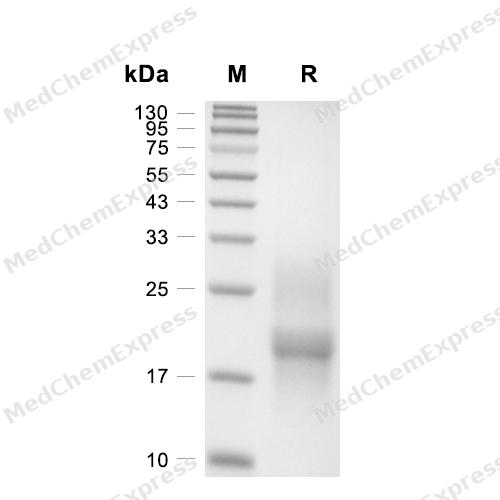
Purity - SDS-PAGE
-
Bioactivity - Cell-Based Assay
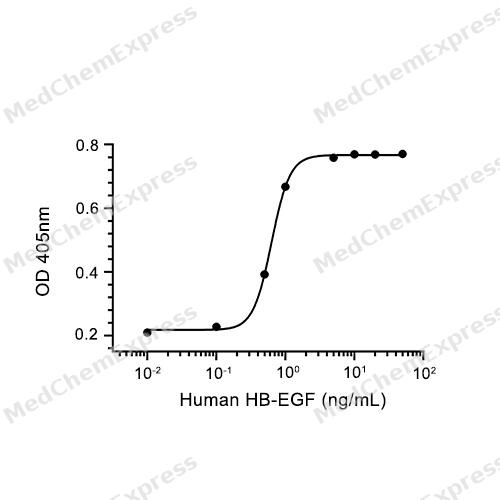
Bioactivity - Cell-Based Assay


Publications (1)
-
Journal Impact Factor
-
Most Recent
-
Mol Cell Endocrinol
Embryo-derived human chorionic gonadotropin promotes human decidualization through activating epithelial prostaglandin F2α secretion. [Abstract]2025 Sep 1:606:112581. PMID: 40398806


Technical Parameters
-
Species Human
-
Source HEK293
-
Tag C-6*His
-
Accession
Q99075 (L20-L148)
-
Molecular Construction
-
N-term
-
HB-EGF (L20-L148)
Accession # Q99075 -
6*His
-
C-term
-
-
Protein Length
Full Length of Mature Protein (with N-Propeptide)
-
Synonyms
HBEGF; Diphtheria Toxin Receptor (Heparin-Binding EGF-Like Growth Factor); Prev. HEGFL; Heparin-Binding Epidermal Growth Factor; Prev. DTR; Short Form Heparin-Binding EGF-Like Growth Factor; Prev. DTS; Heparin-Binding EGF-Like Growth Factor; Diphtheria To
-
AA Sequence
LVTGESLERLRRGLAAGTSNPDPPTVSTDQLLPLGGGRDRKVRDLQEADLDLLRVTLSSKPQALATPNKEEHGKRKKKGKGLGKKRDPCLRKYKDFCIHGECKYVKELRAPSCICHPGYHGERCHGLSL
-
Predicted Molecular Mass
14.3 kDa
-
Molecular Weight
Approximately 16-27 kDa, based on SDS-PAGE under reducing conditions.
-
Glycosylation
Yes
-
Purity
≥ 95%, as determined by reducing SDS-PAGE.


Product Properties
Lyophilized powder
1.Lyophilized from a 0.22 μm filtered solution of PBS, pH 7.4.
2.Lyophilized from a 0.22 μm filtered solution of PBS, pH 7.4, 8% trehalose.
Please refer to the lot-specific COA for specific buffer information.
<1 EU/μg, determined by LAL method.
It is not recommended to reconstitute to a concentration less than 100 μg/mL in ddH2O. For long term storage it is recommended to add a carrier protein (0.1% BSA, 5% HSA, 10% FBS or 5% Trehalose).
Stored at -20°C for 2 years from date of receipt. After reconstitution, it is stable at 4°C for 1 week or -20°C for longer (with carrier protein). It is recommended to freeze aliquots at -20°C or -80°C for extended storage.
Room temperature in continental US; may vary elsewhere.


Documentation
-
Data Sheet (236 KB)
-
SDS (254 KB)
- English - EN (254 KB)
- Français - FR (254 KB)
- Deutsch - DE (254 KB)
- Norwegian - NO (254 KB)
- Español - ES (254 KB)
- Swedish - SV (254 KB)
- Italian - IT (254 KB)
- Korean - KR (254 KB)
- Portuguese - PT (254 KB)
-
Handling Instructions (2659 KB)

Calculators
Concentration (start) × Volume (start) = Concentration (final) × Volume (final)


 Powered by Bioz

