



HER4 Protein, Human (Biotinylated, HEK293, His-Avi)

Based on 1 Customer Validation
HER4 is an important tyrosine protein kinase receptor for members of the neuregulin and EGF families that directs heart, central nervous system, and mammary gland development. It is critical for myocardial differentiation, postnatal cardiomyocyte proliferation, neural crest cell migration, axon guidance, and mammary gland function. HER4 Protein, Human (Biotinylated, HEK293, His-Avi) is the recombinant human-derived HER4 protein, expressed by HEK293 , with C-Avi, C-His labeled tag.
- Species: Human
- Source: HEK293
-
Storage:Stored at -20°C for 2 years from date of receipt. After reconstitution, it is stable at 4°C for 1 week or -20°C for longer (with carrier protein). It is recommended to freeze aliquots at -20°C or -80°C for extended storage.


To place orders, for customer services and technical support, please contact: MedChemExpress USA
Tel: 609-228-6898 E-mail: [email protected] [email protected]


-
 Biological Activity
-
Technical Parameters
-
Product Properties
- Documentation
- Help & FAQs




Biological Activity
Description
HER4 is an important tyrosine protein kinase receptor for members of the neuregulin and EGF families that directs heart, central nervous system, and mammary gland development. It is critical for myocardial differentiation, postnatal cardiomyocyte proliferation, neural crest cell migration, axon guidance, and mammary gland function. HER4 Protein, Human (Biotinylated, HEK293, His-Avi) is the recombinant human-derived HER4 protein, expressed by HEK293 , with C-Avi, C-His labeled tag.
Background
HER4, a tyrosine-protein kinase, serves as a pivotal cell surface receptor for neuregulins and EGF family members, playing indispensable roles in the development of the heart, central nervous system, and mammary gland, as well as in gene transcription, cell proliferation, differentiation, migration, and apoptosis. It is essential for normal cardiac muscle differentiation during embryonic development and postnatal cardiomyocyte proliferation. Moreover, HER4 is required for the proper development of the embryonic central nervous system, particularly neural crest cell migration and axon guidance, as well as for mammary gland differentiation and lactation induction. Acting as a receptor for neuregulins NRG1, NRG2, NRG3, NRG4, and EGF family members BTC, EREG, and HBEGF, ligand binding triggers receptor dimerization and autophosphorylation, creating multiple combinations of intracellular phosphotyrosines that elicit ligand- and context-specific cellular responses. HER4 mediates phosphorylation of SHC1 and activates the MAP kinases MAPK1/ERK2 and MAPK3/ERK1. Isoforms JM-A CYT-1 and JM-B CYT-1 phosphorylate PIK3R1, activating phosphatidylinositol 3-kinase and AKT1 to protect against apoptosis and promote cell migration in response to NRG1. Isoforms JM-A CYT-2 and JM-B CYT-2 lack the phosphotyrosine necessary for PIK3R1 interaction, thus foregoing these effects. Proteolytic processing of isoforms JM-A CYT-1 and JM-A CYT-2 yields soluble intracellular domains (4ICD) that translocate to the nucleus, promoting nuclear import of STAT5A, mammary epithelium differentiation, cell proliferation, and gene expression activation. Additionally, ERBB4 soluble intracellular domains can translocate to mitochondria, inducing apoptosis.
Verified Bioactivity
1.This product does not contain protein kinase domain.
2.Immobilized Biotinylated Human/Cynomolgus HER4, His Tag at 2 μg/mL (100 μL/well) on the streptavidin precoated plate (5 μg/mL). Dose responsecurve for Human NRG1 Beta 1 hFc Tag withthe EC50 of 5-15 ng/mL determined by ELISA.
3.Immobilized Human NRG1β1, at 10 μg/mL (100 μL/well) can bind Biotinylated Human HER4, the ED50for the effect is 1.152 μg/mL.
MCE Validation Data
-
Bioactivity - ELISA
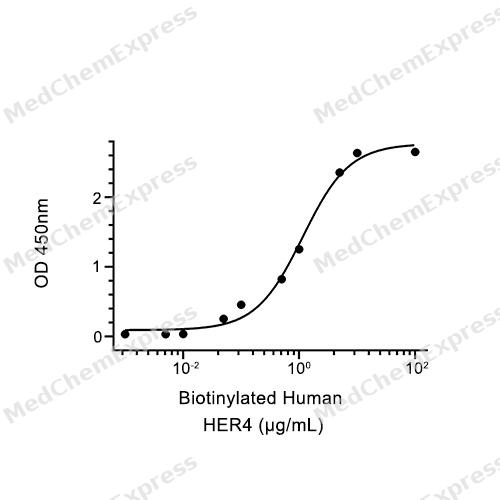
Bioactivity - ELISA


Technical Parameters
-
Species Human
-
Source HEK293
-
Tag C-Avi;C-8*His
-
Accession
Q15303-1 (Q26-P651)
-
Molecular Construction
-
N-term
-
HER4 (Q26-P651)
Accession # Q15303-1 -
8*His-Avi
-
C-term
-
-
Protein Length
Extracellular Domain
-
Conjugation
Biotin
-
Conjugate Method
The single lysine residue in Avitag is biotinylated through an enzymatic reaction.
-
Synonyms
ERBB4; Proto-Oncogene-Like Protein C-ErbB-4; Erb-B2 Receptor Tyrosine Kinase 4; P180erbB4; HER4; V-Erb-A Avian Erythroblastic Leukemia Viral Oncogene Homolog-Like 4; ALS19; Avian Erythroblastic Leukemia Viral (V-Erb-B2) Oncogene Homolog 4; V-Erb-B2 Avian
-
AA Sequence
QSVCAGTENKLSSLSDLEQQYRALRKYYENCEVVMGNLEITSIEHNRDLSFLRSVREVTGYVLVALNQFRYLPLENLRIIRGTKLYEDRYALAIFLNYRKDGNFGLQELGLKNLTEILNGGVYVDQNKFLCYADTIHWQDIVRNPWPSNLTLVSTNGSSGCGRCHKSCTGRCWGPTENHCQTLTRTVCAEQCDGRCYGPYVSDCCHRECAGGCSGPKDTDCFACMNFNDSGACVTQCPQTFVYNPTTFQLEHNFNAKYTYGAFCVKKCPHNFVVDSSSCVRACPSSKMEVEENGIKMCKPCTDICPKACDGIGTGSLMSAQTVDSSNIDKFINCTKINGNLIFLVTGIHGDPYNAIEAIDPEKLNVFRTVREITGFLNIQSWPPNMTDFSVFSNLVTIGGRVLYSGLSLLILKQQGITSLQFQSLKEISAGNIYITDNSNLCYYHTINWTTLFSTINQRIVIRDNRKAENCTAEGMVCNHLCSSDGCWGPGPDQCLSCRRFSRGRICIESCNLYDGEFREFENGSICVECDPQCEKMEDGLLTCHGPGPDNCTKCSHFKDGPNCVEKCPDGLQGANSFIFKYADPDRECHPCHPNCTQGCNGPTSHDCIYYPWTGHSTLPQHARTP
-
Predicted Molecular Mass
72.7 kDa
-
Molecular Weight
Approximately 75-110 kDa, based on SDS-PAGE under reducing conditions, due to the glycosylation.
-
Glycosylation
Yes
-
Purity
≥ 95%, as determined by reducing SDS-PAGE.


Product Properties
Lyophilized powder.
Lyophilized from a 0.22 μm filtered solution of PBS, pH 7.4, 8% trehalose.
<1 EU/μg, determined by LAL method.
It is not recommended to reconstitute to a concentration less than 100 μg/mL in ddH2O.
Stored at -20°C for 2 years from date of receipt. After reconstitution, it is stable at 4°C for 1 week or -20°C for longer (with carrier protein). It is recommended to freeze aliquots at -20°C or -80°C for extended storage.
Room temperature in continental US; may vary elsewhere.


Documentation
-
Data Sheet (240 KB)
-
SDS (251 KB)
- English - EN (251 KB)
- Français - FR (251 KB)
- Deutsch - DE (251 KB)
- Norwegian - NO (251 KB)
- Español - ES (251 KB)
- Swedish - SV (251 KB)
- Italian - IT (251 KB)
- Korean - KR (251 KB)
- Portuguese - PT (251 KB)
-
Handling Instructions (2659 KB)

Calculators
Concentration (start) × Volume (start) = Concentration (final) × Volume (final)


 Powered by Bioz

