



IL-10R alpha Protein, Human (HEK293, His)
Based on 1 Customer Validation
IL-10R alpha protein is an IL10 cytokine surface receptor that is involved in IL10-mediated inflammation and immune regulation and inhibits the synthesis of pro-inflammatory cytokines. IL-10R alpha Protein, Human (HEK293, His) is expressed by HEK 293 cells and has a transmembrane region (V236-L256) with a 6*His tag at the C-terminus.
- Species: Human
- Source: HEK293
-
Storage:Stored at -20°C for 2 years from date of receipt. After reconstitution, it is stable at 4°C for 1 week or -20°C for longer (with carrier protein). It is recommended to freeze aliquots at -20°C or -80°C for extended storage.


To place orders, for customer services and technical support, please contact: MedChemExpress USA
Tel: 609-228-6898 E-mail: [email protected] [email protected]


-
 Biological Activity
-
Technical Parameters
-
Product Properties
- Documentation
- References
- Help & FAQs




Biological Activity
Description
IL-10R alpha protein is an IL10 cytokine surface receptor that is involved in IL10-mediated inflammation and immune regulation and inhibits the synthesis of pro-inflammatory cytokines. IL-10R alpha Protein, Human (HEK293, His) is expressed by HEK 293 cells and has a transmembrane region (V236-L256) with a 6*His tag at the C-terminus[1].
Background
IL-10R alpha is a ligand-binding subunit of the type II cytokine receptor consisting of 2 alpha and 2 beta subunits and is expressed primarily in hematopoietic cells such as B cells, T cells, NK cells, monocytes and macrophages, but not in non-hematopoietic cells such as fibroblasts or endothelial cells[1].
IL-10R alpha binds to the ligand and leads to a conformational change in the beta subunit, which results in the beta subunit also binding IL-10, forming a heterotetramer that leads to activation of the signalling complex of JAK1 and TYK2 kinases. In this case, JAK1 binds to the alpha subunit and TYK2 binds to the beta subunit, phosphorylating specific tyrosine residues in the intracellular structural domain of IL10R alpha. This further leads to phosphorylation and activation of the transcription factor STAT3, which dimerises STAT3 monomers into the nucleus and induces transcriptional expression of the target gene[1].
IL-10R alpha is involved in suppressing inflammatory responses and Th 1 cell-mediated immune responses, and also regulates neutrophil functional responses. In addition, IL10R alpha-mediated activation of STAT3 also inhibits starvation-induced autophagy[2].
In Vitro
IL-10R alpha is poorly expressed in human neutrophils while IL-10R alpha expression is significantly up-regulated by incubation in LPS-containing medium for 4 h which allows human neutrophils to respond fully to IL-10[3].
IL-10R alpha is overexpressed in most acute myeloid leukaemia (AML) cells from AML patients and plays an important role in promoting stem cells in leukaemia cells and could be used as a biomarker and potential target for therapeutic intervention in AML[4].
IL-10R alpha can be selectively induced by IFN-γ(10 ng/mL) on human intestinal epithelial cells (T84), so that IL-10R signaling activates protective mechanisms and plays an important role in maintaining and restoring the IEC barrier in vitro[5].
Verified Bioactivity
Immobilized Human IL-10 (HY-P7030) at 5 μg/mL (100 μL/well) can bind Human IL-10 R alpha/CD210. The ED50 for this effect is 0.9403 ng/mL.
MCE Validation Data
-
Purity - SDS-PAGE
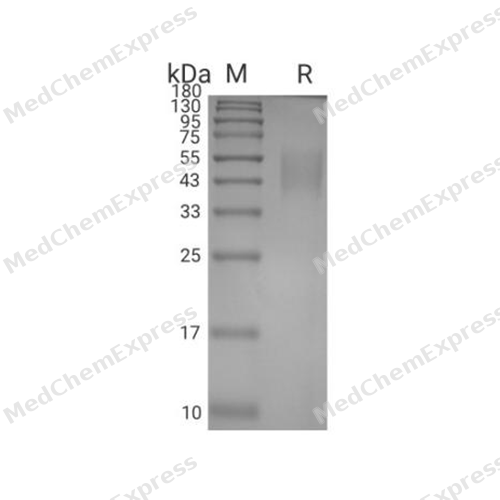
Purity - SDS-PAGE
-
Bioactivity - ELISA
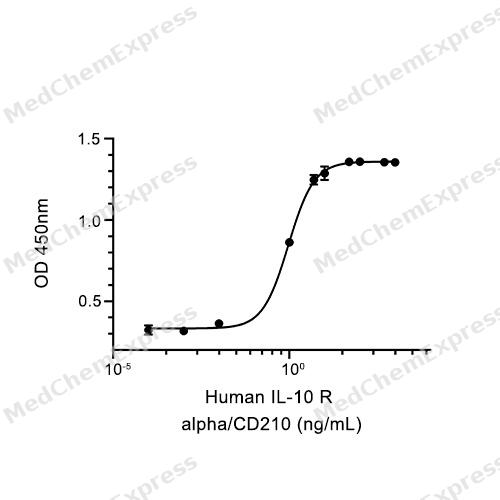
Bioactivity - ELISA


Technical Parameters
-
Species Human
-
Source HEK293
-
Tag C-6*His
-
Accession
Q13651 (H22-N235)
-
Molecular Construction
-
N-term
-
IL-10Rα (H22-N235)
Accession # Q13651 -
6*His
-
C-term
-
-
Protein Length
Extracellular Domain
-
Synonyms
IL10RA; Interleukin 10 Receptor, Alpha; Prev. IL10R; IL-10R Subunit Alpha; Interleukin-10 Receptor Subunit Alpha; IL-10R Subunit 1; Interleukin-10 Receptor Subunit 1; IL-10R1; HIL-10R; CDw210a; CDW210A; Interleukin-10 Receptor Alpha Chain; CD210a; CD210 A
-
AA Sequence
HGTELPSPPSVWFEAEFFHHILHWTPIPNQSESTCYEVALLRYGIESWNSISNCSQTLSYDLTAVTLDLYHSNGYRARVRAVDGSRHSNWTVTNTRFSVDEVTLTVGSVNLEIHNGFILGKIQLPRPKMAPANDTYESIFSHFREYEIAIRKVPGNFTFTHKKVKHENFSLLTSGEVGEFCVQVKPSVASRSNKGMWSKEECISLTRQYFTVTN
-
Molecular Weight
Approximately 38-75 kDa, based on SDS-PAGE under reducing conditions, due to the glycosylation.
-
Glycosylation
Yes
-
Purity
≥ 95%, as determined by reducing SDS-PAGE.


Product Properties
Lyophilized powder.
Lyophilized from a 0.2 μm filtered solution of PBS, pH 7.4.
<1 EU/μg, determined by LAL method.
It is not recommended to reconstitute to a concentration less than 100 μg/mL in ddH2O. For long term storage it is recommended to add a carrier protein (0.1% BSA, 5% HSA, 10% FBS or 5% Trehalose).
Stored at -20°C for 2 years from date of receipt. After reconstitution, it is stable at 4°C for 1 week or -20°C for longer (with carrier protein). It is recommended to freeze aliquots at -20°C or -80°C for extended storage.
Room temperature in continental US;may vary elsewhere.


Documentation
-
Data Sheet (264 KB)
-
SDS (251 KB)
- English - EN (251 KB)
- Français - FR (251 KB)
- Deutsch - DE (251 KB)
- Norwegian - NO (251 KB)
- Español - ES (251 KB)
- Swedish - SV (251 KB)
- Italian - IT (251 KB)
- Korean - KR (251 KB)
- Portuguese - PT (251 KB)
-
Handling Instructions (2659 KB)


References
[1]. Dror S Shouval, et al. Interleukin 10 receptor signaling: master regulator of intestinal mucosal homeostasis in mice and humans. Adv Immunol. 2014;122:177-210. [Content Brief]
[2]. J Shi, et al. IL10 inhibits starvation-induced autophagy in hypertrophic scar fibroblasts via cross talk between the IL10-IL10R-STAT3 and IL10-AKT-mTOR pathways. Cell Death Dis. 2016 Mar 10;7(3):e2133. [Content Brief]
[3]. L Crepaldi, et al. Up-regulation of IL-10R1 expression is required to render human neutrophils fully responsive to IL-10. J Immunol. 2001 Aug 15;167(4):2312-22. [Content Brief]
[4]. Nianci Chen, et al. Targeting of IL-10R on acute myeloid leukemia blasts with chimeric antigen receptor-expressing T cells. Blood Cancer J. 2021 Aug 14;11(8):144. [Content Brief]
[5]. Douglas J Kominsky, et al. IFN-γ-mediated induction of an apical IL-10 receptor on polarized intestinal epithelia. J Immunol. 2014 Feb 1;192(3):1267-76. [Content Brief]

Calculators
Concentration (start) × Volume (start) = Concentration (final) × Volume (final)


 Powered by Bioz

