



IL-36 gamma/IL-1F9 Protein, Mouse
Based on 1 publication(s) in Google Scholar
IL-36 gamma (IL-1F9), a subform of IL-36 family, belongs to IL-1 superfamily. IL-36 gamma mediates inflammatory response. L-36 beta binds to IL-36R and recruits the co-receptor IL-1RacP, and thereby activating NF-κB and MAPK signaling pathways, but the activation requires N-terminal cleavage by neutrophil granule-derived proteases. IL-36 gamma/IL-1F9 Protein, Mouse is a recombinant mouse IL-36 gamma (G13-S164) without any tag, which is produced in E. coli.
- Species: Mouse
- Source: E. coli
-
Storage:Stored at -20°C for 2 years from date of receipt. After reconstitution, it is stable at 4°C for 1 week or -20°C for longer (with carrier protein). It is recommended to freeze aliquots at -20°C or -80°C for extended storage.


To place orders, for customer services and technical support, please contact: MedChemExpress USA
Tel: 609-228-6898 E-mail: [email protected] [email protected]


-
 Biological Activity
-
Technical Parameters
-
Product Properties
- Documentation
- References
- Help & FAQs




Biological Activity
Description
IL-36 gamma (IL-1F9), a subform of IL-36 family, belongs to IL-1 superfamily. IL-36 gamma mediates inflammatory response. L-36 beta binds to IL-36R and recruits the co-receptor IL-1RacP, and thereby activating NF-κB and MAPK signaling pathways, but the activation requires N-terminal cleavage by neutrophil granule-derived proteases[1][2]. IL-36 gamma/IL-1F9 Protein, Mouse is a recombinant mouse IL-36 gamma (G13-S164) without any tag, which is produced in E. coli.
Background
IL-36 gamma (IL-1F9), a subform of IL-36 family, belongs to IL-1 superfamily. IL-36 gamma is expressed in peripheral blood lymphocytes, keratinocytes, bronchial epithelial cells and THP-1 cells[3].
The sequence of amino acids in IL-36 gamma differs in different species. Human IL-36 gamma shares <55% aa sequence identity with mouse.
IL-36 gamma has β-trefoil structure. L-36 gamma binds to IL-36R and recruits the co-receptor IL-1RAcP. So that heterodimeric signaling complex brings Toll/IL-1R (TIR) domains of the 2 receptor chains in close proximity, and thereby activating NF-κB and MAPK signaling pathways[1]. But the activation requires N-terminal cleavage at Val1518 by neutrophil granule-derived proteases, such as cathepsin G, elastase and proteinase-3[1][2]. IL-36 gamma is an effective type I and IL-17-mediated immunity against bacterial lung infection[4]. IL-36 gamma also mediates immune protection during influenza infection in mice[5].
IL-36 gamma is a pro-inflammatory factor. IL-36 gamma mediates inflammatory response through the activation of NF-κB and MAPK signaling pathway[2].
In Vitro
IL-36 gamma (mouse, 0-50 ng/mL, 36 h) increases IL-12p40, IL-23p19, and TNF-α mRNA in BMDCs[6].
IL-36 gamma (mouse, 100 ng/mL, 24 h) induces COX-2 expression and the production of PGE2 in pulmonary macrophages (PMs) isolated from WT mice[7].
In Vivo
IL-36 gamma (mouse, 100 ng, 250 ng, or 500 ng in 10 µL, i.vag. instillation) limits HSV-2 viral replication, and protects against lethal HSV-2 challenge in mice[8].
Verified Bioactivity
Measured by its ability to induce IL-6 secretion by NIH-3T3 mouse embryonic fibroblast cells. The ED50 for this effect is ≤11.16 ng/mL. Corresponding to a specific activity is 8.961×10⁴ U/mg.
MCE Validation Data
-
Purity - SDS-PAGE
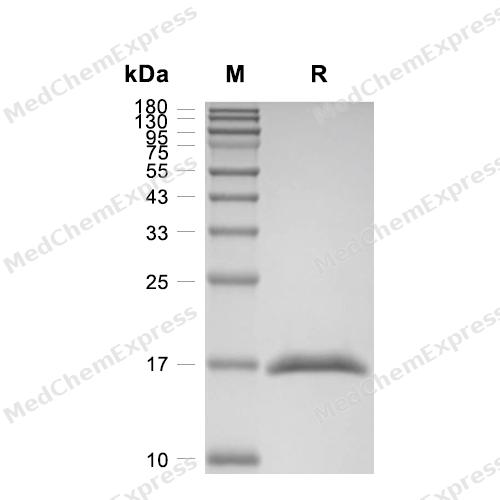
Purity - SDS-PAGE
-
Bioactivity - Cell-Based Assay
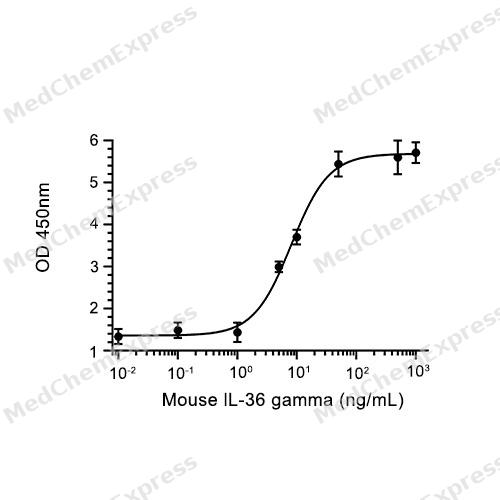
Bioactivity - Cell-Based Assay


Publications (1)
-
Journal Impact Factor
-
Most Recent
-
Sci Rep
2026 May 9;16(1):21231. PMID: 42103804


Technical Parameters
-
Species Mouse
-
Source E. coli
-
Tag Tag Free
-
Accession
Q8R460 (G13-S164)
-
Molecular Construction
-
N-term
-
IL-36γ (G13-S164)
Accession # Q8R460 -
C-term
-
-
Protein Length
Full Length of Mature Protein
-
Synonyms
IL36G; Interleukin 1-Related Protein 2; Prev. IL1F9; Interleukin-36 Gamma; IL-1RP2; IL1RP2; IL-1F9; Interleukin 1 Family, Member 9; IL-1H1; IL-1 Related Protein 2; IL1H1; IL-1-Related Protein 2; IL1E; IL-1-Epsilon; Interleukin-1 Homolog 1; IL-1 Epsilon; I
-
AA Sequence
GRETPDFGEVFDLDQQVWIFRNQALVTVPRSHRVTPVSVTILPCKYPESLEQDKGIAIYLGIQNPDKCLFCKEVNGHPTLLLKEEKILDLYHHPEPMKPFLFYHTRTGGTSTFESVAFPGHYIASSKTGNPIFLTSKKGEYYNINFNLDIKS
-
Predicted Molecular Mass
17.3 kDa
-
Molecular Weight
Approximately 17 kDa, based on SDS-PAGE under reducing conditions.
-
Purity
≥ 95%, as determined by reducing SDS-PAGE.


Product Properties
Lyophilized powder
Lyophilized from a 0.2 μm filtered solution of 20 mM MOPS, 10 mM TCEP, 150 mM NaCl, pH 7.4.
<1 EU/μg, determined by LAL method.
It is not recommended to reconstitute to a concentration less than 100 μg/mL in ddH2O.
Stored at -20°C for 2 years from date of receipt. After reconstitution, it is stable at 4°C for 1 week or -20°C for longer (with carrier protein). It is recommended to freeze aliquots at -20°C or -80°C for extended storage.
Room temperature in continental US; may vary elsewhere.


Documentation
-
Data Sheet (265 KB)
-
SDS (252 KB)
- English - EN (252 KB)
- Français - FR (252 KB)
- Deutsch - DE (252 KB)
- Norwegian - NO (252 KB)
- Español - ES (252 KB)
- Swedish - SV (252 KB)
- Italian - IT (252 KB)
- Korean - KR (252 KB)
- Portuguese - PT (252 KB)
-
Handling Instructions (2659 KB)


References
[1]. Bassoy EY, et al. Regulation and function of interleukin-36 cytokines. Immunol Rev. 2018 Jan;281(1):169-178. [Content Brief]
[2]. Zhou L,et al. Interleukin-36: Structure, Signaling and Function. Adv Exp Med Biol. 2021;21:191-210. [Content Brief]
[3]. Gresnigt MS, et al. Biology of IL-36 cytokines and their role in disease. Semin Immunol. 2013 Dec 15;25(6):458-65. [Content Brief]
[5]. Wein AN, et al. IL-36γ Protects against Severe Influenza Infection by Promoting Lung Alveolar Macrophage Survival and Limiting Viral Replication. J Immunol. 2018 Jul 15;201(2):573-582. [Content Brief]
[6]. Kovach MA, et al. IL-36γ is a crucial proximal component of protective type-1-mediated lung mucosal immunity in Gram-positive and -negative bacterial pneumonia. Mucosal Immunol. 2017 Sep;10(5):1320-1334. [Content Brief]
[7]. Aoyagi T, et al. Interleukin-36γ and IL-36 receptor signaling mediate impaired host immunity and lung injury in cytotoxic Pseudomonas aeruginosa pulmonary infection: Role of prostaglandin E2. PLoS Pathog. 2017 Nov 22;13(11):e1006737. [Content Brief]
[8]. Gardner JK, Herbst-Kralovetz MM. IL-36γ induces a transient HSV-2 resistant environment that protects against genital disease and pathogenesis. Cytokine. 2018 Nov;111:63-71. [Content Brief]

Calculators
Concentration (start) × Volume (start) = Concentration (final) × Volume (final)


 Powered by Bioz

