



Insulin Receptor/CD220 Protein, Human (HEK293, His, solution)
Based on 1 publication(s) in Google Scholar
The Insulin Receptor/CD220 protein is a receptor tyrosine kinase that coordinates insulin action by phosphorylating substrates such as IRS and SHC upon insulin binding. Phosphorylated IRS activates PI3K-AKT/PKB to exert metabolic effects, and activates Ras-MAPK to promote growth and differentiation. Insulin Receptor/CD220 Protein, Human (HEK293, His, solution) is the recombinant human-derived Insulin Receptor/CD220 protein, expressed by HEK293 , with C-His labeled tag.
- Species: Human
- Source: HEK293
-
Storage:Stored at -80°C for 1 year from date of receipt. It is stable at -20°C for 3 months after opening. It is recommended to freeze aliquots at -80°C for extended storage. Avoid repeated freeze-thaw cycles.


To place orders, for customer services and technical support, please contact: MedChemExpress USA
Tel: 609-228-6898 E-mail: [email protected] [email protected]


-
 Biological Activity
-
Technical Parameters
-
Product Properties
- Documentation
- Help & FAQs




Biological Activity
Description
The Insulin Receptor/CD220 protein is a receptor tyrosine kinase that coordinates insulin action by phosphorylating substrates such as IRS and SHC upon insulin binding. Phosphorylated IRS activates PI3K-AKT/PKB to exert metabolic effects, and activates Ras-MAPK to promote growth and differentiation. Insulin Receptor/CD220 Protein, Human (HEK293, His, solution) is the recombinant human-derived Insulin Receptor/CD220 protein, expressed by HEK293 , with C-His labeled tag.
Background
The Insulin Receptor/CD220 protein, a receptor tyrosine kinase, orchestrates the diverse actions of insulin through the phosphorylation of multiple intracellular substrates upon insulin binding. These substrates include insulin receptor substrates (IRS1, 2, 3, 4), SHC, GAB1, CBL, and other signaling intermediates. Phosphorylated IRS proteins activate two main signaling pathways: the PI3K-AKT/PKB pathway, pivotal for insulin's metabolic effects, and the Ras-MAPK pathway, which collaborates with PI3K to regulate cell growth and differentiation. The PI3K-AKT/PKB pathway triggers the translocation of the glucose transporter SLC2A4/GLUT4 to the cell membrane, facilitating glucose transport. Activated AKT/PKB, a downstream effector, induces an anti-apoptotic effect by phosphorylating BAD, regulates the expression of metabolic enzymes, and modulates the mTORC1 signaling pathway, integrating insulin signals for cell growth and metabolism. The Ras/RAF/MAP2K/MAPK pathway mediates insulin-induced cell growth, survival, and cellular differentiation. In addition to insulin, the receptor can bind insulin-like growth factors (IGFI and IGFII). Hybrid receptors composed of IGF1R and INSR isoforms exhibit varying affinities for IGFs and insulin, influencing their activation patterns. Furthermore, in adipocytes, the receptor inhibits lipolysis.
Verified Bioactivity
This product does not contain protein kinase domain.
MCE Validation Data
-
Purity - SDS-PAGE
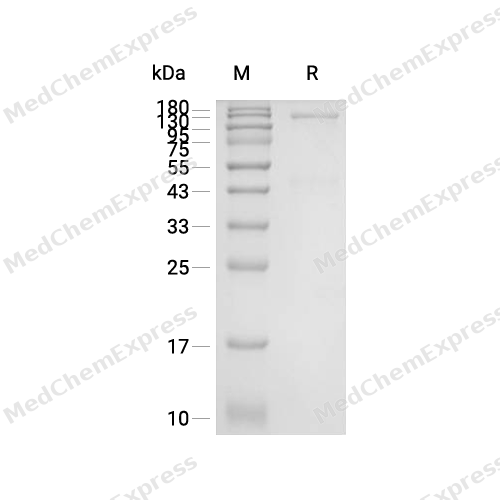
Purity - SDS-PAGE


Publications (1)
-
Journal Impact Factor
-
Most Recent


Technical Parameters
-
Species Human
-
Source HEK293
-
Tag C-His
-
Accession
P06213-1 (H28-K956)
-
Protein Length
Partial
-
Synonyms
INSR; Receptor Protein-Tyrosine Kinase; Insulin Receptor; CD220 Antigen; CD220; HHF5; IR
-
AA Sequence
HLYPGEVCPGMDIRNNLTRLHELENCSVIEGHLQILLMFKTRPEDFRDLSFPKLIMITDYLLLFRVYGLESLKDLFPNLTVIRGSRLFFNYALVIFEMVHLKELGLYNLMNITRGSVRIEKNNELCYLATIDWSRILDSVEDNYIVLNKDDNEECGDICPGTAKGKTNCPATVINGQFVERCWTHSHCQKVCPTICKSHGCTAEGLCCHSECLGNCSQPDDPTKCVACRNFYLDGRCVETCPPPYYHFQDWRCVNFSFCQDLHHKCKNSRRQGCHQYVIHNNKCIPECPSGYTMNSSNLLCTPCLGPCPKVCHLLEGEKTIDSVTSAQELRGCTVINGSLIINIRGGNNLAAELEANLGLIEEISGYLKIRRSYALVSLSFFRKLRLIRGETLEIGNYSFYALDNQNLRQLWDWSKHNLTITQGKLFFHYNPKLCLSEIHKMEEVSGTKGRQERNDIALKTNGDQASCENELLKFSYIRTSFDKILLRWEPYWPPDFRDLLGFMLFYKEAPYQNVTEFDGQDACGSNSWTVVDIDPPLRSNDPKSQNHPGWLMRGLKPWTQYAIFVKTLVTFSDERRTYGAKSDIIYVQTDATNPSVPLDPISVSNSSSQIILKWKPPSDPNGNITHYLVFWERQAEDSELFELDYCLKGLKLPSRTWSPPFESEDSQKHNQSEYEDSAGECCSCPKTDSQILKELEESSFRKTFEDYLHNVVFVPRKTSSGTGAEDPRPSRKRRSLGDVGNVTVAVPTVAAFPNTSSTSVPTSPEEHRPFEKVVNKESLVISGLRHFTGYRIELQACNQDTPEERCSVAAYVSARTMPEAKADDIVGPVTHEIFENNVVHLMWQEPKEPNGLIVLYEVSYRRYGDEELHLCVSRKHFALERGCRLRGLSPGNYSVRIRATSLAGNGSWTEPTYFYVTDYLDVPSNIAK
-
Predicted Molecular Mass
107 kDa
-
Molecular Weight
Approximately 110-130 kDa (α subunit) & 40-48 kDa (ECD of β subunit), based on SDS-PAGE under reducing conditions, due to the glycosylation.
-
Glycosylation
Yes
-
Purity
≥ 95%, as determined by reducing SDS-PAGE.


Product Properties
Solution.
Supplied as a 0.22 μm filtered solution of PBS, pH 7.4.
<1 EU/μg, determined by LAL method.
Please use rapid thawing with running water to thaw the protein.
Stored at -80°C for 1 year from date of receipt. It is stable at -20°C for 3 months after opening. It is recommended to freeze aliquots at -80°C for extended storage. Avoid repeated freeze-thaw cycles.
Shipping with dry ice.


Documentation
-
Data Sheet (242 KB)
-
SDS (252 KB)
- English - EN (252 KB)
- Français - FR (252 KB)
- Deutsch - DE (252 KB)
- Norwegian - NO (252 KB)
- Español - ES (252 KB)
- Swedish - SV (252 KB)
- Italian - IT (252 KB)
- Korean - KR (252 KB)
- Portuguese - PT (252 KB)
-
Handling Instructions (2659 KB)

Calculators
Concentration (start) × Volume (start) = Concentration (final) × Volume (final)


 Powered by Bioz

