



IP-10/CXCL10 Protein, Rat (P.pastoris, His)

Based on 1 Customer Validation
CXCL10, also known as interferon γ-induced protein 10 kDa (IP-10), is a cytokine belonging to the CXC chemokine family. CXCL10 exerts its biological effects by binding to CXCR3. CXCL10 is a pleiotropic molecule capable of exerting potent biological functions, including promoting the chemotactic activity of CXCR3+ cells, inducing apoptosis, regulating cell growth and proliferation as well as angiogenesis in infectious and inflammatory diseases and cancer. IP-10/CXCL10 Protein, Rat (P.pastoris, His) is produced in P.pastoris with a C-Terminal His-tag. It consists of 77 amino acids (I22-P98).
- Species: Rat
- Source: P. pastoris
-
Storage:Stored at -80°C for 1 year from date of receipt. It is stable at -20°C for 3 months after opening. It is recommended to freeze aliquots at -80°C for extended storage. Avoid repeated freeze-thaw cycles.


To place orders, for customer services and technical support, please contact: MedChemExpress USA
Tel: 609-228-6898 E-mail: [email protected] [email protected]


-
 Biological Activity
-
Technical Parameters
-
Product Properties
- Documentation
- References
- Help & FAQs




Biological Activity
Description
CXCL10, also known as interferon γ-induced protein 10 kDa (IP-10), is a cytokine belonging to the CXC chemokine family. CXCL10 exerts its biological effects by binding to CXCR3. CXCL10 is a pleiotropic molecule capable of exerting potent biological functions, including promoting the chemotactic activity of CXCR3+ cells, inducing apoptosis, regulating cell growth and proliferation as well as angiogenesis in infectious and inflammatory diseases and cancer[1]. IP-10/CXCL10 Protein, Rat (P.pastoris, His) is produced in P.pastoris with a C-Terminal His-tag. It consists of 77 amino acids (I22-P98).
Background
CXCL10 is a pro-inflammatory chemokine secreted by a wide spectrum of cells. CXCL10 activates T lymphocytes (Th1), NK cells, macrophages, dendritic and B cells. Alterations in CXCL10 expression levels have been associated with inflammatory diseases including infectious diseases, angiogenesis, immune dysfunction and tumor development[1].
Mature human CXCL10 shares 68% amino acid sequence identity with mouse and rat CXCL10.
Human CXCL10 gene, is initially isolated in 1985 by Luster while treating a lymphoma cell line (U937) with recombinant IFN-γ. CXCL10 cDNA has an open reading frame of 1173-bp containing 4 exons and encoding a protein of 98-amino acids. The primary translational product of the CXCL10 gene is a 12 kDa protein containing two internal disulfide cross bridges. CXCL10 exerts its biological effects by binding to CXCR3, a seven trans-membrane-spanning G protein-coupled receptor in a paracrine or autocrine fashion, which is predominantly expressed on activated T, B lymphocyte, natural killer (NK), dendritic and macrophage cells. CXCL10 induction depends predominantly on the carboxyl-terminal region of CXCR3, which is essential for CXCR3 internalization, chemotaxis and calcium mobilization induced by the CXCL10 ligand. The powerful chemotactic action of CXCL10 on activated lymphocytes allows it to modulate both innate and adaptive immunity, inducing tissue damage and modulating tumor formation[1].
CXCL10 is a pleiotropic molecule capable of exerting potent biological functions, including promoting the chemotactic activity of CXCR3+ cells, inducing apoptosis, regulating cell growth and proliferation as well as angiogenesis in infectious and inflammatory diseases and cancer. ELR-negative CXCL10 is an angiostatic chemokine, which inhibits angiogenesis. Abnormal levels of CXCL10 have been observed in body fluids of individuals infected with viruses, bacteria, fungi and parasites[1].
Verified Bioactivity
Measured by its ability to chemoattract BaF3 mouse pro-B cells transfected with human CXCR3. The ED50 for this effect is 0.6286 µg/mL.
MCE Validation Data
-
Bioactivity - Cell-Based Assay
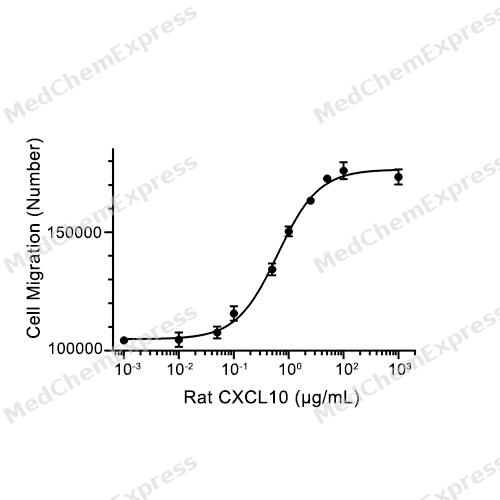
Bioactivity - Cell-Based Assay


Technical Parameters
-
Species Rat
-
Source P. pastoris
-
Tag C-His
-
Accession
P48973/NP_620789 (I22-P98)
-
Molecular Construction
-
N-term
-
CXCL10 (I22-P98)
Accession # P48973/NP_620789 -
His
-
C-term
-
-
Protein Length
Full Length of Mature Protein
-
Synonyms
CXCL10; Small Inducible Cytokine Subfamily B (Cys-X-Cys), Member 10; Prev. SCYB10; Small-Inducible Cytokine B10; Prev. INP10; C-X-C Motif Chemokine 10; IP-10; Protein 10 From Interferon (Gamma)-Induced Cell Line; GIP-10; Interferon-Inducible Cytokine IP-1
-
AA Sequence
IPLARTVRCTCIDFHEQPLRPRAIGKLEIIPASLSCPHVEIIATMKKNNEKRCLNPESEAIKSLLKAVSQRRSKRAP
-
Predicted Molecular Mass
10 kDa
-
Molecular Weight
Approximately 10-14 kDa, based on SDS-PAGE under reducing conditions.
-
Purity
≥ 95%, as determined by reducing SDS-PAGE.


Product Properties
Solution
Supplied as a 0.22 μm filtered solution of PBS pH 7.4.
<1 EU/μg, determined by LAL method.
Stored at -80°C for 1 year from date of receipt. It is stable at -20°C for 3 months after opening. It is recommended to freeze aliquots at -80°C for extended storage. Avoid repeated freeze-thaw cycles.
Shipping with dry ice.


Documentation
-
Data Sheet (263 KB)
-
SDS (254 KB)
- English - EN (254 KB)
- Français - FR (254 KB)
- Deutsch - DE (254 KB)
- Norwegian - NO (254 KB)
- Español - ES (254 KB)
- Swedish - SV (254 KB)
- Italian - IT (254 KB)
- Korean - KR (254 KB)
- Portuguese - PT (254 KB)
-
Handling Instructions (2659 KB)


References
[1]. Liu M, et al. CXCL10/IP-10 in infectious diseases pathogenesis and potential therapeutic implications. Cytokine Growth Factor Rev. 2011 Jun;22(3):121-30. [Content Brief]
[2]. Huilian Bu, et al. Spinal IFN-γ-induced protein-10 (CXCL10) mediates metastatic breast cancer-induced bone pain by activation of microglia in rat models. Breast Cancer Res Treat. 2014 Jan;143(2):255-63. [Content Brief]
[3]. Tim Clarner, et al. CXCL10 triggers early microglial activation in the cuprizone model. J Immunol. 2015 Apr 1;194(7):3400-13. [Content Brief]

Calculators
Concentration (start) × Volume (start) = Concentration (final) × Volume (final)


 Powered by Bioz

