



LDHB Protein, Human (His)
Based on 1 publication(s) in Google Scholar
The LDHB protein, also known as lactate dehydrogenase B, is an enzyme that plays a crucial role in cellular energy metabolism. References indicate that the LDHB protein effectively catalyzes the simultaneous, stereospecific interconversion of pyruvate and lactate. LDHB Protein, Human (His) is the recombinant human-derived LDHB protein, expressed by E. coli , with N-6*His labeled tag.
- Species: Human
- Source: E. coli
-
Storage:Stored at -80°C for 1 year from date of receipt. It is stable at -20°C for 3 months after opening. It is recommended to freeze aliquots at -80°C for extended storage. Avoid repeated freeze-thaw cycles.


To place orders, for customer services and technical support, please contact: MedChemExpress USA
Tel: 609-228-6898 E-mail: [email protected] [email protected]


-
 Biological Activity
-
Technical Parameters
-
Product Properties
- Documentation
- Help & FAQs




Biological Activity
Description
The LDHB protein, also known as lactate dehydrogenase B, is an enzyme that plays a crucial role in cellular energy metabolism. References indicate that the LDHB protein effectively catalyzes the simultaneous, stereospecific interconversion of pyruvate and lactate. LDHB Protein, Human (His) is the recombinant human-derived LDHB protein, expressed by E. coli , with N-6*His labeled tag.
Background
LDHB protein, also known as Lactate Dehydrogenase B, is an enzyme that plays a crucial role in cellular energy metabolism. LDHB protein efficiently catalyzes the simultaneous, stereospecific interconversion of pyruvate and lactate. This enzymatic activity is accompanied by the reciprocal interconversion of NADH and NAD(+), which are essential coenzymes involved in redox reactions. LDHB helps facilitate the conversion of pyruvate, a product of glycolysis, into lactate, and vice versa. This interconversion process is important for maintaining the balance of lactate and pyruvate in cells and is critical for energy production and the regulation of cellular redox state.
Verified Bioactivity
Measured by its ability to reduce pyruvate to lactate. The specific activity is 101589.5 pmol/min/μg, as measured under the described conditions.
MCE Validation Data
-
Purity - SDS-PAGE
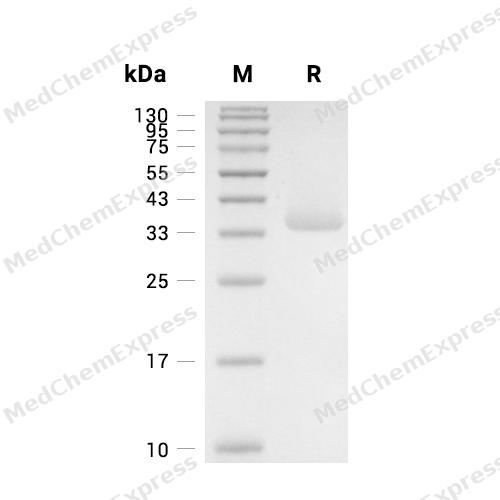
Purity - SDS-PAGE


Publications (1)
-
Journal Impact Factor
-
Most Recent
-
Mol Neurodegener
In vivo profiling of astrocyte secretome reveals brain-region specific regulatory networks in a mouse model of amyloid pathology. [Abstract]2026 May 23. PMID: 42177534


Technical Parameters
-
Species Human
-
Source E. coli
-
Tag N-6*His
-
Accession
P07195 (M1-L334)
-
Molecular Construction
-
N-term
-
6*His
-
LDHB (M1-L334)
Accession # P07195 -
C-term
-
-
Protein Length
Full Length
-
Synonyms
LDHB; LDH-H; Lactate Dehydrogenase B; Epididymis Secretory Protein Li 281; L-Lactate Dehydrogenase B Chain; Testicular Secretory Protein Li 25; Renal Carcinoma Antigen NY-REN-46; Lactate Dehydrogenase H Chain; LDH Heart Subunit; L-Lactate Dehydrogenase; H
-
AA Sequence
MATLKEKLIAPVAEEEATVPNNKITVVGVGQVGMACAISILGKSLADELALVDVLEDKLKGEMMDLQHGSLFLQTPKIVADKDYSVTANSKIVVVTAGVRQQEGESRLNLVQRNVNVFKFIIPQIVKYSPDCIIIVVSNPVDILTYVTWKLSGLPKHRVIGSGCNLDSARFRYLMAEKLGIHPSSCHGWILGEHGDSSVAVWSGVNVAGVSLQELNPEMGTDNDSENWKEVHKMVVESAYEVIKLKGYTNWAIGLSVADLIESMLKNLSRIHPVSTMVKGMYGIENEVFLSLPCILNARGLTSVINQKLKDDEVAQLKKSADTLWDIQKDLKDL
-
Predicted Molecular Mass
38.8 kDa
-
Molecular Weight
Approximately 37 kDa, based on SDS-PAGE under reducing conditions.
-
Purity
≥ 95%, as determined by reducing SDS-PAGE.


Product Properties
Solution
Supplied as a 0.22 μm filtered solution of 20 mM Tris-HCl, 150 mM NaCl, pH 8.0.
Note: For SPR assay, please replace the buffer. Primary amine components (e.g., Tris, imidazole) can affect protein-coupled chips.
<1 EU/μg, determined by LAL method.
Stored at -80°C for 1 year from date of receipt. It is stable at -20°C for 3 months after opening. It is recommended to freeze aliquots at -80°C for extended storage. Avoid repeated freeze-thaw cycles.
Shipping with dry ice.


Documentation
-
Data Sheet (236 KB)
-
SDS (252 KB)
- English - EN (252 KB)
- Français - FR (252 KB)
- Deutsch - DE (252 KB)
- Norwegian - NO (252 KB)
- Español - ES (252 KB)
- Swedish - SV (252 KB)
- Italian - IT (252 KB)
- Korean - KR (252 KB)
- Portuguese - PT (252 KB)
-
Handling Instructions (2659 KB)

Calculators
Concentration (start) × Volume (start) = Concentration (final) × Volume (final)


 Powered by Bioz

