



LDHA Protein, Human (His)

Based on 1 Customer Validation
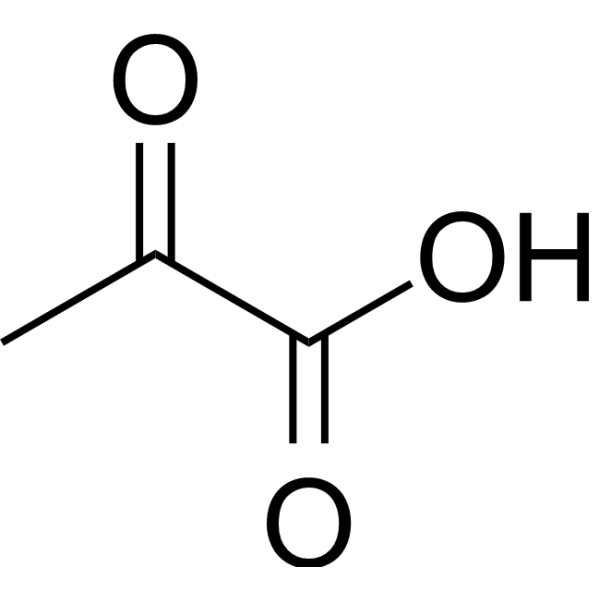
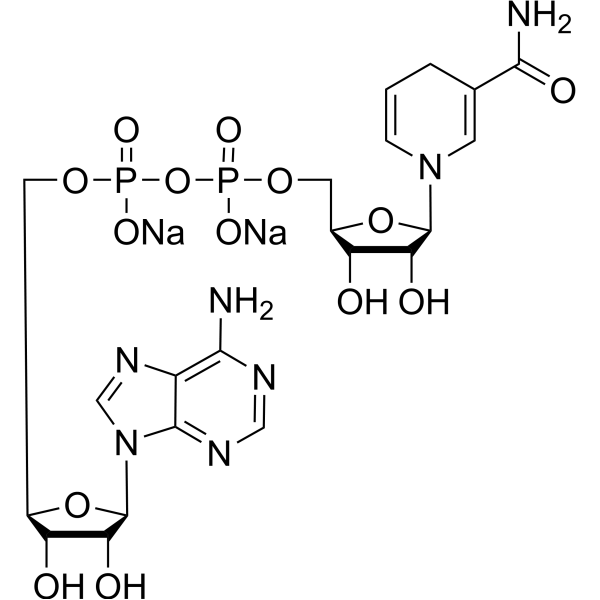
LDHA protein catalyzes the stereospecific interconversion of pyruvate and lactate, concomitantly exchanging NADH and NAD(+). LDHA Protein, Human (His) is the recombinant human-derived LDHA protein, expressed by E. coli , with N-6*His labeled tag.
- Species: Human
- Source: E. coli
-
Storage:Stored at -80°C for 1 year from date of receipt. It is stable at -20°C for 3 months after opening. It is recommended to freeze aliquots at -80°C for extended storage. Avoid repeated freeze-thaw cycles.


To place orders, for customer services and technical support, please contact: MedChemExpress USA
Tel: 609-228-6898 E-mail: [email protected] [email protected]


-
 Biological Activity
-
Technical Parameters
-
Product Properties
- Documentation
- Help & FAQs




Biological Activity
Description
LDHA protein catalyzes the stereospecific interconversion of pyruvate and lactate, concomitantly exchanging NADH and NAD(+). LDHA Protein, Human (His) is the recombinant human-derived LDHA protein, expressed by E. coli , with N-6*His labeled tag.
Background
LDHA protein catalyzes the simultaneous and stereospecific interconversion of pyruvate and lactate, accompanied by the reciprocal interconversion of NADH and NAD(+).
Verified Bioactivity
Measured by its ability to reduce pyruvate to lactate. The specific activity is > 70000 pmol/min/μg, as measured under the described conditions.
MCE Validation Data
-
Purity - SDS-PAGE
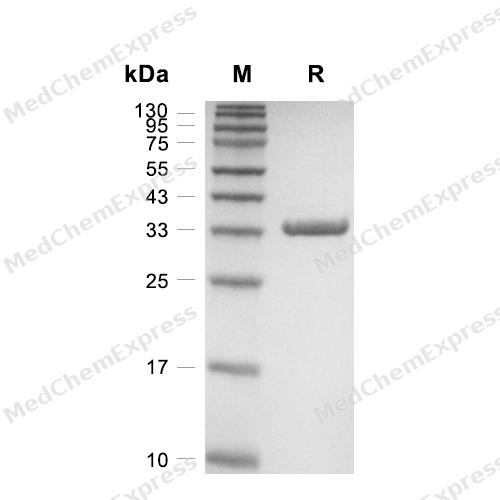
Purity - SDS-PAGE

Assay Procedure
Materials
Assay buffer: 25 mM Tris, 100 mM NaCl, pH 7.5
LDHA Protein, Human (His) (HY-P70225)
beta-NADH (diluted to 20 mM with 0.1 M sodium borate), pH 9.0
sodium pyruvate (HY-W015913)
Procedure
1. Dilute Human LDHA to 0.4 ng/uL using assay buffer.
2. Substrate mixture: A substrate mixture containing 1.6 mM beta-NADH and 4 mM sodium pyruvate was prepared using assay buffer.
3. Experimental group: 50 μL protein + 50 μL substrate mixture.
Blank group: 50 μL assay buffer + 50 μL substrate mixture.
4. Plates were read in kinetic mode at 340 nm (absorbance) for 5 minutes.
5. Calculate specific activity:
Specific Activity (pmol/min/μg) = | Adjusted Vmax* (OD/min) x well volume (L) x 1012 pmol/mol |
| ext. coeff ** (M-1cm-1) x path corr.*** (cm) x amount of enzyme (μg) |
*Adjusted for Control
**ext. coeff:6220 M-1cm-1
***path correction: 0.320 cm
Per Well:
Human LDHA: 0.02 μg
beta-NADH: 0.8 mM
sodium pyruvate: 2 mM


Technical Parameters
-
Species Human
-
Source E. coli
-
Tag N-6*His
-
Accession
P00338-1 (M1-F332)
-
Molecular Construction
-
N-term
-
6*His
-
LDHA (M1-F332)
Accession # P00338-1 -
C-term
-
-
Protein Length
Full Length of Isoform-1
-
Synonyms
LDHA; Epididymis Secretory Sperm Binding Protein Li 133P; Lactate Dehydrogenase A; Proliferation-Inducing Gene 19; L-Lactate Dehydrogenase A Chain; Lactate Dehydrogenase M; LDH Muscle Subunit; L-Lactate Dehydrogenase; Cell Proliferation-Inducing Gene 19 P
-
AA Sequence
MATLKDQLIYNLLKEEQTPQNKITVVGVGAVGMACAISILMKDLADELALVDVIEDKLKGEMMDLQHGSLFLRTPKIVSGKDYNVTANSKLVIITAGARQQEGESRLNLVQRNVNIFKFIIPNVVKYSPNCKLLIVSNPVDILTYVAWKISGFPKNRVIGSGCNLDSARFRYLMGERLGVHPLSCHGWVLGEHGDSSVPVWSGMNVAGVSLKTLHPDLGTDKDKEQWKEVHKQVVESAYEVIKLKGYTSWAIGLSVADLAESIMKNLRRVHPVSTMIKGLYGIKDDVFLSVPCILGQNGISDLVKVTLTSEEEARLKKSADTLWGIQKELQF
-
Molecular Weight
Approximately 37 kDa, based on SDS-PAGE under reducing conditions.
-
Purity
≥ 95%, as determined by reducing SDS-PAGE.


Product Properties
Solution
1.Supplied as a 0.22 μm filtered solution of 20 mM Tris-HCl, 500 mM NaCl, 5% trehalose, 5% mannitol, 0.01% Tween 80, 1 mM EDTA, 50% glycerol, pH 8.0.
2.Supplied as a 0.22 μm filtered solution of 20 mM Tris-HCl, 100 mM NaCl, pH 8.0, 20% glycerol.
Please refer to the lot-specific COA for specific buffer information.
Note: For SPR assay, please replace the buffer. Primary amine components (e.g., Tris, imidazole) can affect protein-coupled chips.
<1 EU/μg, determined by LAL method.
Stored at -80°C for 1 year from date of receipt. It is stable at -20°C for 3 months after opening. It is recommended to freeze aliquots at -80°C for extended storage. Avoid repeated freeze-thaw cycles.
Shipping with dry ice.


Documentation
-
Data Sheet (236 KB)
-
SDS (252 KB)
- English - EN (252 KB)
- Français - FR (252 KB)
- Deutsch - DE (252 KB)
- Norwegian - NO (252 KB)
- Español - ES (252 KB)
- Swedish - SV (252 KB)
- Italian - IT (252 KB)
- Korean - KR (252 KB)
- Portuguese - PT (252 KB)
-
Handling Instructions (2659 KB)

Calculators
Concentration (start) × Volume (start) = Concentration (final) × Volume (final)


 Powered by Bioz

