



MMP-2 Protein, Human (HEK293, His)
Based on 3 publication(s) in Google Scholar
MMP-2 protein is a multifunctional metalloproteinase that actively participates in physiological processes such as vascular remodeling, angiogenesis, tissue repair, tumor invasion, inflammation, and atherosclerotic plaque rupture. In addition to degrading extracellular matrix proteins, it also acts on non-matrix proteins to promote vasoconstriction. MMP-2 Protein, Human (HEK293, His) is the recombinant human-derived MMP-2 protein, expressed by HEK293 , with C-6*His labeled tag.
- Species: Human
- Source: HEK293
-
Storage:Stored at -20°C for 2 years from date of receipt. After reconstitution, it is stable at 4°C for 1 week or -20°C for longer (with carrier protein). It is recommended to freeze aliquots at -20°C or -80°C for extended storage.


To place orders, for customer services and technical support, please contact: MedChemExpress USA
Tel: 609-228-6898 E-mail: [email protected] [email protected]


-
 Biological Activity
-
Technical Parameters
-
Product Properties
- Documentation
- Help & FAQs


-
HY-148905
p-Aminophenylmercuric acetate -

HY-P70250
MMP-1 Protein, Human (HEK293, His, solution) -
HY-P72507
MMP-8 Protein, Human (HEK293, His) -
HY-P73300
MMP-9 Protein, Human (HEK293) -
HY-P74744
MMP-12 Protein, Human -
HY-P4931
Mca-KPLGL-Dap(Dnp)-AR-NH2 -
HY-P70139
Stromelysin-1/MMP-3 Protein, Human (HEK293, His)


Biological Activity
Description
MMP-2 protein is a multifunctional metalloproteinase that actively participates in physiological processes such as vascular remodeling, angiogenesis, tissue repair, tumor invasion, inflammation, and atherosclerotic plaque rupture. In addition to degrading extracellular matrix proteins, it also acts on non-matrix proteins to promote vasoconstriction. MMP-2 Protein, Human (HEK293, His) is the recombinant human-derived MMP-2 protein, expressed by HEK293 , with C-6*His labeled tag.
Background
The MMP-2 protein, a ubiquitinous metalloproteinase, actively participates in a spectrum of physiological processes, including vasculature remodeling, angiogenesis, tissue repair, tumor invasion, inflammation, and atherosclerotic plaque rupture. Beyond its role in degrading extracellular matrix proteins, this protein demonstrates versatility by acting on non-matrix proteins, such as big endothelial 1 and beta-type CGRP, thereby promoting vasoconstriction. Additionally, it cleaves KISS at a Gly-|-Leu bond and appears to play a role in myocardial cell death pathways. By regulating the activity of GSK3beta and cleaving GSK3beta in vitro, it contributes to myocardial oxidative stress. In association with MMP14, MMP-2 is involved in the formation of fibrovascular tissues. Notably, the C-terminal non-catalytic fragment of MMP-2, known as PEX, possesses anti-angiogenic and anti-tumor properties, inhibiting cell migration and adhesion to FGF2 and vitronectin. Furthermore, it serves as a ligand for integrin alpha-v/beta3 on the surface of blood vessels.
Verified Bioactivity
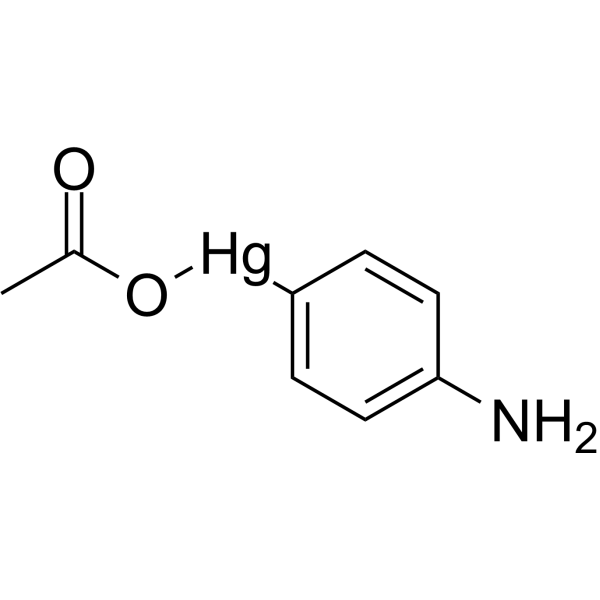
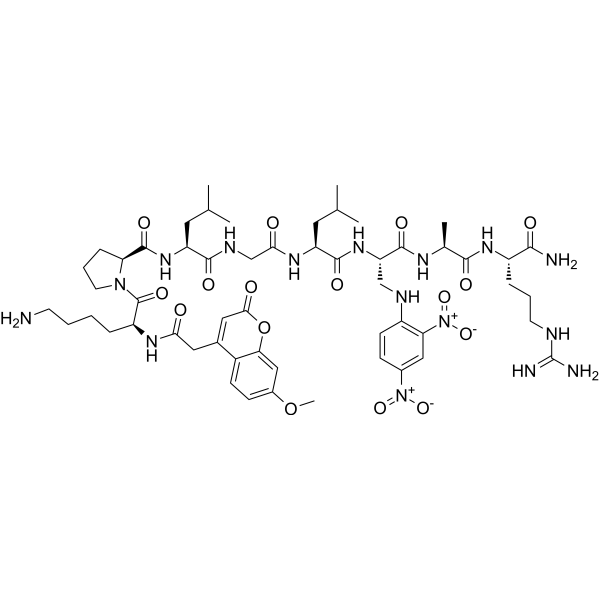
Measured by its ability to cleave the fluorogenic peptide substrate, Mca-PLGL-Dpa-AR-NH2. The specific activity is 4367.17 pmol/min/µg, as measured under the described conditions. (Activation description: The proenzyme needs to be activated by APMA (HY-148905) for an activated form.)
MCE Validation Data
-
Purity - SDS-PAGE
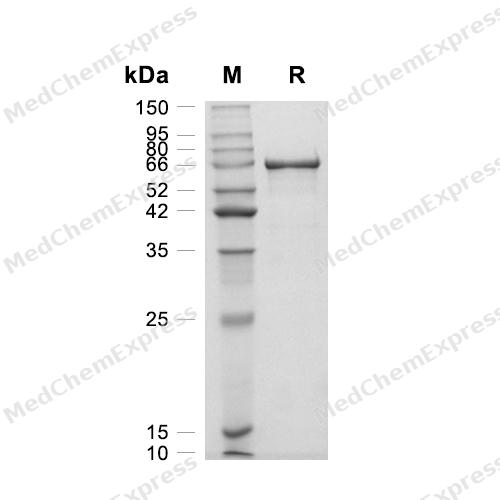
Purity - SDS-PAGE

Assay Procedure
Materials
Assay buffer: 50 mM Tris, 10 mM CaCl?, 150 mM NaCl, 0.05% (w/v) Brij 35, pH 7.5 (TCNB)
Test protein: MMP-2 Protein, Human (HEK293, His) (HY-P70268)
Activator protein: p-Aminophenylmercuric acetate (APMA), dissolved in DMSO to 100 mM
Substrate: MOCAc-PLGL(Dpa)AR (HY-131498)
Standard: MCA-Pro-Leu-OH
F16 Black Maxisorp Plate
Procedure
1. Dilute Human MMP-2 to 100 μg/mL in assay buffer.
2. Add APMA to a final concentration of 1 mM to the Human MMP-2 protein to activate Human MMP-2.
3. Incubate at 37°C for 1 hour.
4. Dilute the activated Human MMP-2 to 0.2 μg/mL using assay buffer.
5. Dilute the substrate to 20 μM using assay buffer.
6. Experimental group: 50 μL of Human MMP-2 protein at varying concentrations + 50 μL of 20 μM substrate.
7. Control group: 50 μL of 20 μM substrate + 50 μL buffer.
8. Read for 5 minutes in kinetic mode at excitation and emission wavelengths of 320 nm and 405 nm respectively.
9. Calculate specific activity:
Specific Activity (pmol/min/μg) = | Adjusted Vmax* (RFU/min) x Conversion Factor ** (pmol/RFU) |
| amount of enzyme (μg) |
*Adjusted for Control
**Derived using calibration standard


Publications (3)
-
Journal Impact Factor
-
Most Recent
-
Cancer Cell
PDGFRα+ITGA11+ fibroblasts foster early-stage cancer lymphovascular invasion and lymphatic metastasis via ITGA11-SELE interplay. [Abstract]2024 Apr 8;42(4):682-700.e12. PMID: 38428409 -
ACS Biomater Sci Eng
Detachable Dual-Targeting Nanoparticles for Improving the Antitumor Effect by Extracellular Matrix Depletion. [Abstract]2023 Mar 13;9(3):1437-1449. PMID: 36795746 -
J Biotechnol
Production of recombinant human type I collagen homotrimers in CHO cells and their physicochemical and functional properties. [Abstract]2024 Nov 20:395:149-160. PMID: 39357624


Technical Parameters
-
Species Human
-
Source HEK293
-
Tag C-6*His
-
Accession
P08253-1 (A30-C660)
-
Molecular Construction
-
N-term
-
MMP-2 (A30-C660)
Accession # P08253-1 -
6*His
-
C-term
-
-
Protein Length
Full Length of Isoform-1 (with Propeptide)
-
Synonyms
MMP2; Matrix Metallopeptidase 2 (Gelatinase A, 72kDa Gelatinase, 72kDa Type IV Collagenase); Prev. CLG4A; Collagenase Type IV-A; Prev. CLG4; Neutrophil Gelatinase; TBE-1; 72 KDa Gelatinase; MMP-2; Gelatinase A; 72 KDa Type IV Collagenase; MMP-II; Matrix Metalloproteinase-2; MONA; Matrix Metalloproteinase 2 (Gelatinase A, 72kDa Gelatinase, 72kDa Type IV Collagenase); Matrix Metallopeptidase 2; Matrix Metalloproteinase-II
-
AA Sequence
APSPIIKFPGDVAPKTDKELAVQYLNTFYGCPKESCNLFVLKDTLKKMQKFFGLPQTGDLDQNTIETMRKPRCGNPDVANYNFFPRKPKWDKNQITYRIIGYTPDLDPETVDDAFARAFQVWSDVTPLRFSRIHDGEADIMINFGRWEHGDGYPFDGKDGLLAHAFAPGTGVGGDSHFDDDELWTLGEGQVVRVKYGNADGEYCKFPFLFNGKEYNSCTDTGRSDGFLWCSTTYNFEKDGKYGFCPHEALFTMGGNAEGQPCKFPFRFQGTSYDSCTTEGRTDGYRWCGTTEDYDRDKKYGFCPETAMSTVGGNSEGAPCVFPFTFLGNKYESCTSAGRSDGKMWCATTANYDDDRKWGFCPDQGYSLFLVAAHEFGHAMGLEHSQDPGALMAPIYTYTKNFRLSQDDIKGIQELYGASPDIDLGTGPTPTLGPVTPEICKQDIVFDGIAQIRGEIFFFKDRFIWRTVTPRDKPMGPLLVATFWPELPEKIDAVYEAPQEEKAVFFAGNEYWIYSASTLERGYPKPLTSLGLPPDVQRVDAAFNWSKNKKTYIFAGDKFWRYNEVKKKMDPGFPKLIADAWNAIPDNLDAVVDLQGGGHSYFFKGAYYLKLENQSLKSVKFGSIKSDWLGC
-
Molecular Weight
Approximately 72 kDa, based on SDS-PAGE under reducing conditions.
-
Glycosylation
Yes
-
Purity
≥ 95%, as determined by reducing SDS-PAGE.


Product Properties
Lyophilized powder
Lyophilized from a 0.22 μm filtered solution of 20 mM Tris-HCl, 150 mM NaCl, pH 7.5.
Note: For SPR assay, please replace the buffer. Primary amine components (e.g., Tris, imidazole) can affect protein-coupled chips.
<1 EU/μg, determined by LAL method.
It is not recommended to reconstitute to a concentration less than 100 μg/mL in ddH2O. For long term storage it is recommended to add a carrier protein (0.1% BSA, 5% HSA, 10% FBS or 5% Trehalose).
Stored at -20°C for 2 years from date of receipt. After reconstitution, it is stable at 4°C for 1 week or -20°C for longer (with carrier protein). It is recommended to freeze aliquots at -20°C or -80°C for extended storage.
Room temperature in continental US; may vary elsewhere.


Documentation
-
Data Sheet (240 KB)
-
SDS (252 KB)
- English - EN (252 KB)
- Français - FR (252 KB)
- Deutsch - DE (252 KB)
- Norwegian - NO (252 KB)
- Español - ES (252 KB)
- Swedish - SV (252 KB)
- Italian - IT (252 KB)
- Korean - KR (252 KB)
- Portuguese - PT (252 KB)
-
Handling Instructions (2659 KB)

Calculators
Concentration (start) × Volume (start) = Concentration (final) × Volume (final)


 Powered by Bioz

