



MMP-8 Protein, Human (HEK293, His)
Based on 1 publication(s) in Google Scholar
MMP-8, also known as matrix metalloproteinase-8 or collagenase-2, is recognized for its enzymatic abilities, particularly its ability to break down fibrillar types I, II, and III collagen. This enzymatic activity suggests that MMP-8 plays an important role in the remodeling and turnover of collagen-rich tissues such as connective tissue, cartilage, and bone. MMP-8 Protein, Human (HEK293, His) is the recombinant human-derived MMP-8 protein, expressed by HEK293 , with C-10*His labeled tag.
- Species: Human
- Source: HEK293
-
Storage:Stored at -20°C for 2 years from date of receipt. After reconstitution, it is stable at 4°C for 1 week or -20°C for longer (with carrier protein). It is recommended to freeze aliquots at -20°C or -80°C for extended storage.


To place orders, for customer services and technical support, please contact: MedChemExpress USA
Tel: 609-228-6898 E-mail: [email protected] [email protected]


-
 Biological Activity
-
Technical Parameters
-
Product Properties
- Documentation
- Help & FAQs


-

HY-P70250
MMP-1 Protein, Human (HEK293, His, solution) -
HY-P73300
MMP-9 Protein, Human (HEK293) -
HY-P73296
MMP-2 Protein, Human (HEK293) -
HY-P70268
MMP-2 Protein, Human (HEK293, His) -

HY-148905
p-Aminophenylmercuric acetateMatrix Metalloproteinases Activator -
HY-P78328
MMP-8 Protein, Mouse (HEK293, His) -
HY-P74744
MMP-12 Protein, Human


Biological Activity
Description
MMP-8, also known as matrix metalloproteinase-8 or collagenase-2, is recognized for its enzymatic abilities, particularly its ability to break down fibrillar types I, II, and III collagen. This enzymatic activity suggests that MMP-8 plays an important role in the remodeling and turnover of collagen-rich tissues such as connective tissue, cartilage, and bone. MMP-8 Protein, Human (HEK293, His) is the recombinant human-derived MMP-8 protein, expressed by HEK293 , with C-10*His labeled tag.
Background
MMP-8, also referred to as matrix metalloproteinase-8 or collagenase-2, is recognized for its enzymatic capabilities and specifically its ability to break down fibrillar type I, II, and III collagens. This enzymatic activity suggests that MMP-8 plays a significant role in the remodeling and turnover of collagen-rich tissues, such as connective tissues, cartilage, and bone. By degrading these fibrillar collagens, MMP-8 can contribute to processes such as tissue remodeling, wound healing, and inflammation resolution. Understanding the precise functions and regulation of MMP-8 can provide valuable insights into its involvement in collagen metabolism and tissue remodeling, potentially offering therapeutic opportunities for conditions characterized by abnormal collagen degradation or accumulation.
Verified Bioactivity
Measured by its ability to cleave the fluorogenic peptide substrate, Mca-PLGL-Dpa-AR-NH2. The specific activity is > 250 pmol/min/µg, as measured under the described conditions. (Activation description: The proenzyme needs to be activated by APMA (HY-148905) for an activated form.)
MCE Validation Data
-
Purity - SDS-PAGE
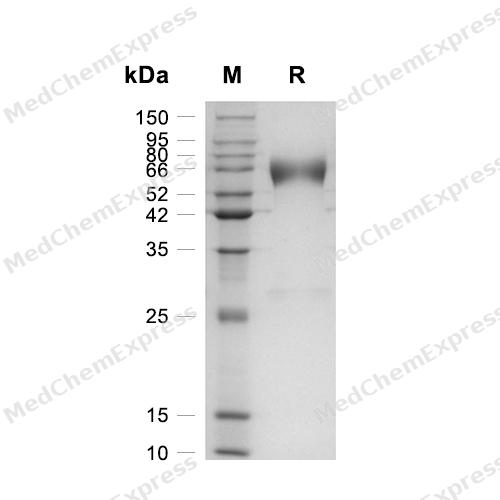
Purity - SDS-PAGE


Publications (1)
-
Journal Impact Factor
-
Most Recent
-
J Biotechnol
Production of recombinant human type I collagen homotrimers in CHO cells and their physicochemical and functional properties. [Abstract]2024 Nov 20:395:149-160. PMID: 39357624


Technical Parameters
-
Species Human
-
Source HEK293
-
Tag C-10*His
-
Accession
P22894 (F21-G467)
-
Molecular Construction
-
N-term
-
MMP-8 (F21-G467)
Accession # P22894 -
10*His
-
C-term
-
-
Protein Length
Full Length of Mature Protein (with Propeptide)
-
Synonyms
MMP8; PMNL Collagenase; Prev. CLG1; MMP-8; Matrix Metalloproteinase 8 (Neutrophil Collagenase); PMN Leukocyte Collagenase; Matrix Metalloproteinase-8; Collagenase 2; Neutrophil Collagenase; HNC; Matrix Metallopeptidase 8; PMNL-CL
-
AA Sequence
FPVSSKEKNTKTVQDYLEKFYQLPSNQYQSTRKNGTNVIVEKLKEMQRFFGLNVTGKPNEETLDMMKKPRCGVPDSGGFMLTPGNPKWERTNLTYRIRNYTPQLSEAEVERAIKDAFELWSVASPLIFTRISQGEADINIAFYQRDHGDNSPFDGPNGILAHAFQPGQGIGGDAHFDAEETWTNTSANYNLFLVAAHEFGHSLGLAHSSDPGALMYPNYAFRETSNYSLPQDDIDGIQAIYGLSSNPIQPTGPSTPKPCDPSLTFDAITTLRGEILFFKDRYFWRRHPQLQRVEMNFISLFWPSLPTGIQAAYEDFDRDLIFLFKGNQYWALSGYDILQGYPKDISNYGFPSSVQAIDAAVFYRSKTYFFVNDQFWRYDNQRQFMEPGYPKSISGAFPGIESKVDAVFQQEHFFHVFSGPRYYAFDLIAQRVTRVARGNKWLNCRYG
-
Molecular Weight
Approximately 65-75 kDa, based on SDS-PAGE under reducing conditions, due to the glycosylation.
-
Glycosylation
Yes
-
Purity
≥ 90%, as determined by reducing SDS-PAGE.


Product Properties
Lyophilized powder
1.Lyophilized from a 0.22 μm filtered solution of PBS, pH 7.4.
2.Lyophilized from a 0.22 μm filtered solution of PBS, pH 7.4, 8% trehalose.
Please refer to the lot-specific COA for specific buffer information.
<1 EU/μg, determined by LAL method.
It is not recommended to reconstitute to a concentration less than 100 μg/mL in ddH2O. For long term storage it is recommended to add a carrier protein (0.1% BSA, 5% HSA, 10% FBS or 5% Trehalose).
Stored at -20°C for 2 years from date of receipt. After reconstitution, it is stable at 4°C for 1 week or -20°C for longer (with carrier protein). It is recommended to freeze aliquots at -20°C or -80°C for extended storage.
Room temperature in continental US; may vary elsewhere.


Documentation
-
Data Sheet (238 KB)
-
SDS (251 KB)
- English - EN (251 KB)
- Français - FR (251 KB)
- Deutsch - DE (251 KB)
- Norwegian - NO (251 KB)
- Español - ES (251 KB)
- Swedish - SV (251 KB)
- Italian - IT (251 KB)
- Korean - KR (251 KB)
- Portuguese - PT (251 KB)
-
Handling Instructions (2659 KB)

Calculators
Concentration (start) × Volume (start) = Concentration (final) × Volume (final)


 Powered by Bioz

